

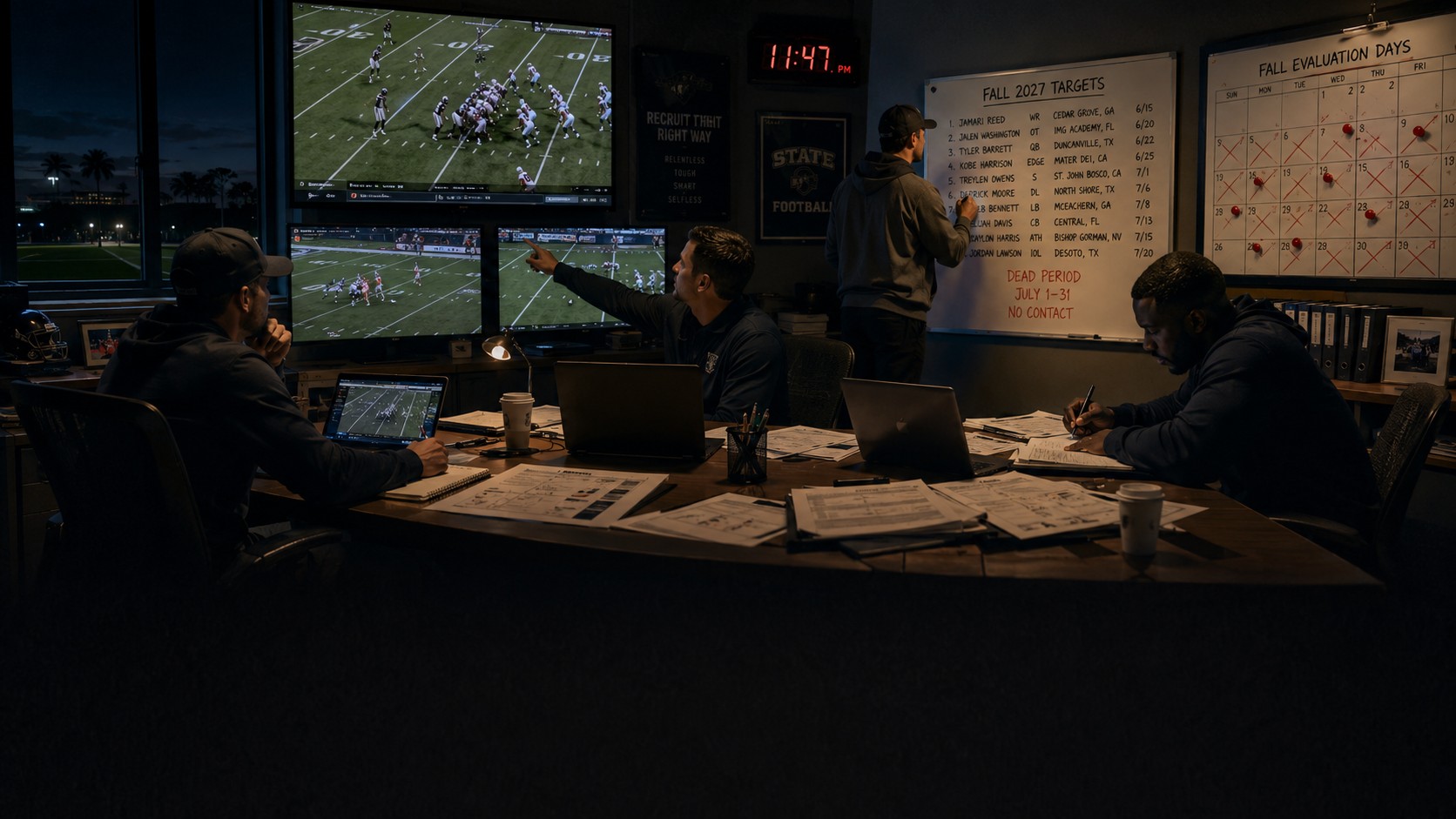
The dead period started June 22 and runs through July 31. No college coach can stand on a high school sideline right now, watch a practice, or sit across from a family. Most people assume recruiting goes quiet during this stretch. What actually happens is the opposite: the part of the process families rarely see gets very busy.
What coaches do when they cannot get off campus
This is when coaching staffs watch film. Not just highlights, full games, training clips, the raw cut of a camp evaluation. When the road is unavailable, the screen takes its place. A position coach who spent June driving from camp to camp is back at his desk now, sorting through what he saw and cross-referencing it against game tape. Meanwhile the recruiting coordinator is building the fall calendar: which high schools to visit, which games to attend, which prospects need to be seen in person before the early signing period opens in December.
That calendar is not a rough draft. It is a committed document. Evaluation days have a finite supply, and once the fall gets busy, adding new names to the schedule means bumping something else.
33 evaluation days, and they are already being allocated
Every FBS staff gets 33 evaluation days during the fall. September through November, coaches can attend 33 days of high school events, with no program permitted to evaluate the same prospect on more than one calendar day at his school. That sounds like enough. Inside a staff, it gets thin fast.
A program chasing 22 to 25 players for its class might have 10 coaches actively recruiting. Multiply that across positions, geographic regions, and position-group needs, and the 33 days narrow quickly. An offensive line coach with film on six prospects but evaluation days budgeted for four is making cuts before he ever sets foot on a sideline.
The decisions about which games to attend are made before fall camp opens. In the final week of July, recruiting coordinators are finalizing those lists. School names go on the fall schedule based on what happened over the past 60 days: who showed up at summer camps, whose film arrived in the inbox, which high school coach made a call that carried weight. A prospect whose materials have not reached the right programs before August 1 is harder to add once the fall calendar is already set.
How a prospect gets onto the fall list
The camp route is the most obvious. Programs compiled notes on every prospect they saw this summer, and those notes are being matched against game film right now. An athlete who performed well at a college camp in June, whose full game film holds up, is a strong candidate for a fall evaluation visit. Elite 11 finalists and similar summer circuit standouts are already on the lists of programs that watched them compete.
But camp attendance is not the only path. Film that arrives in the right inbox in July, with context from a credible voice, carries real weight right now. A high school coach who picks up the phone in July and says he has a player worth watching this fall, that call gets answered. Come October, when a staff is traveling three days a week and managing game preparation on top of recruiting, the same call is harder to return.
One thing worth understanding about this particular July: according to ESPN's summer tracking, roughly 60 percent of the top 300 prospects in the 2027 class are already committed. That means a significant share of every staff's communication time goes toward managing existing relationships, keeping committed players connected, and making sure the players who said yes in May still feel confident in July. For an uncommitted family, that is useful context. Standing out requires being visible, with film that is sharp and a voice in that inbox that a coach already trusts.
When those fall evaluation lists are finalized in August, is your athlete's film already in the right inbox?