

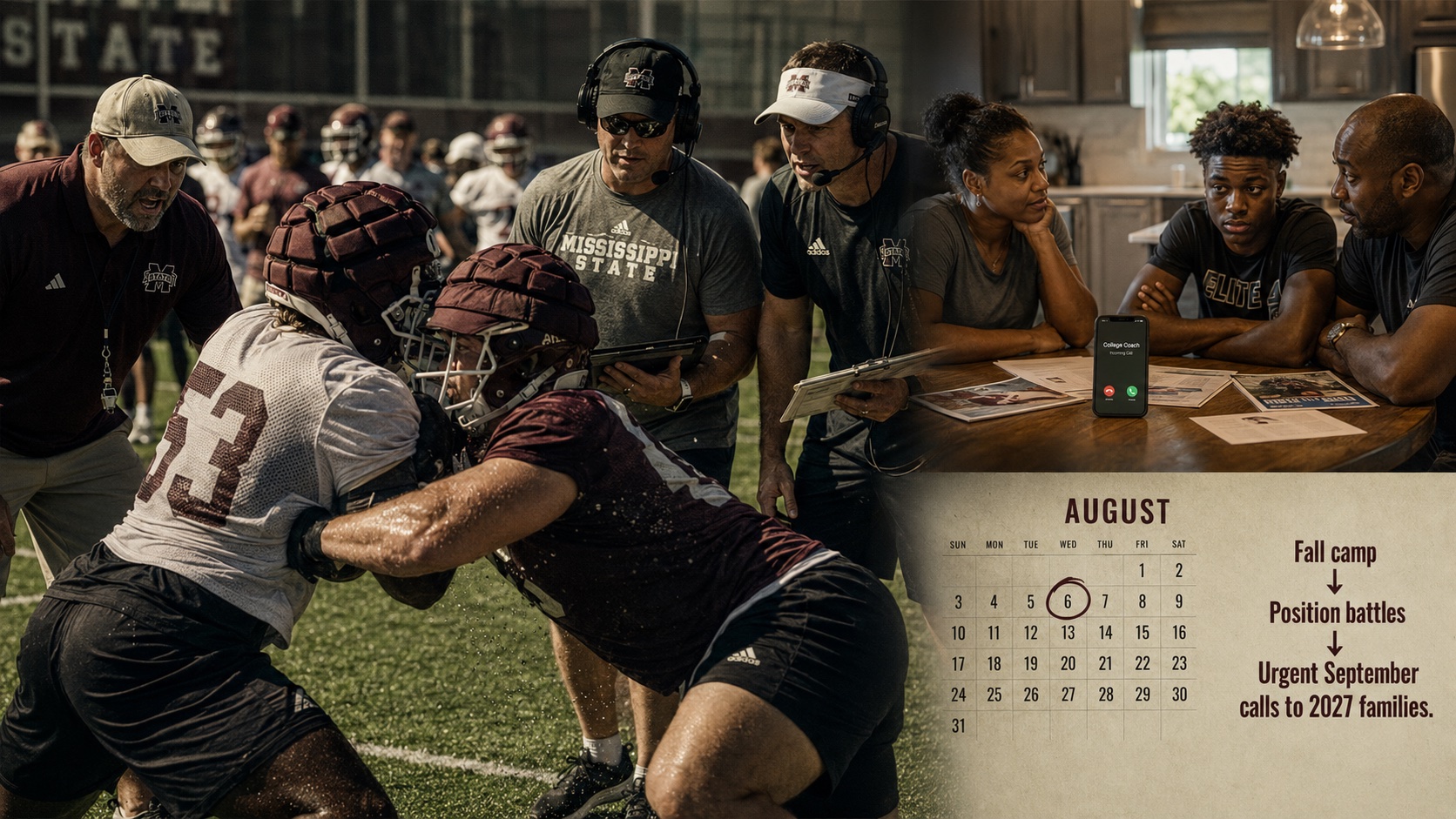
The part of August families rarely see
Fall camp opened this week across FBS football. For the next three to four weeks, most coaching staffs will be consumed by one thing: figuring out what they actually have on their current roster.
That internal focus creates a specific pattern families in the 2027 cycle need to understand. Recruiting calls slow down during camp. Not because interest has cooled, but because the coaches who recruit your athlete are in full-day practice schedules from early morning to late evening. The calls that happen in August are real, but they are lighter. Position coaches are not sitting down to have long recruiting conversations on a Tuesday night in the middle of preseason camp.
I have been through enough August camps to know that the head coach is walking the practice field worrying about who is winning the starting job at three different positions, and the defensive coordinator is installed in the film room until midnight. Nobody is sleeping. Nobody is primarily thinking about the 2027 board. That does not mean you have lost the relationship. It means they are doing their job.
What coaches discover in camp that changes everything
Here is what families rarely think about: what a coaching staff learns in those first two weeks of fall camp directly determines how urgently they pursue specific positions in 2027.
Take a receiver corps that added four or five portal transfers this spring. If those transfers show up in August and immediately win depth chart spots, the coach who was evaluating 2027 wide receivers has a clear, real answer about his needs. A position that looked like a recruiting priority in June might effectively close in September. The offer is still real. The interest may still be genuine. But the urgency has shifted.
The reverse is also true. A program that brought in an interior offensive lineman from the portal, expecting him to start, watches him struggle in camp against veteran defensive tackles. That staff enters September with a sharper need at that position and a recalibrated conversation for any uncommitted 2027 prospect on their board there.
Programs do not announce this publicly. A head coach is not going to hold a press conference saying the left guard battle is still unsettled and they are accelerating their 2027 offensive line board. But the pattern shows up downstream. It shows up in who calls. And it shows up in how those calls feel.
This is especially worth watching at programs that made significant portal additions this offseason. Several Power 4 staffs came into fall camp with receiver rooms, defensive back groups, and offensive line units that looked rebuilt on paper. What the first few weeks of camp reveal about whether those additions actually held up is something coaches know long before any depth chart becomes public. For a 2027 recruit in any of those position groups, that private knowledge is already shaping how the staff thinks about its board.
The signal families should be watching in September
When camp breaks and the regular season starts in early September, communication volume from programs picks up for everyone. That is normal. What matters is the quality and urgency of what comes through.
A call from the position coach, not a support staffer, in the first week of September, asking specifically about visit availability and timing, is a different kind of call than a general check-in. A head coach who had your athlete at an interested-but-not-prioritized level but is now asking directly for a campus date, right after camp has ended, is communicating something. Fall camp produced information that changed the priority.
If a program your athlete has been tracking goes almost completely silent after camp breaks, that is also information. Not necessarily a closed door, but a narrowed one. A position group that settled cleanly in camp rarely pushes hard for urgent 2027 additions.
The question for families evaluating where they stand as September begins: is the communication you are receiving getting more specific, or staying general? Specific means they know their board better now and your athlete is on it with clarity. General means the door is open, but so are several other doors.
Three weeks of preseason practice with a live roster answers questions about a program's positional needs faster than anything else that happens all year. Families who understand that September contact reflects those answers, not just calendar momentum, are reading the process more accurately than most.
What position coach from a program on your athlete's list reached out this past week? And was it a check-in, or was it a question?