

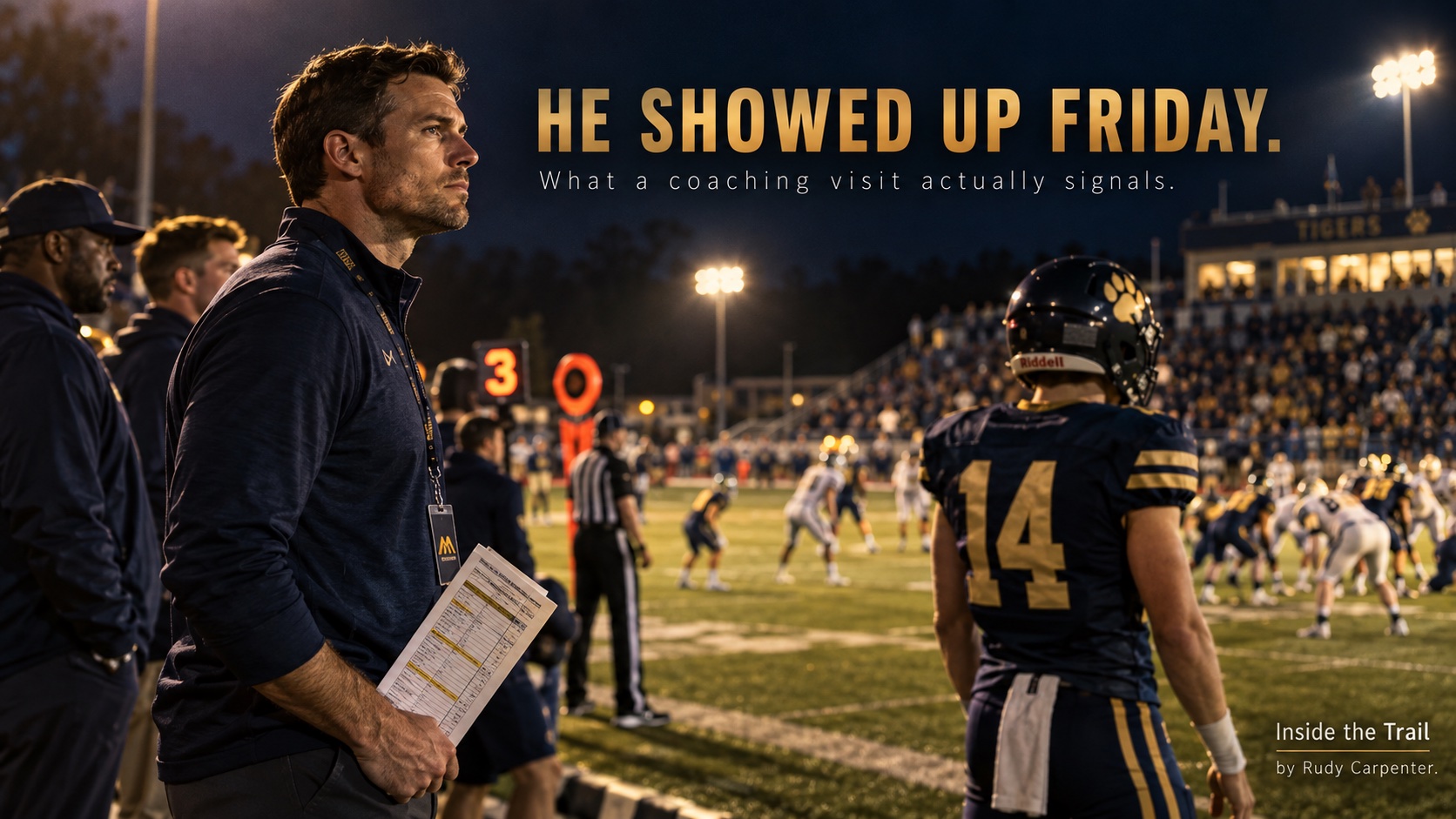
When coaches leave campus, pay attention to who
The college football calendar creates a window every fall that most families never hear about. At some point between September and November, every program gets a week off from game action. What happens in that week, specifically where the coaching staff goes and who goes, is one of the more revealing data points in the entire recruiting cycle.
I talked to a position coach a few days ago who had just come back from four days on the road during his program's bye week. Four states, six high school games on Friday night, back-to-back evaluation days on Saturday. He said he spent more one-on-one time with families that week than he had since spring. That is intentional. Bye weeks are the one window in the fall when coaches can get off campus without leaving a game plan unfinished.
Here is what families should understand: not every staff member who shows up to a Friday game carries the same message. A position coach in the stands means you are in the conversation. A coordinator showing up means you are in the conversation at a level that requires someone with authority over the system. A head coach in the bleachers means the program has decided internally that this athlete is a priority, full stop.
Those three presences represent three different levels of internal commitment, and they typically arrive weeks or months apart. The position coach comes first to confirm what film already suggested. The coordinator comes when the position coach has made a strong enough case internally. The head coach comes when the board has been set and the program is protecting a position.
What the visit is actually for
Here is what I hear families get wrong about bye week visits. The trip to the game is rarely the moment a decision gets made. It is the moment a decision gets confirmed.
By the time a coach makes a four-hour drive to a Friday game, the internal conversation at his program has been going on for weeks. Film has been watched. Academic records have been pulled. A position on the board has, at minimum, been sketched in pencil. The visit is not an audition. It is confirmation that what the staff saw on film holds up in person.
What happens on Saturday matters more than what happened Friday night. The follow-up call. The text from the coach the morning after. Whether the recruiting coordinator reaches out by Monday. That sequence tells you how seriously the program took what they saw. A coach who shows up on Friday and goes quiet for two weeks saw something that gave him pause. A coach who calls Saturday morning is moving.
I have watched families spend months trying to get a coach to come to a game, which is understandable. But the more useful question is not whether a coach came. It is who came, and what happened afterward.
The read that matters more than the visit
By the time October rolls around, position coaches have already been at dozens of games. Some of those trips were informal, a two-hour drive to confirm a gut feeling. Some were longer trips for a priority target. The families who understand the difference between those two types of visits are the ones making better decisions about where their time and energy should go.
A position coach in the stands for the second time is different from a position coach who came once and then sent the offensive coordinator the following month. A head coach who shows up without a prior coordinator visit is not following the normal sequence, and that absence tells you something too.
The framework is simple: visits are not standalone events. They are data points in a longer conversation the program is having internally. Knowing where you stand in that conversation, not just whether a coach showed up, is the information that matters.
So when someone from a program shows up at your athlete's game in October, the question worth asking is not whether they came. It is: what did the 72 hours after the visit look like, and did it feel like the conversation moved forward or went quiet?