

The Summer Window Is Behind Them
By the time high school football opens its fall season, most programs have their 2027 recruiting classes substantially built. Recruiting analysts tracking the class report that roughly 98 percent of the top-ranked 2027 prospects have already committed, meaning the vast majority of decisions at the upper tier of the national board are made.
That is not the same as saying the class is finished.
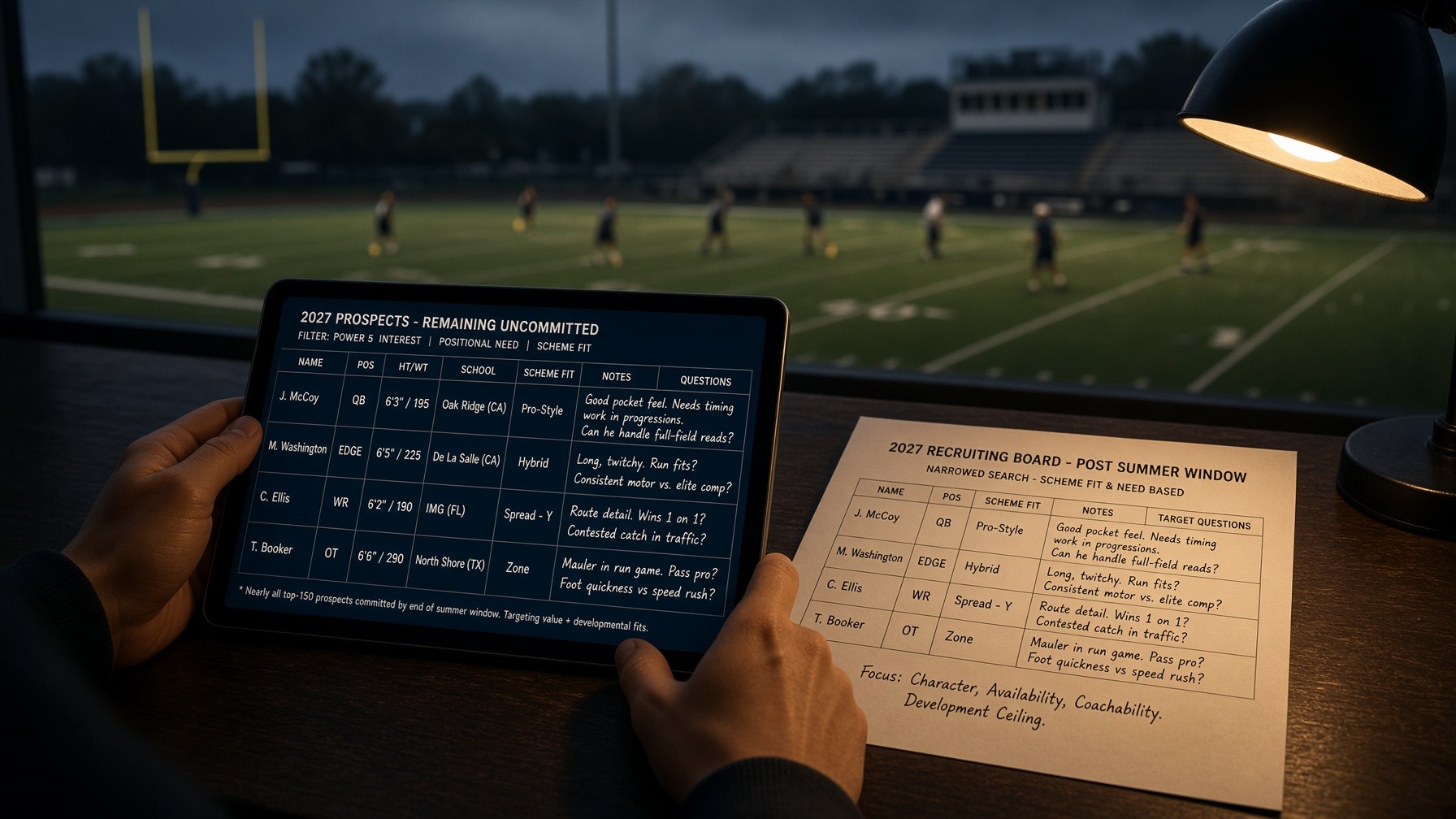
What it means is that programs have moved from the broad collection phase into a more precise, positional-need phase. The question on the board is no longer general. It is specific: which athlete fills this exact hole?
How Program Recruiting Behavior Shifts
During the spring and summer windows, programs build their boards expansively. They evaluate volume. They offer early. They compete for players before those players commit elsewhere.
Once a class is substantially committed, that behavior changes. Programs with unfilled positional needs become more targeted. The remaining conversations are shaped entirely by what is still missing from the roster.
A family receiving sustained attention from a program in September is receiving it for a reason that is now very specific. That is a different kind of interest than an offer in March. In the fall, continued pursuit means a staff has looked at its roster, assessed its needs, and decided this athlete addresses a specific problem.
What This Means for Uncommitted 2027 Families
For families navigating a 2027 process that is still ongoing, this shift matters in practical ways.
Conversations with coaching staffs become more direct. In the spring, a coach might keep multiple options open at a position. In September, with most of the class committed, a coach actively pursuing an uncommitted athlete at a needed position is having a more serious conversation.
Fit becomes easier to assess. Programs know what they need. If a program reaches out with sustained interest in September, the family can have a clearer conversation about role, position, and how the staff sees the athlete, because the program's own board is specific enough that they can articulate it.
The competitive environment has also narrowed. An athlete who was competing against five potential options at his position in April now faces a different landscape. The programs still pursuing that position have real needs and real intent.
The Practical Framing
The late-cycle recruiting environment rewards clarity. Families who understand what they are looking for, and who engage directly when a program shows real interest, are in a better position than those who treat fall attention the same way they treated spring outreach.
If your athlete is an uncommitted 2027 prospect and a program reaches out this fall with sustained interest, the conversation has different weight. The program knows its board. The interest is specific. And the window before the December signing period is narrowing.
None of that is a reason to make a rushed decision. It is a reason to have a more honest and productive conversation about fit, role, and what the program is actually offering. Programs with gaps at needed positions will work harder for the right athlete in September than they might have in May, when options were more abundant. Understanding that dynamic is part of navigating the process well.