

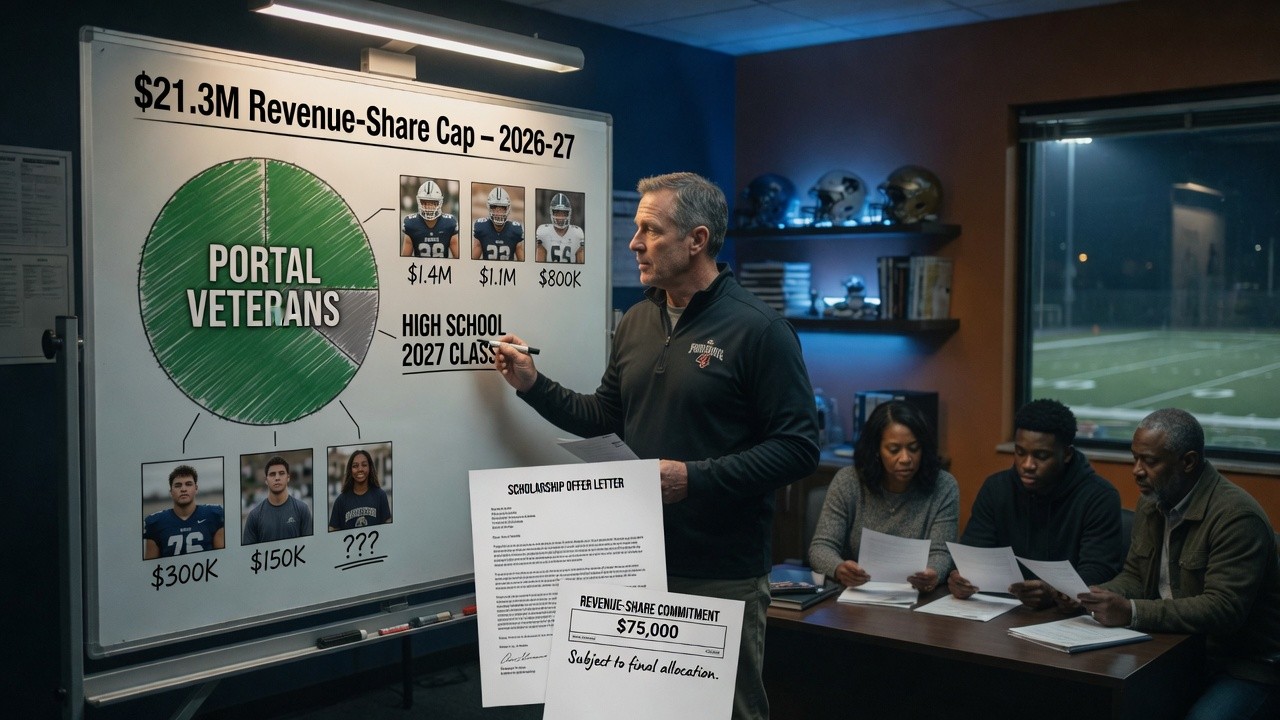
How programs are dividing a fixed budget
The revenue-share cap for the 2026-27 academic year is approximately $21.3 million per school. At most Power 4 programs, roughly 75 percent of that pool flows to football. That number is fixed. How it gets distributed across a 105-man roster is a series of allocation decisions, and those decisions increasingly favor proven, portal-ready veterans over incoming high school prospects.
A Big Ten general manager was direct in recent reporting: "High school spending is going to get a lot lower." An SEC personnel director added that while elite prospects at premium positions would still command serious financial commitments, "across the board, programs are going to be more selective with their money in recruiting."
This is not a trend toward fewer scholarship offers. It is a trend toward offers that carry a smaller attached financial commitment than they might have carried two years ago.
What the offer letter does not show
A scholarship offer has always been separate from a financial package. In the revenue-share era, that separation has become more consequential for families evaluating their options.
The scholarship itself, covering tuition, room, board, and fees, is unchanged. The variable is what a program commits in revenue-share dollars alongside it. One ACC general manager described the trade-off directly: "Are you really going to give a few hundred grand to a kid who's not going to play next year when you could just use that money in the portal?"
Portal veterans arrive roster-ready. High school prospects arrive needing development time. When budget is fixed, that math shapes allocation decisions in ways families comparing offers may not be reading clearly.
Where competition still concentrates
The dynamic does not apply uniformly across the 2027 class. At the top of the board, competition for elite prospects remains real. Programs recruiting top-100 quarterbacks in the 2027 cycle are committing close to $1.4 million in Year 1 revenue-adjacent packages. Top offensive linemen are tracking near $1 million. For those athletes, the financial pressure on programs has not eased.
For the broader 2027 class, it has shifted. Families evaluating legitimate scholarship offers from strong programs may find that the financial commitment behind the offer is more modest than the publicized market figures suggest. The visible numbers are real, but they describe a narrow tier of the market.
What a family should ask when an offer arrives
The offer is a starting point, not a complete picture. The relevant questions for a 2027 family are not just whether an offer exists, but what financial commitment a program is prepared to make alongside it, and where that commitment ranks against the program's existing roster obligations.
A program that has already allocated most of its revenue-share pool to portal veterans is in a different position than one building actively through high school recruiting. Those two programs may send the same scholarship offer letter. The financial weight behind each is not the same.
Beginning August 1, programs are required to put revenue-share terms in writing. That date is not a deadline and does not create urgency. It creates a practical framework for asking better questions. Families who understand what sits behind an offer before that conversation begins will be in a much stronger position when it does.