

The clearinghouse is real, and it rejects deals
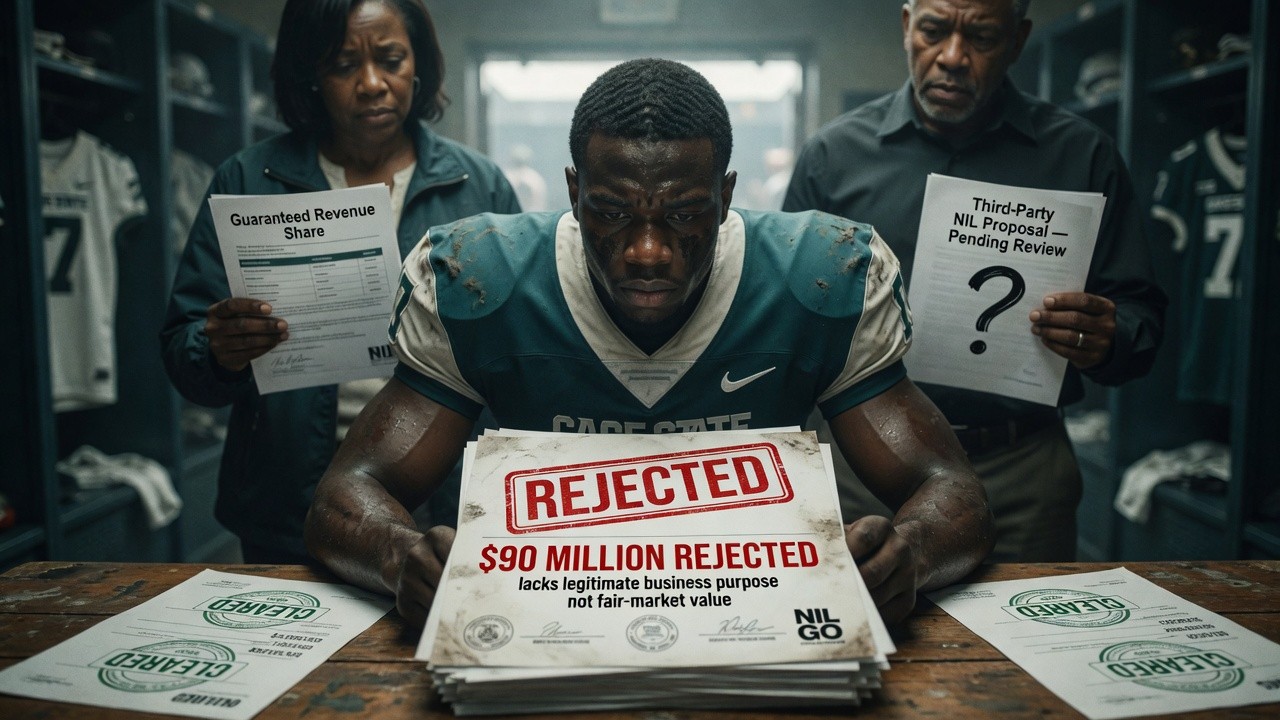
Since June 2025, the College Sports Commission's NIL Go clearinghouse has rejected approximately $90 million in third-party NIL agreements. Between May and June 2026 alone, $34 million in proposed deals were turned away while $113 million cleared.
The clearinghouse operates independently of any individual program. Every third-party NIL deal exceeding $600 must be submitted to NIL Go (operated by Deloitte under the House settlement framework) before it is enforceable. A deal that does not clear cannot be paid.
Why deals are getting turned away
The CSC identifies two primary rejection reasons. The proposed compensation lacks a legitimate business purpose, or the value is not commensurate with fair-market rates for a similarly situated athlete.
In practice, deals that appear designed to circumvent the revenue-sharing cap face the most scrutiny. That includes arrangements with program-affiliated collectives, multimedia rights partners, and apparel companies structured to look like NIL but function as roster payment.
In May 2026, the CSC won an arbitration case against 18 Nebraska players who had arranged deals with Playfly Sports, a firm with existing school partnerships. The ruling: the deals did not represent legitimate NIL activation.
What a rejected deal looks like inside an offer
Programs have been presenting total compensation packages that combine direct revenue-sharing payments with third-party NIL numbers. The revenue-share piece is a direct institutional commitment. The third-party NIL piece is a proposal that requires clearinghouse review before it is enforceable.
The rejection rate is not uniform. Between January and February 2026, 187 deals worth $14.36 million were rejected out of 3,704 submitted. Rejected deals averaged $51,593 in value. Approved deals averaged $14,792. Larger figures draw more scrutiny, not less.
What this means for a family comparing offers
A family evaluating a total compensation package should treat the two components differently. The direct revenue-share commitment is a contractual term the program controls. The third-party NIL component is a proposal that may or may not clear review.
Before weighting a large third-party NIL figure heavily in a decision, the right question is whether that deal has been submitted to NIL Go and cleared. Programs are not always forthcoming with that distinction.
A number on a term sheet is the starting point, not the finish line.