

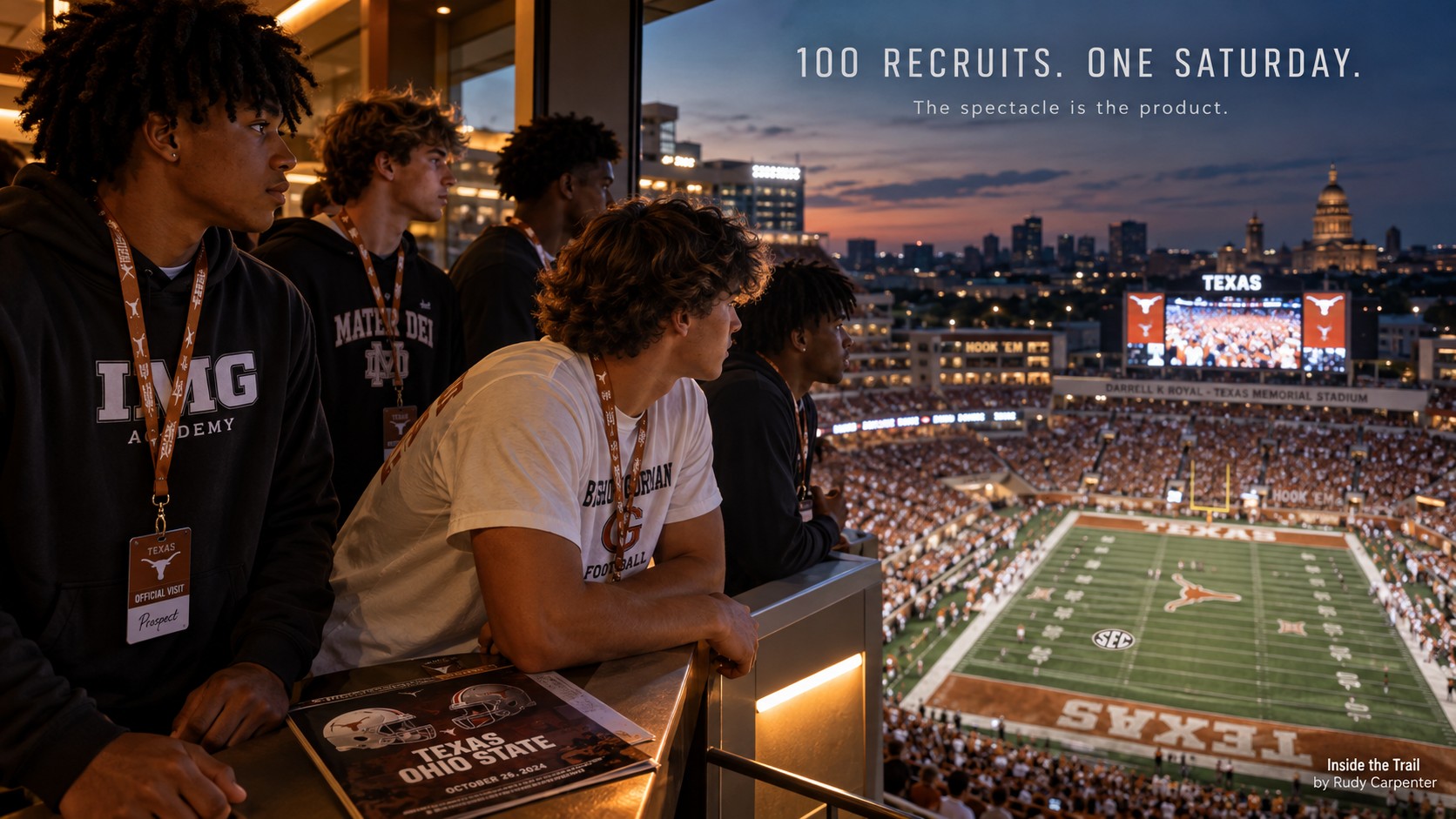
This past Saturday, Texas hosted more than 100 recruits for its home matchup with No. 1 Ohio State, including eighteen five-star prospects spread across three class years. Ohio State had its own large group of priority targets in the building at the same time. If you were tracking the recruiting trail this week, you were watching one of the biggest game-day recruiting weekends of the early season unfold simultaneously across two campuses.
The spectacle is the product
Nobody inside either program is pretending that hosting 100 recruits in one afternoon is a quiet, targeted exercise. The volume is the point. Programs at that level want young players to feel what it is like to be in a packed stadium, to see the support staff in action, to hear 100,000 people and understand the standard they are considering competing at.
A position coach I talked to about this kind of weekend described the logic plainly: on Saturday, you are not evaluating the recruit. You are selling the environment. The evaluation happened before the invite went out.
That distinction matters for families. The invite is a signal, but the invite is not the same signal as being at the top of a board. When a program hosts 100 or more recruits on a single afternoon, the experience is, by design, a broad-funnel moment. Everyone walks the same facility, sits in the same atmosphere, and feels the same electricity. What separates families who used a visit like this well from the ones who came home with a great memory and not much else is whether they understood the difference between being in the room and being on the board.
What the visit list actually tells you
There are three things I watch for when a family tells me their athlete was invited to a large game-day visit.
First, who extended the invite. Did it come from the position coach recruiting your athlete directly, from the head coach's office, or from a broader recruiting pipeline sweep? Programs manage game-day invite lists very differently. Some are selective even for marquee games, keeping the list to 30 or 40 high-priority prospects. Others use marquee weekends as open-funnel pipeline events, intentionally bringing volume because the game itself does the selling. Knowing which approach a specific program takes tells you whether this particular invite is targeted or atmospheric.
Second, who finds your athlete on Saturday. In a group of 100 prospects, the position coach who crosses the stadium to spend real time with your kid tells you something. The coach who waves from across the room tells you something else. The one who never makes contact at all is giving you information too, and it is the most useful kind.
Third, what the follow-up looks like by Tuesday. A game-day visit that produces a call from the offensive coordinator two days later is a different situation than one that ends with a handshake and goes quiet. The visit is an inflection point. What a program does in the 72 hours after it is the actual data.
What does not travel home with you
The mistake I see families make consistently on big game-day visits is leaving with feelings instead of information.
A 100,000-person crowd for a top-5 matchup generates a lot of feelings. The energy is real. The facilities are genuinely impressive. The people who work in those programs are skilled at making recruits feel wanted, and they should be. That is part of the job, and they are very good at it.
But feelings and standing on a recruiting board are different things. A family that walks out of Ohio Stadium or Darrell K Royal on a Saturday afternoon and concludes their athlete is a high-priority target, based on how great the day felt, may be reading the atmosphere rather than the signals.
What moves an athlete from a broad visit list to the short list is not what happened inside the stadium. It is what the staff did in the weeks before the invite and what they do in the days after.
So if your athlete was at a program this past Saturday for one of these big games, the question worth sitting with is not whether you had a great experience. You probably did. The real question is simpler: who reached out after the crowds cleared, who showed up at your school this week, and what did they say when there was no stadium lighting behind it?