

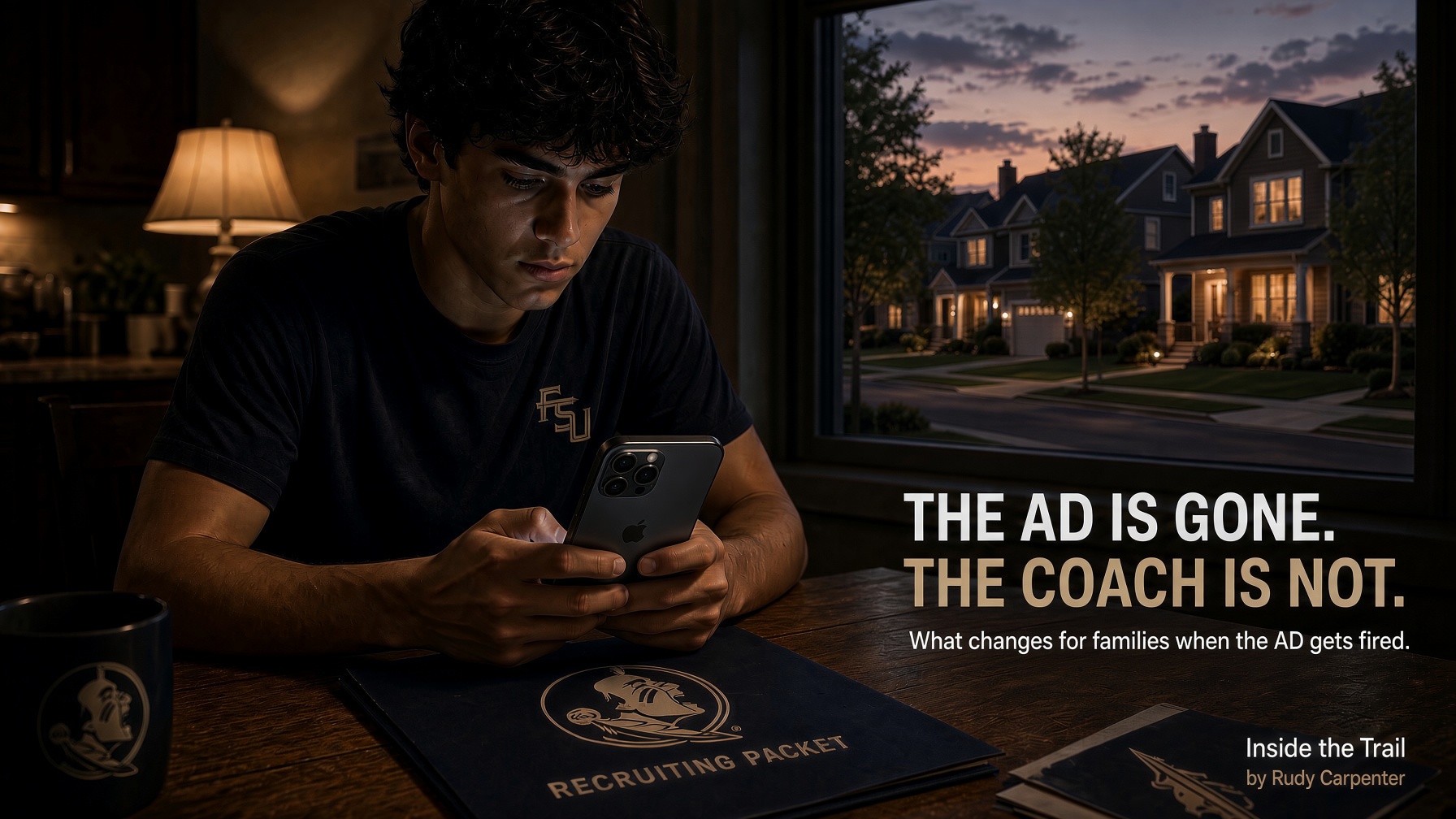
A position coach I spoke with this week put it this way: the most complicated calls to make after a program fires its AD are the recruiting calls. You are still doing the job. You still want the families you have been building relationships with. But you do not know what your situation looks like in January, and neither does anyone else in the building.
Florida State fired athletic director Michael Alford on September 14. Mike Norvell is still coaching and his staff is still recruiting. But the institution sent a signal that week, and families evaluating Seminole offers need to understand what that signal actually means.
The layer above the head coach
Most recruiting analysis stops at the head coach. That is where the hot-seat coverage lives, where the carousel projections start. But the AD is where the actual institutional decision lives.
When a program fires its athletic director during the season, the sequence that follows has a fairly consistent shape. An interim comes in. Conversations begin with candidates. A timeline forms around a potential head coaching change, typically tied to the end of the regular season or the bowl game. The head coach is rarely told anything concrete until a decision is made.
What that means in practice is that a coaching staff actively recruiting families does not know its own timeline. The position coach calling your athlete on Tuesday afternoon is not hiding something from you. He is simply in the same uncertainty you are, with less ability to do anything about it.
The FSU situation is notable because of the buyout structure. Norvell's contract runs through 2031 and carries a significant financial penalty for termination. That slows the process. It does not change the institutional signal.
What the coaches who are calling you are actually navigating
Position coaches carry the daily relationship in recruiting. The head coach makes the offer call, but it is the position coach who calls three times a week, who builds the personal relationship over a year, who knows which assistant at your son's high school to contact for an update.
When institutional leadership is in flux, those coaches face a calculation families rarely see. They keep recruiting because that is their job and because some of them will survive the transition. Some are confident they will. Others are quietly keeping their own networks active, letting other programs know they are worth a call if a position opens up.
The result is that the calls a family receives from a staff in this situation can look exactly the same from the outside. Same warmth. Same frequency. Same apparent commitment. What is harder to see is whether the person calling is recruiting for the program your athlete would actually enroll in.
Most coaches handle this period with integrity. I am not suggesting families distrust every call they receive from a staff in transition. What I am suggesting is that the question changes. It is not just whether this staff wants your athlete. It is whether this is the staff your athlete will play for.
How to hold a relationship with a program in institutional transition
The instinct some families have in this moment is to commit faster. Lock something in before the uncertainty resolves. That instinct usually works against them.
A verbal commitment during this window is a commitment to a staff that may not be the staff coaching your athlete in September of his freshman year. Verbal commitments are non-binding in both directions. A new head coach is not obligated to honor offers made by the staff he replaced. Most programs make a genuine effort to honor existing verbal commitments, and that is real. But most programs is not a contract, and it does not hold in every case.
The stronger approach is to stay warm with the program without making a decision. Continue the relationship. Answer the calls. Maintain genuine interest. But let the institutional picture clarify before any family moves from interest to a commitment that carries real consequences.
If the relationship your athlete has built is real, the next staff will see it. Programs going through coaching transitions evaluate the inherited recruiting class carefully. The families who have been visibly engaged, visited, and built genuine relationships are the ones who receive priority calls from incoming staffs.
If the relationship existed primarily with the coaches who may be leaving, that information matters too.
The question worth sitting with before making any decisions: if the coaches who recruited your athlete are no longer on staff by the time he enrolls, how much does the program itself matter to your family?