

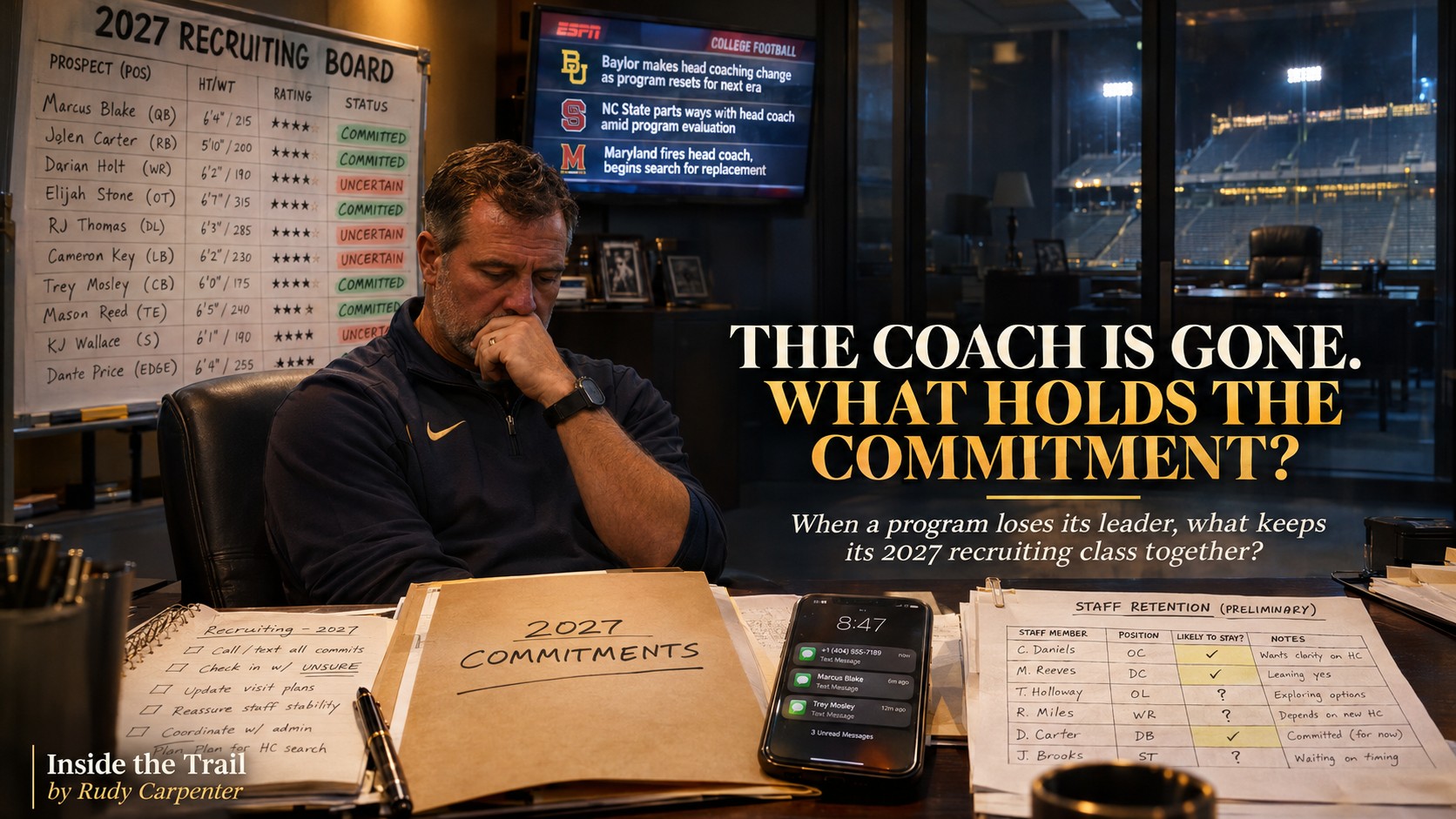
The week after a head coach gets fired, I talk to coaches who are still inside those programs. Not the fired coach, who has already moved on to the next conversation, but the position coaches, the quality control guys, the recruiting analysts. The people still sitting in their offices with their recruits in their phones, still technically employed.
What they describe is different from what the recruiting coverage focuses on. The stories are about which commits are wavering, which programs are sending feelers, which high-profile coach might take the job. The coaches still in the building are dealing with something quieter.
They don't know if they'll be there next month.
What uncertainty does to a commitment
Baylor lost a 2027 defensive line commit in the days after Dave Aranda's dismissal. That's not a surprise, and it doesn't mean the rest of the class is about to fall. What it tells you is something about how that particular commitment was built.
When a recruit's relationship is primarily with the head coach, or with a position coach who is now actively looking for his next job, the commitment is functionally tied to a person. Remove that person, or create enough uncertainty that the person feels temporary, and the commitment becomes a question mark.
The commits who hold longest after a coaching change are almost always the ones who chose the school for reasons that exist independent of any one staff member. The campus. The academic fit. The program's history at a specific position. The size of the city. Those are reasons that survive a firing.
The commits who leave first are usually the ones who can point to one conversation, one relationship, one coach who told them exactly what their role would look like. When that coach is interviewing elsewhere, the conversation changes. It doesn't have to end. But it changes.
What the assistants are actually navigating right now
Position coaches at Baylor and NC State right now are in a genuinely difficult place. They're still employed, still expected to manage existing relationships, still supposed to reach out to uncommitted prospects and hold the board together. But they can't tell a 2027 prospect what the offensive philosophy will look like next fall, because they don't know who's going to be calling the offense.
There's a kind of recruiting call that happens during a coaching search that I've heard described more than once. A position coach reaches out to an uncommitted target, has a real conversation, a good one. The recruit is engaged. But when the family asks whether the coach expects to be retained, there's no honest answer. He can't say yes. He doesn't know.
Those conversations don't always end badly. But they rarely end with a commitment.
The other call that's happening right now, quieter and less visible, is the same position coach reaching out to programs that might want to hire him. Not every assistant at a school in transition wants to wait and see. Some of them know what their odds look like. The good ones have calls being returned from places with openings. When those coaches leave, the recruit network they built goes with them.
How the speed of the search shapes what's left of the class
I've watched programs handle coaching searches well and handle them badly. The difference in recruiting outcomes is usually larger than people expect.
A program that moves decisively, makes a compelling hire within two weeks, and puts that new coach on the phone with every existing commit within 48 hours of the announcement, will lose fewer kids. A program that lets a search drag out, that takes six weeks, that cycles through a dozen public names, gives uncertainty time to compound. Each week of a slow search is another week for a commit to get a call from somewhere else with a clear answer.
Penn State's coaching change last cycle is the far end of that spectrum. More than 20 commits backed out of a class that had been carefully constructed. Some of those families held for weeks, not wanting to leave. The search itself, drawn out and publicly messy, eventually pulled the thread.
Baylor and NC State are both in early days right now. Maryland too. Three Power Four programs in coaching transition at the same time, all trying to hold their 2027 classes together while running searches in public. The outcomes will differ, and the speed of each hire will be a large part of why.
For families with a commit at a program in transition, the question worth sitting with is not whether to stay or go. It's simpler than that: what specifically built the commitment in the first place? If it was the school, the campus, the fit, those reasons are still there. If it was one relationship with one coach, the better question is where that coach's next call is going.