

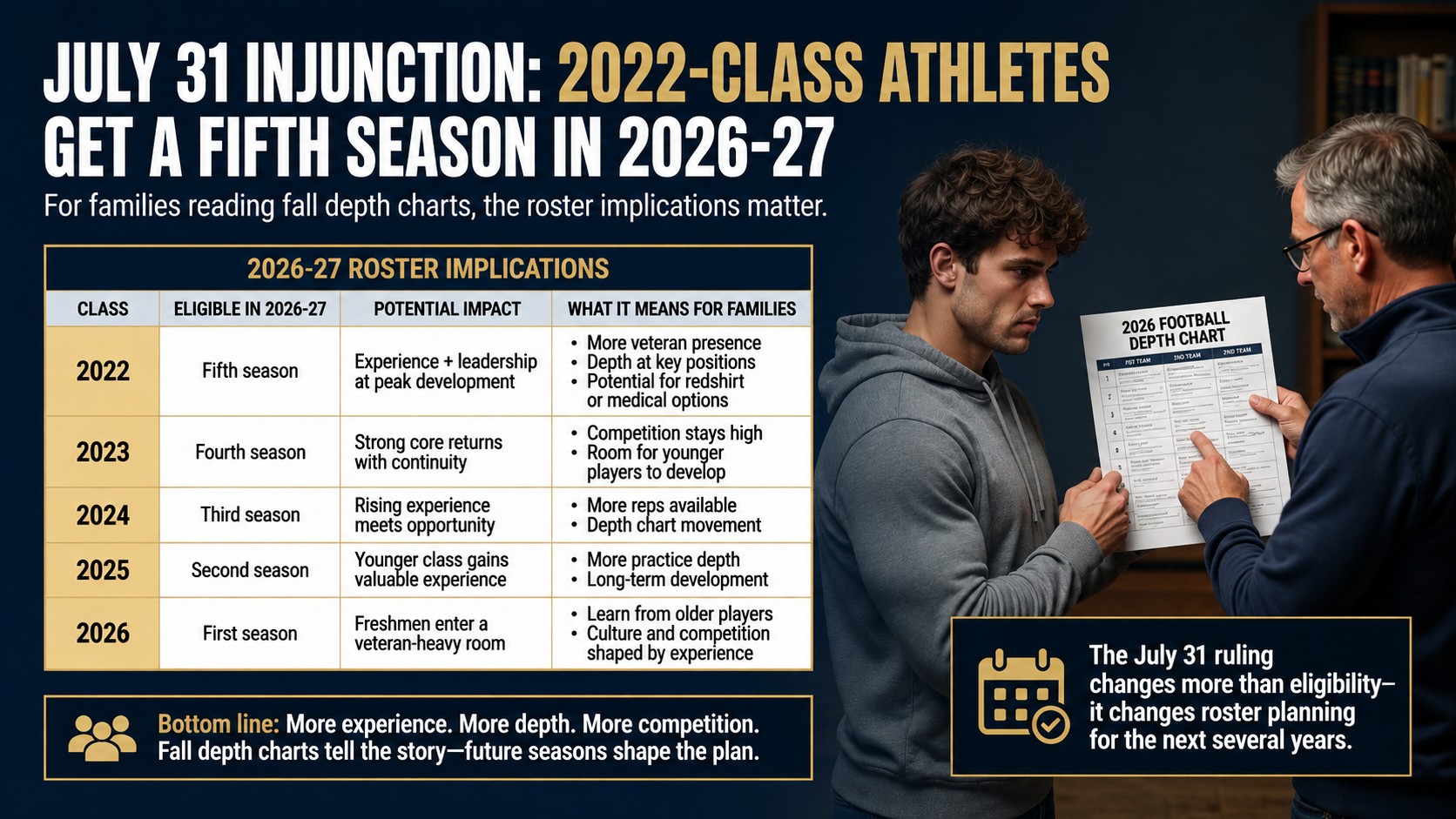
A court order issued July 31 allows certain college athletes who exhausted four seasons of eligibility last spring to return for a fifth year in 2026-27. For families currently evaluating programs, the ruling carries implications beyond the players directly affected.
What the court decided
U.S. District Judge Charlotte Sweeney in Denver granted a class-wide preliminary injunction on July 31, extending eligibility to Division I athletes from the high school class of 2022 who completed four consecutive seasons without redshirting.
That class occupies an unusual position. Athletes who graduated high school in 2020 and 2021 received COVID-related eligibility relief. Athletes entering college in fall 2027 or later will have five seasons under the NCAA's new age-based model. The 2022 class received neither, and the lawsuit argued that exclusion was arbitrary.
The injunction addresses that gap, at least for now. The NCAA has signaled it will seek a stay and appeal the ruling. NCAA President Charlie Baker described the decision as a source of "roster chaos" and called for Congressional action. Whether these athletes remain eligible in 2026-27 depends on appellate decisions that have not yet been made.
What programs are managing right now
Fall camps opened in late July and early August with rosters already constructed under the 105-man cap. Programs had no advance notice of the ruling and have no obligation to accommodate a returning 2022-class athlete.
Players who signed NFL or CFL contracts are disqualified. Athletes who only attended NFL rookie minicamps remain eligible. Any returning player must go back to the school where they played in 2025, because the transfer portal is closed to this group.
The practical result: some programs will choose to accommodate a returning senior if the roster allows and the positional value justifies it. Others will not. That decision belongs entirely to the coaching staff.
What families evaluating offers should understand
A depth chart published in August reflects the roster as it stood before this ruling. At programs that choose to bring back a 2022-class senior, particularly at skill positions, that chart could shift before the season opens.
This will not affect most programs in most situations. The injunction applies to a specific, finite group of players, and many have already moved on professionally or made other arrangements. But at positions with thin depth, or at programs that actively pursued a returning senior, families should be aware that the roster picture may change.
The broader point: in a recruiting environment already shaped by the transfer portal, roster caps, and revenue-sharing budget constraints, another eligibility variable has entered the picture. Families using a program's current depth chart to gauge scholarship availability or playing-time opportunity are reading a document that may not reflect the final roster.
The NCAA's appeal is pending. Until an appellate ruling clarifies the situation, the status of 2022-class athletes at FBS programs remains unsettled. That is not a reason to delay decisions. It is context for how to weigh what a program's depth chart says right now.