

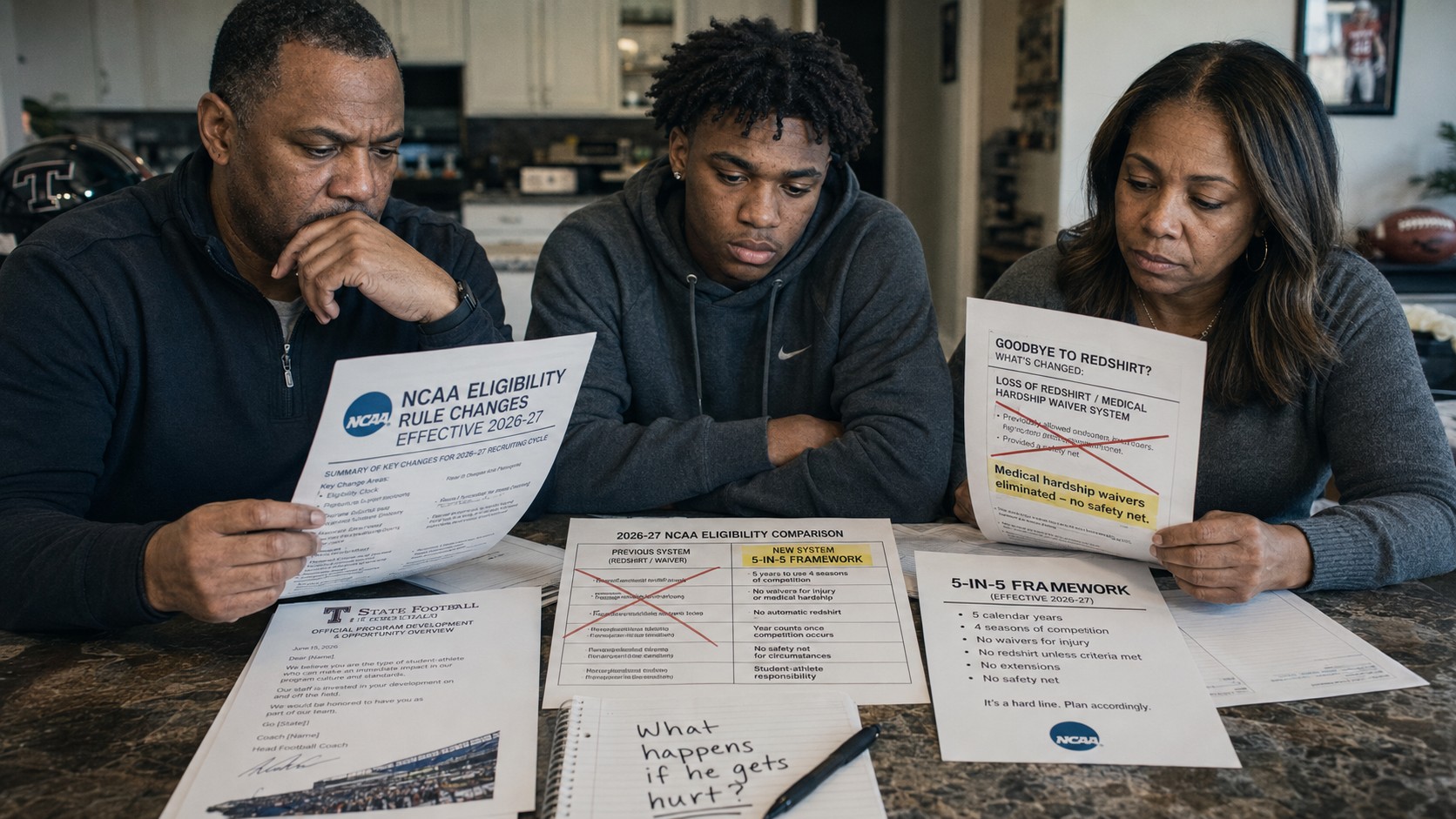
The rule, briefly
The NCAA's 5-in-5 framework gives athletes five seasons of competition inside a five-year eligibility window. The clock starts at full-time enrollment or the academic year following an athlete's 19th birthday, whichever comes first. The rule took effect for athletes enrolling in fall 2026 and beyond.
What matters most for recruiting families is what the rule removes. Medical hardship waivers and injury redshirts are no longer available to Division I athletes operating under this framework. Three exceptions remain: military service, pregnancy, and religious mission. Injury does not qualify.
What coaches can no longer offer
Under the previous system, a player who suffered a significant injury early in a season and appeared in fewer than four games could often apply for a medical hardship waiver. In most cases the season was restored and the athlete retained an extra year of eligibility. Coaches frequently referenced this informally in recruiting conversations: the system had a built-in recovery mechanism if something went wrong.
That backstop no longer exists.
Delayed enrollment (a path some families pursued to buy additional development time before a college eligibility clock began) also no longer preserves that time. Under 5-in-5, the window opens at 19 regardless of when an athlete formally enrolls. Planning around enrollment timing as an eligibility management tool is no longer a reliable strategy.
What this means for 2027 families
For families currently evaluating programs and hearing pitches about development timelines, the practical implication is straightforward: the margin for error is smaller.
An athlete who enrolls and suffers a serious injury in year one has four years remaining in their window. The program cannot apply for a hardship to restore the lost season. Five years is the total, and the clock does not pause for circumstances that would have previously qualified for relief.
That does not make a program wrong for your athlete because of how it describes its development approach. Multi-year plans still make sense. But when a coach discusses a player's development arc, families are well served asking two things: what the plan looks like with no waiver backstop available, and how the program has approached roster management since the medical redshirt was removed.
The rule simplified eligibility administration. For families in the recruiting process, that simplification is worth understanding before a commitment is made.