

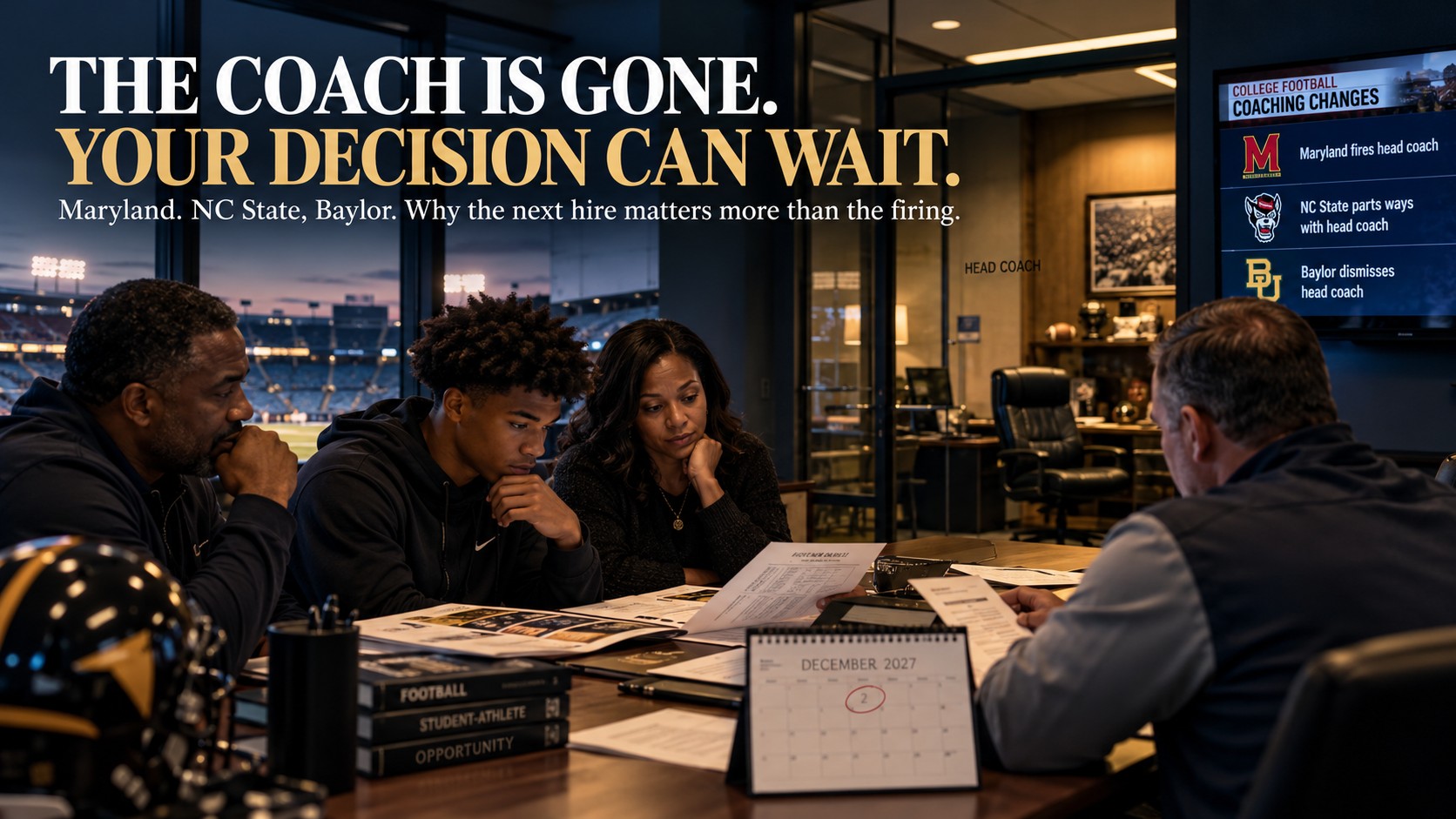
The week that changed three recruiting boards
Between October 21 and October 25, three Power 4 programs (Maryland, NC State, and Baylor) announced the departure of their head coaches. All three are navigating the final weeks of the regular season with interim coaches while searches for permanent replacements begin.
For families with a commitment at any of these schools, or at any program that may be heading in a similar direction, the noise around a coaching change is real. The pressure to decide quickly, however, is almost always premature.
What the firing changes and what it does not
A head coach firing changes the relationship that brought a recruit to a program. In most cases, it does not change the university, the facilities, the academic profile, the conference, or the roster the recruit would join.
The coach who recruited the athlete is gone. The program is still there. Understanding which of those two things drove the original commitment is the first and most important question a family should ask.
If the commitment was primarily relationship-driven, built on a specific coach, system, or staff, the departure matters more. If the commitment was anchored in the broader program profile, the disruption is less structural.
Neither answer tells a family to stay or leave. But it tells them what they are actually evaluating.
Why the interim period is not the right time to decide
When a head coach is fired mid-season, programs typically name an interim while a full national search begins. That interim period rarely produces the clarity a family needs to make a sound decision.
The pattern from recent transitions is consistent: committed recruits who moved quickly in the days immediately following a firing often found themselves revisiting that decision weeks later, once a permanent hire was announced and they could assess the incoming staff. The firing is the starting point. The hire is the more meaningful signal.
The Florida situation this month is illustrative. The class held together in the immediate aftermath of the coaching change. The first decommitment came later, after the new head coach was introduced, when the recruit could actually evaluate fit with a specific incoming staff.
What families should do now
The early signing period opens December 2. That gives families committed to programs in transition roughly five weeks to gather clarity before any signing decision is required.
For now:
- Communicate directly with the interim staff. Ask which coaches are staying, what the timeline looks like, and whether you remain a priority.
- Assess whether the program's core profile (academics, location, roster, conference fit) still matches what drove the original decision.
- Avoid making a public decision before the program has defined its direction. Decommitting and recommitting in a compressed window creates complications that are difficult to manage.
Patience during this period is not passivity. It is the appropriate response to a situation where the institution itself does not yet have all the answers.
The right time to make a decision is when there is enough information to make a good one.