

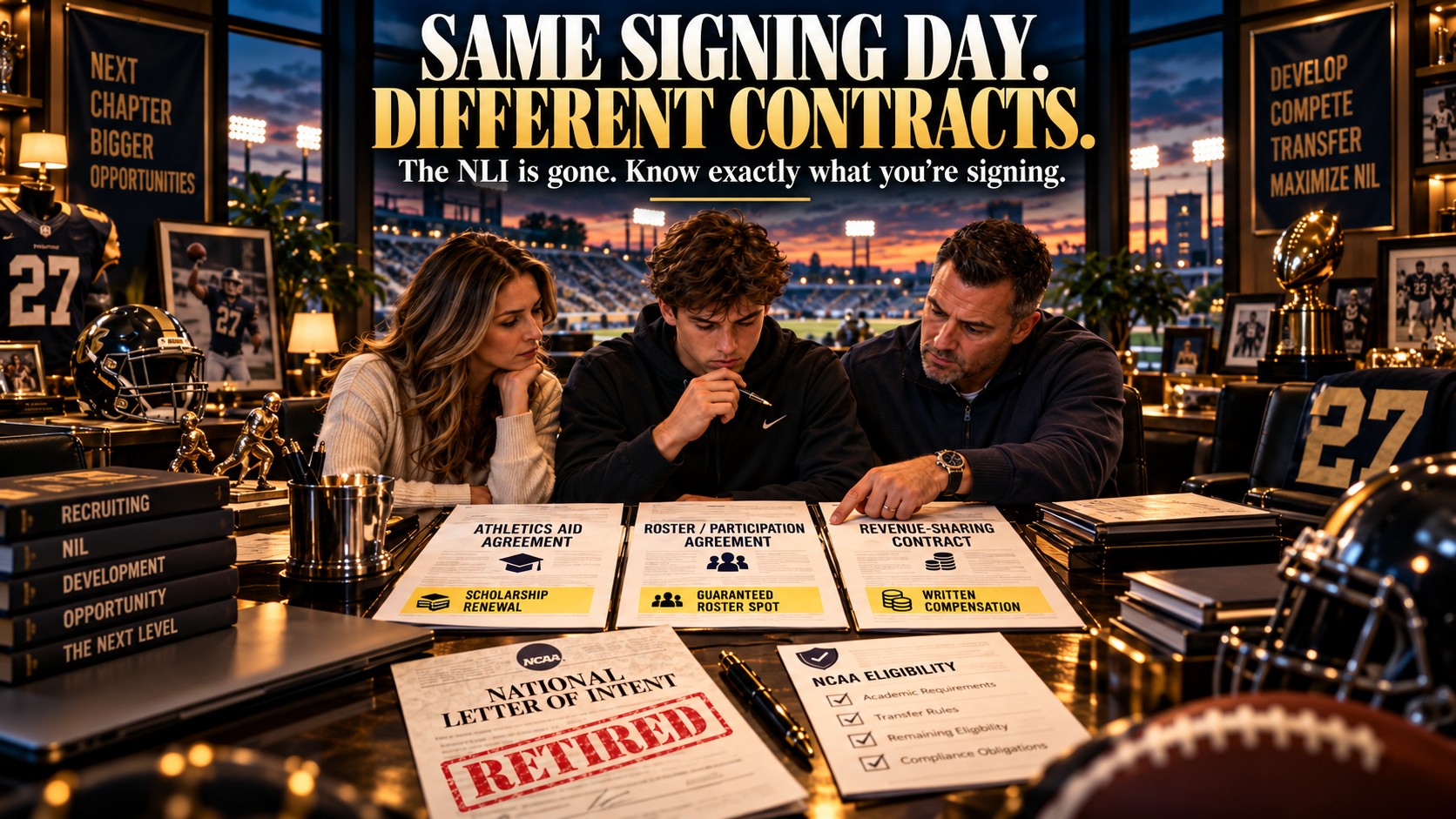
The NLI no longer exists
For more than sixty years, the National Letter of Intent was the document high school football players signed to formalize their commitment to a college program. When the NCAA Division I Council eliminated it in October 2024, the change was framed as a modernization, a shift toward agreements that better reflected the new revenue-sharing environment. Most families heard about it and moved on.
The Class of 2027 is the first group to arrive at December's early signing period with no NLI. What they will sign instead is a different kind of document with different terms, different protections, and different things families should read carefully before the pen comes out.
What replaced it
The new standard document is an athletics aid agreement, a direct contract between the school and the athlete outlining the scholarship and its renewal terms. Unlike the NLI, which was administered by a central program with uniform standards, this agreement is issued by the institution and its terms can vary.
Many programs are now pairing the aid agreement with a second document: a roster or participation agreement and, for athletes receiving compensation above their grant-in-aid, a revenue-share contract. These can arrive together or separately.
The revenue-share agreement is where families are finding the most complexity. Since August 2025, programs have been presenting recruits with formal revenue-share contracts showing compensation figures. Those contracts are non-binding until the athlete actually signs and enrolls. The offer can be reduced, restructured, or withdrawn in the months between commitment and December signing. Recruits can also use competing offers as leverage during that period.
Four things to verify before signing
The most important advisory work in the next six weeks is not about which school to choose. It is about understanding what is actually being offered in writing.
Before your athlete signs, verify these four things explicitly in the agreement.
Scholarship amount and renewal terms
The distinction between a scholarship renewed automatically absent misconduct and one renewed at the program's discretion is not procedural. It affects how much security the athlete has year over year.
Roster status under the program's cap
Under the House settlement framework, programs operate under hard roster caps. Confirm the athlete has a named roster spot, not a contingent one.
Academic eligibility through the Eligibility Center
Certification timelines affect when the agreement becomes enforceable. A signed agreement cannot be honored if clearance is not complete at enrollment.
Revenue-share figures in writing
If a program presented a compensation figure during the recruiting process, it should appear in a written document. If it exists only as a verbal representation, it is not binding.
What this means for families right now
The mechanics of signing day have not changed visually. The table, the hat, the photo. But the document on the table is different, and the framework governing it is new enough that families are arriving at December without a clear map.
The six weeks between now and early signing period are the right time to read the offer documents carefully, ask specific questions about renewal language and roster status, and confirm that what was discussed during visits is actually reflected in what gets signed.