

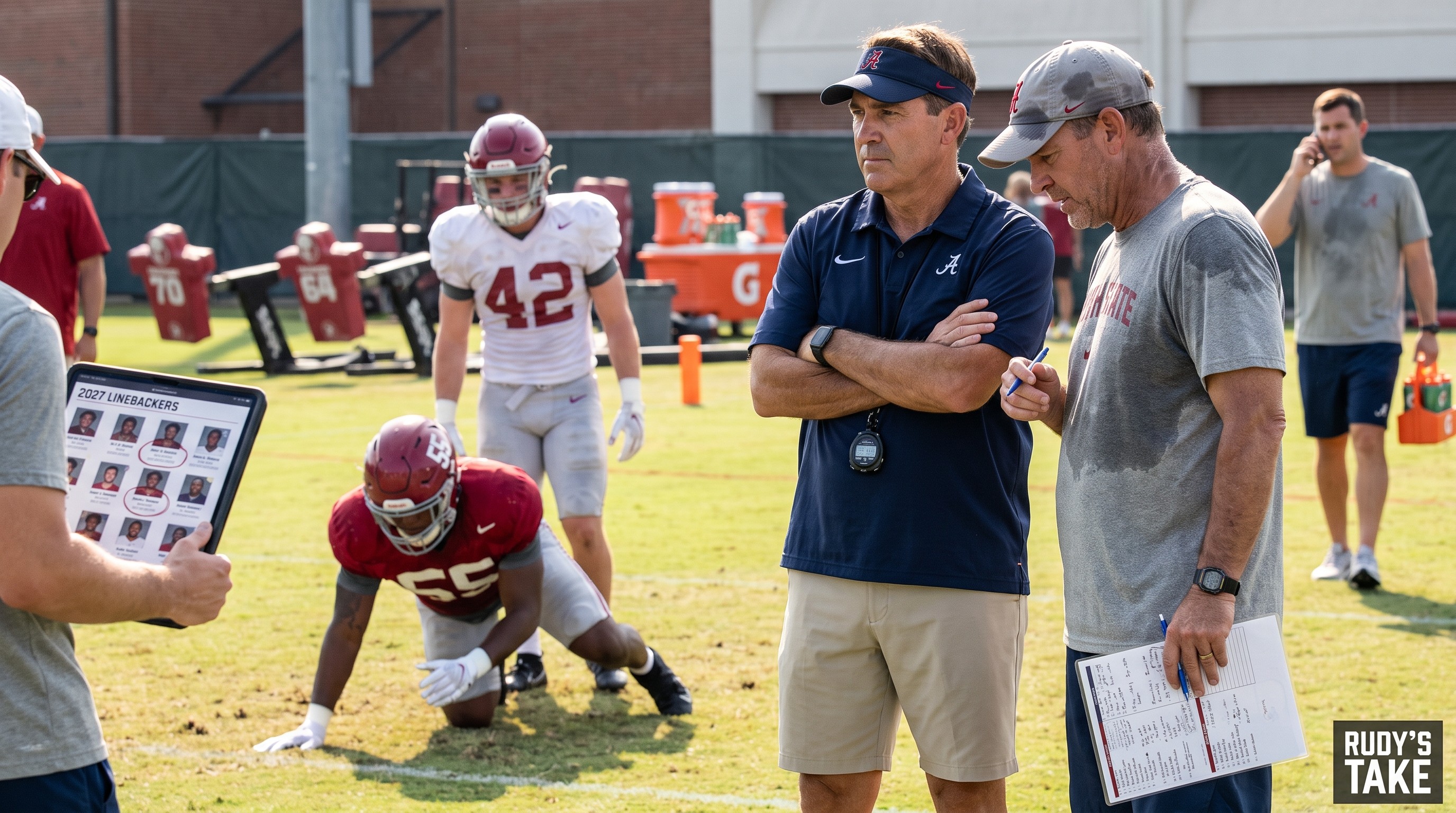
There is a moment in every head coach’s first August camp that nobody really talks about publicly. It happens somewhere in the first week of padded practice. The coach watches his linebackers in a seven-on-seven drill, or he watches his offensive linemen go one-on-one, and he starts doing quiet math about what he actually has versus what the previous staff told him he had.
That gap between expectation and reality is where recruiting boards get rebuilt.
The roster a new coach inherits vs. the one he discovers
Kyle Whittingham opened fall camp at Michigan this week with a linebacker corps that has over 1,500 snaps to replace from last season. He knew that going in. But knowing a number and seeing it in live August camp are two different things. His staff walked out of the first padded practices with a more specific picture of where the depth is thin and where it is not. The calls that go out in September to 2027 families in that position group are going to reflect what they saw, not what the spring roster looked like.
James Franklin is going through the same reckoning in Blacksburg. He built a class that ranks in the top 20 nationally in his first year at Virginia Tech, one of the more impressive class-building performances a first-year staff has produced in the ACC in some time. But the class he is building for 2027 is now being calibrated against what he is seeing in August camp, not just what the roster spreadsheet said in March.
This is the part of the cycle that families almost never see from the outside. When a program goes through a head coaching change, the new staff spends the winter and spring assessing through film, conversations with the outgoing staff, and one spring practice session. They build a picture. Then August arrives, and they find out how accurate that picture was.
When the need is real, the call sounds different
I have talked to enough coordinators during fall camp weeks to know there is a specific difference in how a coach sounds when he is maintaining a relationship versus when he has a genuine position need.
The maintenance call is real. Coaches make them consistently. They check in, stay connected, keep a name alive on the board. That is part of the process, and the coaches who do it well do it even when the need is not urgent.
The need call has more in it. The coach tells you where things stand on the current depth chart. He mentions a specific physical trait he is evaluating at the position. He asks about visit availability, and he means it. The specifics are the signal.
When a new staff opens camp and finds a position group thinner than expected, maintenance calls from earlier in the summer can turn into need calls quickly. Families in that pipeline who were hearing from a position coach every few weeks in July might find themselves hearing from a coordinator directly in September. That shift is not random. That is a new board getting built in real time.
The reverse is also true. If a new coach opens camp and finds more quality at a position group than he anticipated, the calls to families in that group can slow. It is not a reflection of the athlete. It is math. Families sometimes read that silence as a negative signal, and sometimes they are right. But often the need just moved to a different position group, and nobody told them.
What moved when a coordinator moved
One of the more instructive examples from this offseason: Jay Hill left BYU to become Michigan’s defensive coordinator under Whittingham. Hill is a well-regarded coach with real relationships built across Utah and the Mountain West recruiting corridor. He did not just bring his scheme to Ann Arbor. He brought his network.
The shape of Michigan’s defensive recruiting board looks different now than it did six months ago. Not because the program changed what it values at the position, but because a coordinator who built real relationships in a specific geography is now recruiting for a Big Ten program. A family with a defensive prospect who was in BYU’s pipeline over the summer may now find Michigan calling. Programs do not announce that shift. It just starts showing up in the calls.
The question worth asking this September
If your athlete is on a first-year staff’s board, the calls you receive in September will tell you more than anything you heard over the summer. Specifics are the signal. When a coach tells you exactly what he saw on film, exactly what he needs at the position, and exactly when he wants to see your athlete on campus, that call looks different from a routine maintenance call.
The question worth sitting with: is the interest your family is hearing right now the kind that reflects a genuine position need from a staff that just finished its first honest audit of what it has, or the kind that means your athlete is on a board and still being tracked? Most families are not sure how to tell the difference. The coach usually is. And the details he volunteers in the call are almost always where the answer lives.