

What the bill is
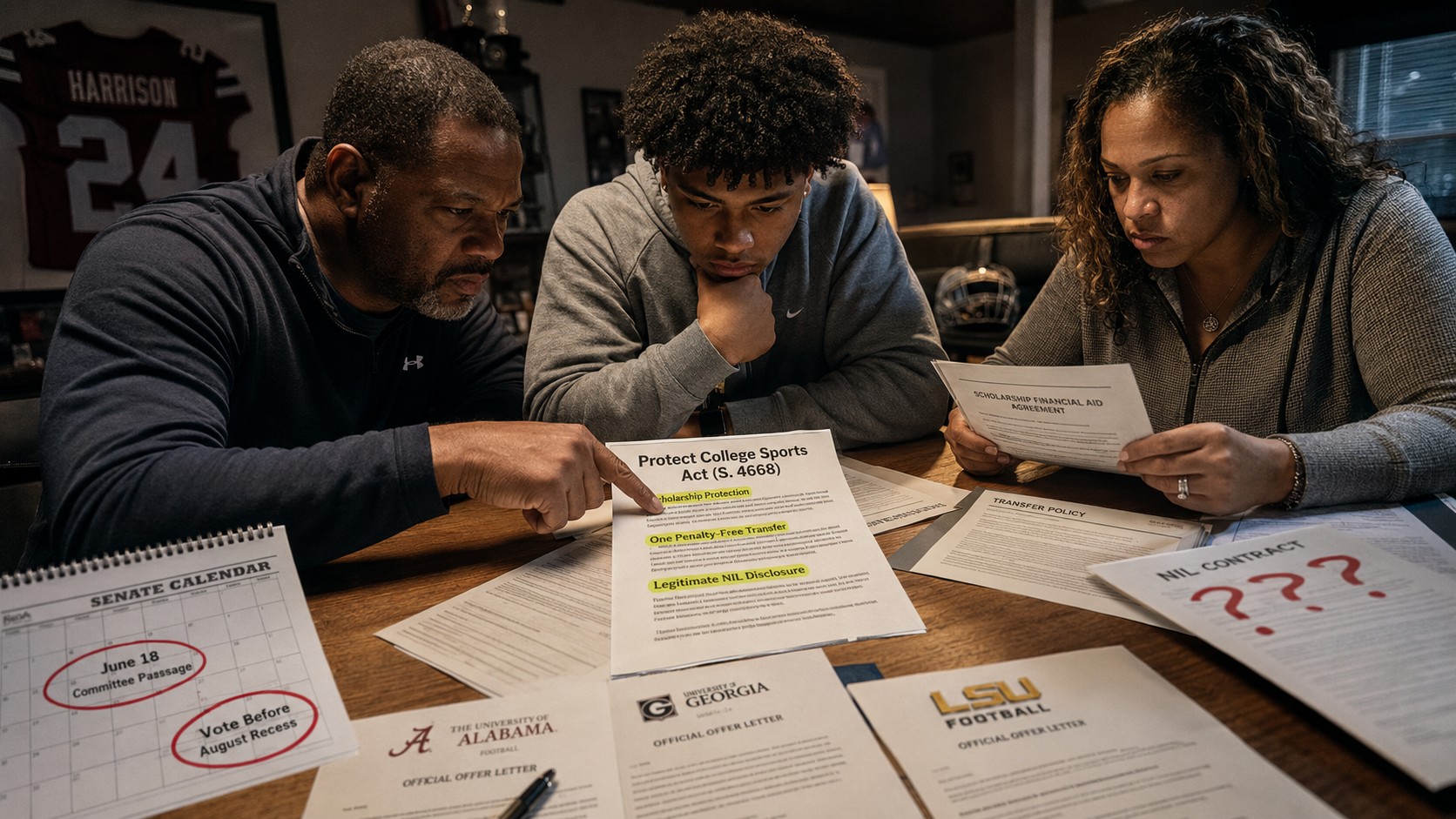
The Protect College Sports Act (S. 4668) passed the Senate Commerce Committee 19-9 on June 18, 2026, and now sits on the full Senate floor. Sponsors are pushing for a vote before the August congressional recess. The bill requires 60 votes to advance, a threshold that makes passage uncertain but not impossible.
The bill is not law. What it represents is the clearest signal yet from Congress about how it wants to structure the regulatory environment around college athletics. For families currently navigating offers, the specific provisions are worth understanding regardless of timing.
The scholarship protection provision
Under the current framework, a scholarship can be reduced or pulled for reasons that are not always transparent to a family at the time of signing. Program policy, roster dynamics, and coaching changes create ambiguity.
The Protect College Sports Act would change that. The bill would prohibit institutions from revoking or reducing athletic scholarships based on performance, injury, or roster decisions. It would also mandate medical expense coverage during participation and for five years after eligibility ends.
If it passes, this becomes federal law, not a school's stated policy or a conference rule that programs can maneuver around. For a family currently reviewing a financial aid agreement, that distinction carries real weight.
The transfer provision
The bill would codify a specific structure for transfers: one penalty-free transfer, with a second transfer triggering a one-year loss of eligibility. Additional unrestricted transfers would be permitted only under defined circumstances, including if an athlete's sport is discontinued, a head coach departs, or in cases involving sexual assault or harassment.
Programs have increasingly pitched the transfer path as a flexible, expected part of the college football journey. This legislation would put a specific cost on the second move. A family that understands this provision reads that pitch differently.
The NIL and agent provisions
The bill would require athletes to disclose NIL agreements above $600, and would give the NCAA and the College Sports Commission authority to reject third-party NIL deals that lack a valid business purpose. Agent fees would be capped at 5% of endorsement contract value, with agents required to register in a publicly searchable database.
The bill's sponsors drew a deliberate line in its framing: "Real NIL is not the same thing as a disguised recruiting payment." That language matters. It signals that Congress views a portion of current NIL activity as compensation masquerading as business, and intends to address it with statutory authority.
What families should take from it now
The Protect College Sports Act is not law. The 60-vote threshold in the Senate is a real barrier, and House passage remains a separate step after that. The timeline is genuinely uncertain.
But the provisions in this bill are not emerging from nowhere. They reflect the direction federal regulators, compliance offices, and courts are already moving. The standard this legislation would establish, on scholarship protections, on the cost of a second transfer, on what qualifies as legitimate NIL, is increasingly the reference point behind every conversation families are having about offers.
Understanding where the regulatory floor is heading is not about predicting a Senate vote. It is about making more informed decisions in a process that is still settling.