

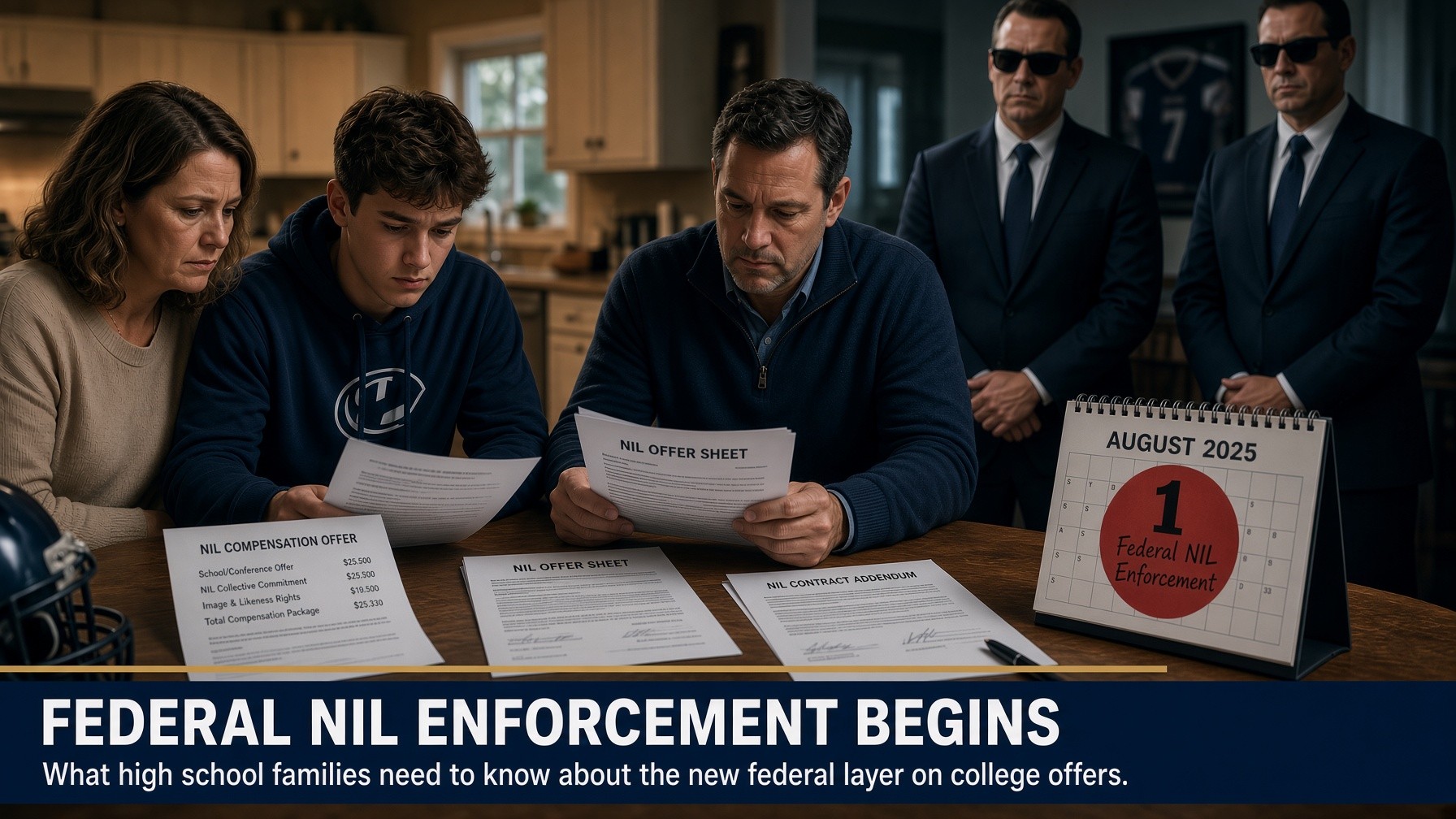
A second oversight layer took effect August 1
For most of the current recruiting cycle, the primary mechanism reviewing NIL and revenue-sharing compensation has been the College Sports Commission clearinghouse. The CSC evaluates deals above certain thresholds to assess whether they reflect fair market value. That process is ongoing.
On August 1, a federal enforcement framework joined it. Executive Order 14400, signed in April, directed the Federal Trade Commission and other federal agencies to establish and begin enforcing standards for NIL practices at federally funded institutions. The operative provisions took effect eighteen days ago.
What the federal standard covers
The order defines a category of improper financial activity that includes compensation exceeding fair market value when that compensation is tied to athletic participation. It also prohibits the use of federal funds for NIL or revenue-sharing payments.
That second point clarifies something families should already understand: the revenue-sharing pool distributed by programs (roughly $20.5 million per school in the current cycle, rising to approximately $21.3 million for 2026-27) is drawn from institutional revenues. Media rights, ticket sales, and conference distributions fund these agreements. Federal grant money does not.
The enforcement standard for what constitutes proper compensation now carries federal weight, not just clearinghouse review.
What changes for families evaluating offers this fall
The practical change is one of consequence, not process.
The CSC clearinghouse is a private body created through the settlement framework. Its review is internal to college athletics. Federal enforcement brings a different category of risk: institutional federal funding eligibility. A program that structures compensation improperly now faces exposure that extends beyond athletics governance.
For families, this does not change what they should ask when a program describes its compensation structure. The right questions remain the same: Is this structured through the institution's revenue-sharing agreement, through a third-party NIL arrangement, or a combination? Is the number guaranteed or performance-contingent? Has it been reviewed?
The enforcement environment makes those questions more important to ask, and gives families more context for why programs are likely to be careful about how they answer.
The distinction that still matters
The federal framework creates clearer separation between revenue-sharing compensation (institutional, reviewed, and subject to the cap) and third-party NIL activity, which continues separately but now faces federal scrutiny alongside CSC review.
For a family sitting across from an athletic department representative this fall, understanding which pool a compensation number is drawing from is more relevant than it was a year ago. Revenue-sharing agreements come through a more structured channel. Third-party arrangements involve different parties, different review timelines, and now different federal exposure.
Asking which pool a number comes from is a reasonable question. It is also a more informed one.