

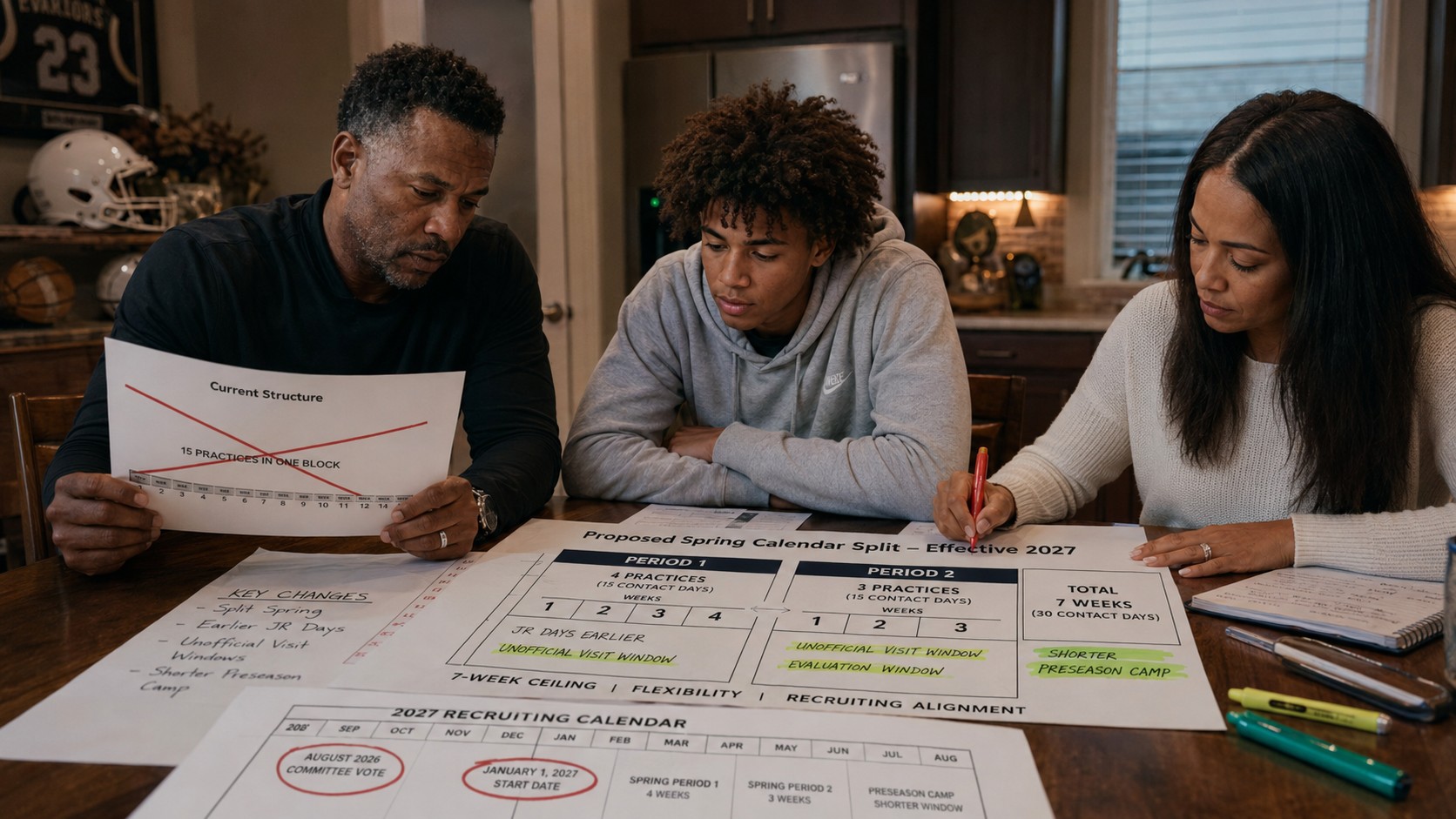
On June 24, the NCAA Division I FBS Oversight Committee introduced a proposal that would replace the current spring practice structure with a new out-of-season activities model. The committee's vote is scheduled for August 2026. If approved, the changes take effect January 1, 2027.
What the committee has proposed
Under the current rules, programs get 15 spring practices conducted over 34 days. The proposed model would give programs 21 on-field practices distributed across two distinct periods, with a combined ceiling of seven weeks and neither period exceeding five weeks. Preseason training camp would also shrink: from 25 practices over 31 days to 21 practices over 27 days.
These proposals are part of a broader package the FBS Oversight Committee introduced in June, which also includes shortening the winter transfer portal window from 15 days to 10 days beginning the first business day after January 1. The full package goes to a final committee vote in August.
What the split changes about the recruiting calendar
The current spring practice format runs as a single concentrated block, typically April through early May, anchored by a spring game that has long served as an unofficial visit and junior day destination for prospects. The two-period model restructures that entirely.
Instead of one spring window, programs would run two distinct practice periods with a combined ceiling of seven weeks. The most likely pattern is a first period in spring and a second in early summer. Junior days, evaluation camps, and unofficial visit weekends that have historically clustered around the spring game may spread across both windows, which changes the rhythm families should expect during a prospect's sophomore and junior years.
The preseason camp reduction adds another dimension. With four fewer practices and four fewer calendar days before the season, coaches are more compressed on their own roster evaluation when August arrives. That places additional value on what they observe during the spring and summer, including visits, camps, and film review, because there is less time to adjust once fall camp starts. For prospects, the evaluation that happens before August matters more, not less.
What it means for a family planning ahead
For 2028 and 2029 families beginning to think about the recruiting calendar, the practical guidance is to plan for earlier and more distributed evaluation windows. If the two-period model passes, programs will likely run evaluation events and junior days in both the spring and early summer. Waiting for the traditional spring game weekend may mean missing an earlier opportunity.
Some patience is warranted. The August vote has not happened yet, and if approved, the first class navigating this new calendar will be 2028 prospects during the spring and summer of 2027. Programs will still be calibrating how they structure each period, and variation by conference and institution is likely.
The broader signal is consistent with other changes the committee introduced in June: a shorter preseason camp, a compressed portal window, two spring periods instead of one. For families navigating recruiting in 2027 and beyond, the pace of the process is not slowing down.