

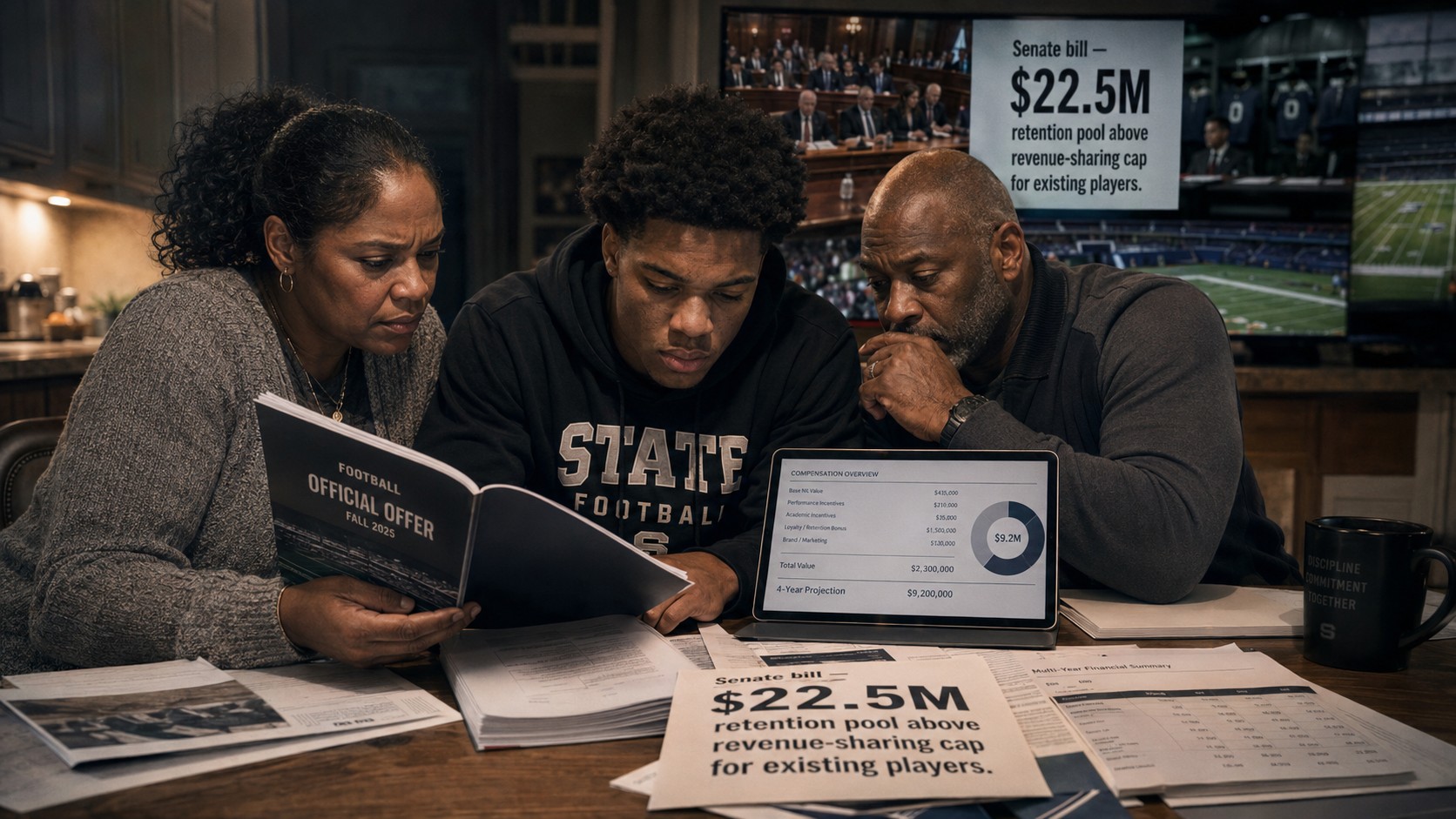
Congress is currently considering a reworked version of the Protect College Sports Act that would add up to $22.5 million in a designated retention pool above each program's existing revenue-sharing cap. The revised provisions were released July 28. As of July 31, both the Big Ten and SEC have signaled conditional support, and Senate Majority Leader John Thune is expected to call the bill for a floor vote before the August congressional recess.
What the retention pool does
Under the current framework, FBS programs can share up to approximately $21.3 million per year with athletes across all sports. That cap applies to all players on the roster, incoming and returning alike.
The retention pool is separate. It would function as an additional budget that programs could use specifically to pay athletes already on their rosters to stay. The pool is not available for new recruits. Of the $22.5 million, an additional $5 million would be designated for women's sports and non-revenue programs.
The distinction matters because the two budgets serve different purposes. The base cap covers what programs offer incoming players. The retention pool is for keeping established players from entering the transfer portal.
What this means for a recruit's place in the budget
For a high school athlete evaluating offers this fall, the relevant number is still the base revenue-sharing pool. The retention pool does not apply to anyone who has not yet enrolled.
But the existence of a separate retention budget does change how programs think about their base pool allocations. A program spending heavily on veteran retention has a different financial posture than one building primarily through the recruiting class. Families comparing offers should understand that the total compensation picture at a given school may have at least two distinct layers: what is offered to new recruits from the base pool, and what is being directed toward keeping existing players through the retention fund.
Neither number is necessarily public. But asking where a program invests its total compensation budget is a reasonable part of evaluating an offer.
A provision that affects recruits directly
The reworked bill also includes a prohibition on compensating high school athletes before they enroll at a college program. This applies across revenue sharing, NIL, and any retention pool alike.
That provision clarifies the boundary: recruiting conversations can include projected compensation figures, but no dollars move until enrollment. It also reduces the pressure on families to treat an offer as binding based on financial terms that, by law, cannot be delivered before a player is on campus.
Where things stand
As of this writing, the Protect College Sports Act has not been voted on. Its passage would require action before Congress's August recess. If it does not pass in this window, the legislative timeline resets.
The specific numbers in the bill, including the retention pool cap, could still change before any final vote.
Families in active offer discussions this fall should treat the retention pool as an emerging framework, not settled law. Understanding how programs are beginning to think about separating veteran retention from new-recruit compensation is useful context regardless of whether this particular bill reaches a final vote.