

What changed this week
Senate Majority Leader John Thune scheduled a floor vote on the Protect College Sports Act for September 14, the day Congress returns from its summer recess. The bill cleared the Senate Commerce Committee in June with bipartisan support. It stalled on the floor in August when competing legislative priorities and a last-minute surge of amendments crowded out a vote. The procedural delay is now resolved. The political question is not.
What the bill would actually do
The legislation would raise the school-level revenue-sharing cap from $21.3 million — the current ceiling under the House v. NCAA settlement — to $48.8 million per school annually. It would also restrict third-party NIL arrangements negotiated through multimedia rights companies, a structure families regularly encounter when a program presents a full compensation offer. Independently-negotiated, organic NIL deals — a local sponsorship, an athlete's own brand relationship — would remain permitted under the bill.
Those two provisions pull in opposite directions. A higher cap means more school-controlled compensation available per athlete. Restricted third-party NIL means less of a headline number would flow through outside sources. Whether the net result is more or less compensation depends heavily on how a specific program has structured its current offer.
What happens if the vote goes either way
Passage is not guaranteed. The bill needed 60 Senate votes to avoid procedural delay, and that threshold was shaky in August. Opposition from both the Congressional Black Caucus and several Senate Republicans from SEC states has not fully resolved.
If the Senate passes it, the House presents additional obstacles before anything changes. If the bill fails entirely, conference leaders have signaled two contingency paths: legal action to modify the House v. NCAA settlement framework directly, or a self-governance arrangement that would allow major conferences to operate outside NCAA compensation rules.
Neither path resolves quickly. The current regulatory environment — House settlement terms, federal NIL enforcement, and school-level revenue-share agreements — remains the operative framework for any offer a family receives this fall.
What families evaluating offers should do with this information
Families in active fall recruiting — attending official visits, processing verbal offers, working through compensation conversations — are making decisions inside a regulatory environment that may shift before February.
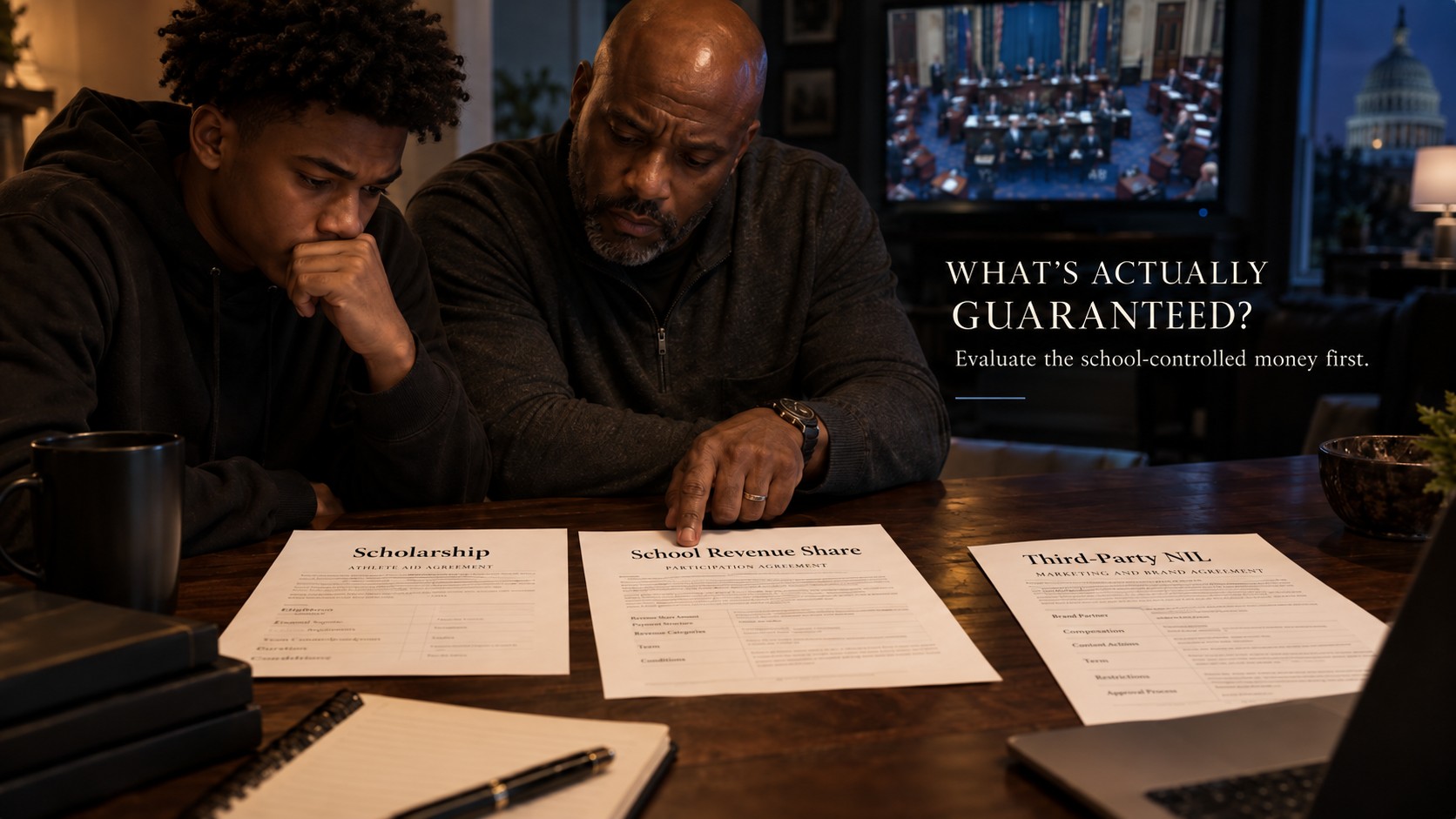
The practical guidance is not to pause for Congress. It is to understand that compensation figures tied heavily to third-party sources carry more variability than school-controlled revenue share, regardless of how the vote resolves.
Evaluate an offer by its school-controlled component first: the scholarship, the institutional revenue-share figure, and the program's support structure. Treat any third-party NIL as variable and confirm arrangements in writing before they factor into a commitment decision. That framework is sound whether the legislation passes this fall or not.