

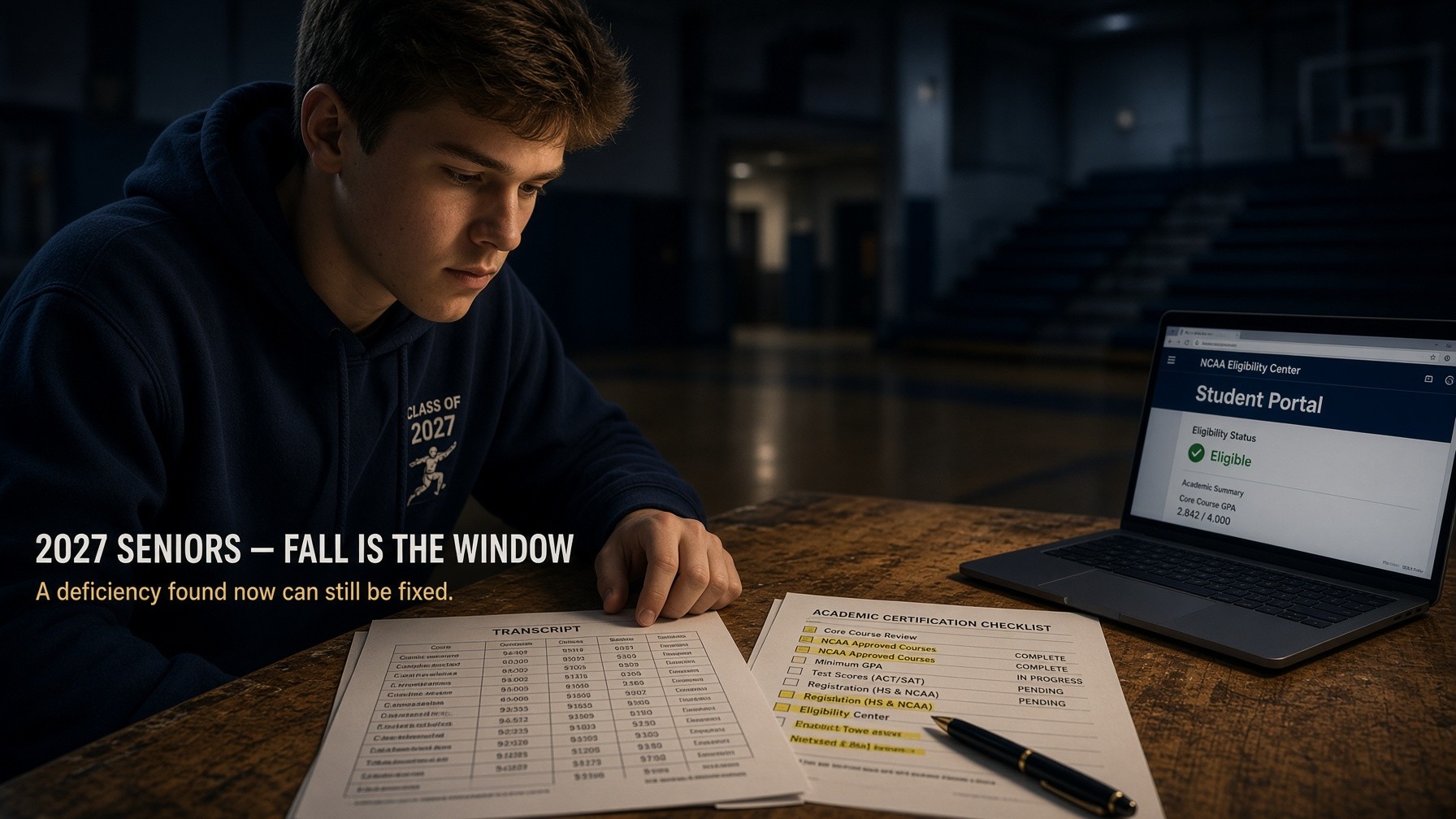
The academic process runs on its own clock
The recruiting process (film evaluation, camps, coach communication, visits) gets most of the attention. The NCAA Eligibility Center process runs alongside it, on a separate timeline, with requirements that cannot be accelerated when time is short.
For a 2027 senior who returned to school this fall, three things need to come together before a scholarship can be fully processed: registration with the Eligibility Center, an academic record that meets Division I initial eligibility standards, and amateurism certification confirming the athlete has not crossed into professional status.
None of these happen automatically. And none of them are resolved by the athletic evaluation process.
The core GPA is not the same as the school GPA
Division I requires a minimum 2.3 core course GPA. That GPA is calculated exclusively from the NCAA's list of approved core courses, not from the full high school transcript.
An athlete with a 3.2 overall GPA who loaded electives into the schedule during freshman and sophomore year may find the core GPA is meaningfully lower. Classes that appear academic on a school transcript (certain electives, courses below the required math threshold, or courses not approved by the Eligibility Center for that specific high school) do not count toward the core GPA.
The Eligibility Center publishes each high school's approved course list. Families who have not cross-referenced their athlete's transcript against that list should do so now, while the senior course schedule can still be adjusted.
The 10/7 checkpoint and what it means in September
Division I requires 16 approved core courses total. Before the start of senior year, athletes are expected to have completed 10 of those 16. Seven of the 10 must be in English, math, or natural/physical science.
September is the moment to verify that benchmark was met. If a course was miscategorized, if a required math class did not meet the Algebra 1 threshold, or if one of the required lab sciences is still incomplete, the senior schedule can still be modified, but the window is narrow.
By December, when the early signing period opens, the fall semester is nearly finished. Issues that surface in January are rarely recoverable before national signing day in February.
What families should confirm before October
The steps are specific:
- Confirm the athlete is registered with the NCAA Eligibility Center
- Submit the junior year transcript to the Eligibility Center if not already done
- Verify the senior course schedule includes enough approved core courses to reach 16 total
- Confirm the core GPA (calculated from approved courses only) is at or above 2.3
- If the athlete has entered into any NIL arrangements during high school, confirm those have been disclosed and reviewed as part of the amateurism certification
The Eligibility Center offers a preliminary certification review. Requesting that review now, rather than waiting for the confirmation that comes after graduation, is the more cautious approach.
A scholarship offer extended verbally in the fall still requires academic certification to be processed formally. For families focused on the football side of recruiting, the academic track can move quietly in the background until it doesn't.