

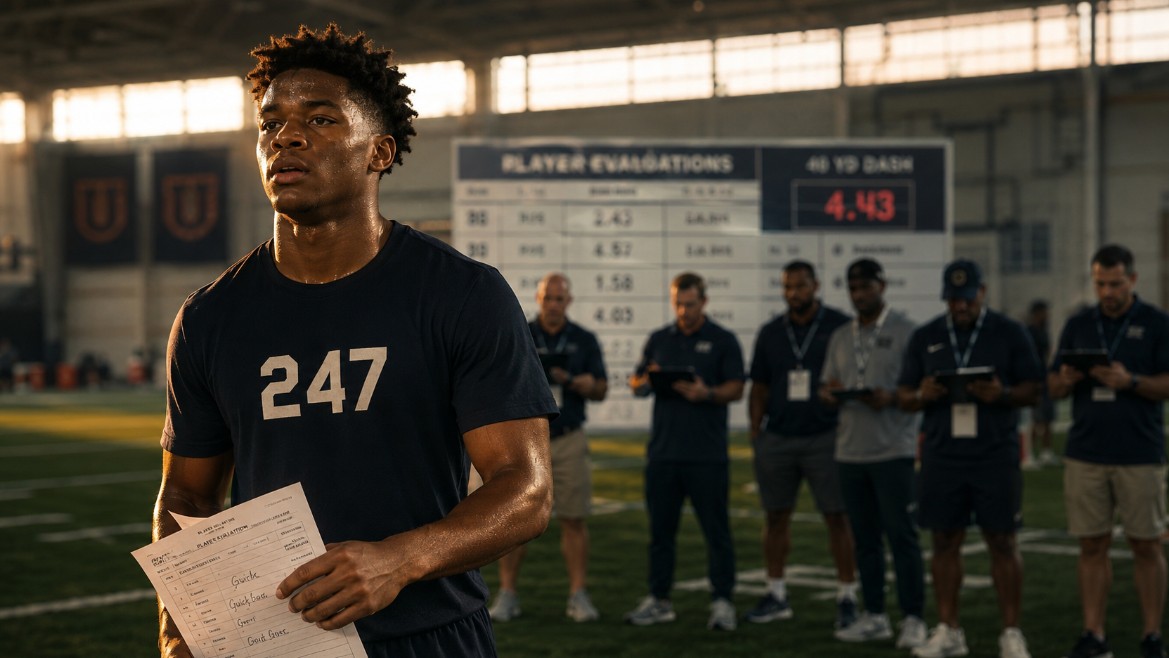
On a June Saturday, a few hundred kids in shorts and cleats spread across a college practice field while a row of position coaches stand behind stopwatches and clipboards. A rising junior runs a clean shuttle, hears a coach read his time out loud, and decides the day is won. The coach who timed him has already looked back down at the field. The number went in a column. It was never the point.
The stopwatch is the first question, not the answer
June is the busiest in-person evaluation month in college football. It is the stretch where the most staffs are on campus, the most camps are running, and the most prospects get watched live instead of on film. That access is the whole reason camps exist. A coach would rather run his own stopwatch than trust a number a family typed into a recruiting profile, so the first thing most camps produce is a set of verified measurables: height, weight, and a hand-timed forty that the staff captured itself.
But the measurable is a filter, not a verdict. It tells a coach whether to keep watching, and that is close to all it tells him. What he is actually studying is harder to put in a column. How does the kid move when he has to change direction. Does he bend, or does he round everything off. Take a coaching point at the first station, and does it show up two reps later, or did it disappear the moment the drill changed. Coaches have a quiet phrase for the player who tests like a star and plays like a backup, the shorts-and-a-t-shirt athlete, and every staff has been burned by one. The opposite kid exists too: average on the stopwatch, undeniable once the drill turns competitive. The staff that trusts its eyes over its clock is the one that finds him.
What a camp can flatter, and what it cannot fake
Every position reads differently in shorts. I played quarterback, so I will start there. Arm talent and a clean release show up at a camp inside of ten throws. What does not show up is the part of the position that actually decides games: how a kid processes, how he moves inside a pocket that is collapsing, what he does on third down when the picture is muddy and nobody is open. None of that lives in a camp setting, which is exactly why a staff that loves your son's arm in June still wants his fall tape before anyone gets serious. The throw was the easy part to evaluate. The hard part only exists on Friday nights.
It runs the other way at other spots. An offensive lineman can look clean at a camp where he never has to put his hands on a defender who is trying to embarrass him, but get-off and hand placement are hard to fake, and a good line coach sees both inside of a few reps. Change of direction and ball skills travel from a camp to a game. Production against air does not. The shift across the sport toward live evaluation, coaches comparing prospects in real time rather than trading film, is real, and it has made June matter more. It has not made a camp the whole picture. It made it one clean slice of a kid's football life, taken under the best possible lighting.
Why families read the camp wrong
Here is the gap I see most often. A family treats a strong camp number, or a friendly conversation with a position coach, as the finish line. The staff treats the same morning as the opening of a file. What actually moves a coach is rarely the thing the family is celebrating. It is the rep after the mistake. The body language when the kid gets beat in a one-on-one. Whether he coaches himself between reps or waits to be corrected. Those are the notes that get written down, and families almost never see them, because they happen in a conversation coaches have with each other on the drive home, not with the parent in the parking lot.
That is the part worth remembering as June winds down and the on-campus evaluation window closes for the summer. The number you can see is the one the staff weighs least. So the question for your family is not whether your athlete had a good camp. It is this: was he evaluated this month as an athlete, or as a football player, and do you actually know the difference between the two?