

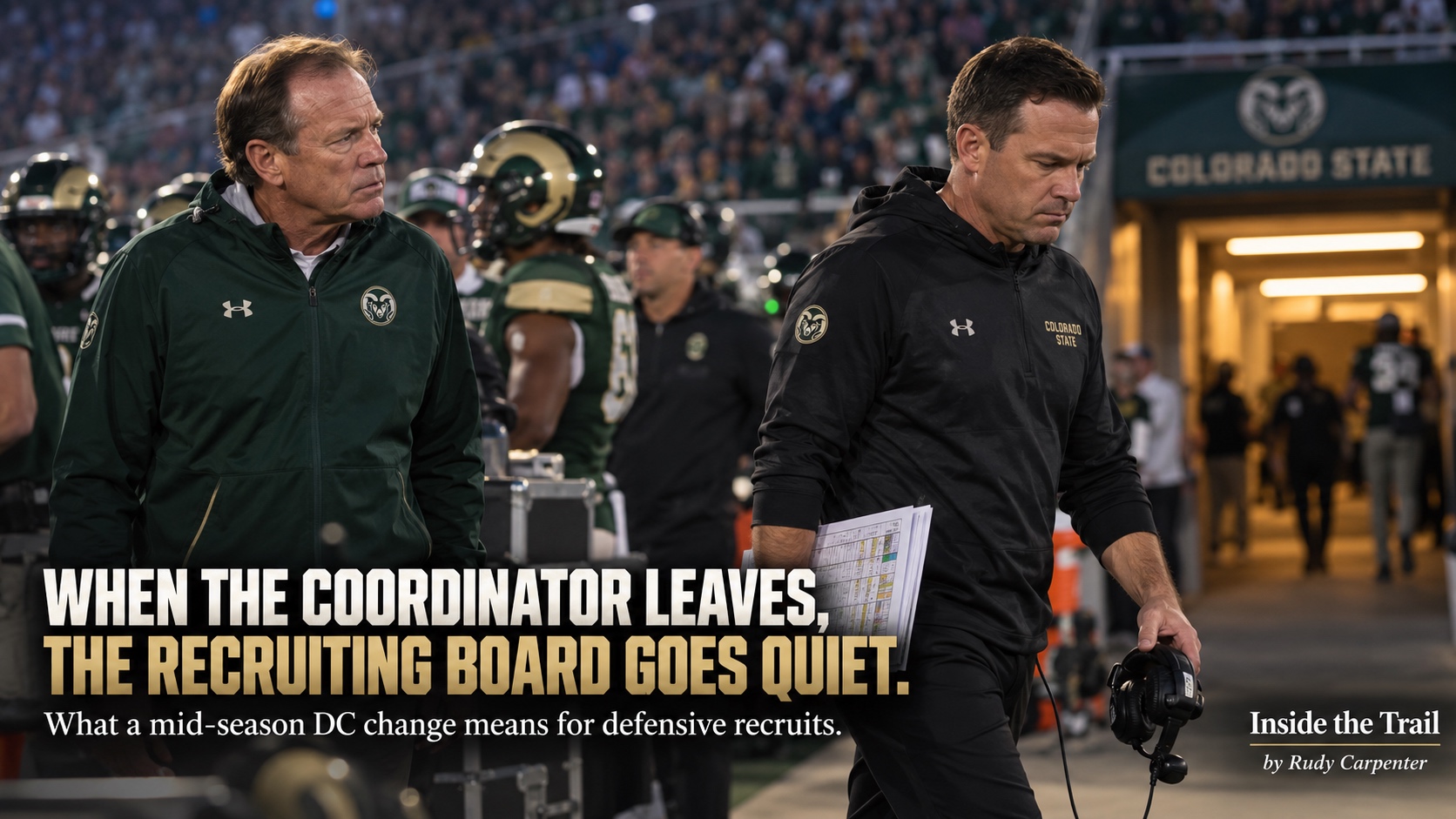
Two defensive coordinators left their jobs inside a seven-day window this week. Illinois parted ways with Bobby Hauck after four games, and Colorado State's Tyson Summers was relieved of his play-calling duties mid-game Saturday before leaving the sideline on his own. Both departures landed in early October, which puts them squarely in evaluation-only territory on the NCAA calendar. Coaches can attend games and watch film on prospects. They cannot initiate contact.
That timing matters. A coordinator departure in October does not pause cleanly. For families whose athletes are in those programs' defensive pipelines, the next few weeks will likely feel quieter than the months before. That quiet has a specific cause, and understanding it puts families in a better position than assuming the silence means disinterest.
The position coaches under a fired coordinator are the ones to watch
When a defensive coordinator leaves mid-season, the defensive position coaches under him immediately enter a holding pattern. The linebackers coach, the secondary coach, the defensive line coach: none of them know right away whether they are staying in their current roles, being asked to absorb new responsibilities, or being shown the door.
The coach who was most actively recruiting your athlete, the one who called after the summer camp and started building a real relationship, may go quiet for a few weeks not because the interest in your athlete changed, but because he is working through his own situation first. The recruiting conversation does not get handed off cleanly. It stalls.
I talked to a defensive position coach last year at a program that had been through a mid-season coordinator change. He described the six weeks after the firing as the most difficult to manage from a recruiting standpoint, not because the school lost interest in the kids they were pursuing, but because no one could speak confidently about the defensive scheme going forward. Scheme matters more than most families realize at that point in a recruitment. A linebacker recruited to fit a base four-two-five looks different to a coordinator building a two-gap front than to one installing a high-safety quarters system. When the scheme is unsettled, evaluating recruits against it goes on hold.
Why the board goes quiet, and what that silence actually signals
There is a reason programs rarely make new defensive commitments during a coordinator transition. The offensive staff can keep working without interruption. The quarterback coach is still calling quarterbacks. The tight ends coach is still building relationships with tight ends. That side of the roster does not pause.
On defense, there is a window where no one quite owns the board. At Illinois, Bret Bielema elevated Roger Cooper to handle play-calling after Hauck's departure. Cooper knows the players already in the building. He will develop opinions about which incoming recruits fit the direction he wants to take the defense. But that process takes time, and communicating it outward, to staff, to families, to recruits themselves, takes more.
In October, with no in-person contact permitted, that communication travels slowly. A coordinator who departs in September or early October loses the chance to meet with uncommitted prospects before the dead period in December. His replacement has to rebuild those recruiting relationships inside the same narrow window, without the ability to sit across from a family and explain the new defensive vision in a room.
The question families in a defensive pipeline should be asking right now
If your athlete is a defensive player being recruited by a program that just lost its coordinator, the question worth asking is not whether the school still wants him. In most cases, the answer at the prospect level stays the same. The more useful question is: which coach built that interest, and how settled is that coach's future at this program now?
When the position coach who had been recruiting your athlete reaches out in the next week or two, that call carries more weight than it would have two months ago. A coach checking in after his coordinator just left is telling you something: that the relationship with your athlete is strong enough to maintain even in the middle of internal uncertainty, and that he expects to be part of whatever comes next. That kind of contact is worth more than a form text.
If the calls stop entirely, that is different information. It does not always mean the school has moved on. It might mean the position coach's own future is genuinely unsettled. A pattern of silence from a program that was previously active is a signal worth paying attention to, not a reason to panic, but a reason to stay engaged and ask direct questions when the contact window reopens.
Mid-season coordinator changes happen roughly a dozen times per year across FBS. Most programs navigate them without losing the prospects they were most serious about. But the transition period is real. Families who understand why the recruiting conversation slows down are in a better position to wait it out than those who read the pause as a cold shoulder.
Is the position coach who was most invested in your athlete's recruitment still on staff, and has he been in touch since the change?