A large market, with active enforcement
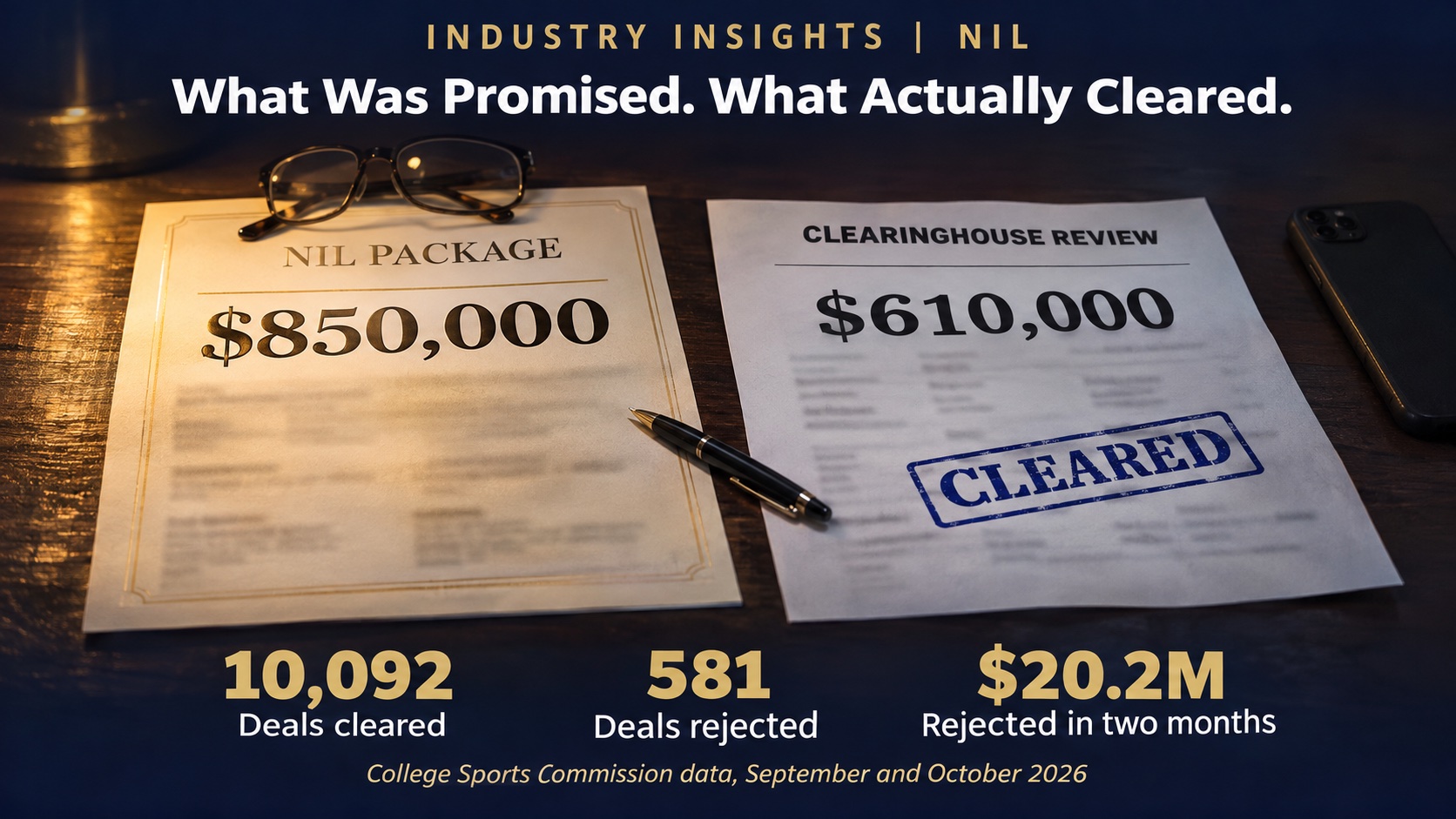
The College Sports Commission's NIL Go platform cleared 10,092 deals worth $192.62 million during September and October 2026, the most active two-month period since the clearinghouse launched in June 2025. During that same stretch, 581 deals worth $20.21 million were rejected.
That rejection rate (roughly 5 percent by deal count, closer to 10 percent by dollar value) is not random noise. According to the Commission's release, submissions are increasingly involving clarifications about funding sources, particularly school money routed through third-party sponsors without genuine business motives.
In plain terms: the system is catching programs that attempt to disguise institutional money as independent NIL activity.
What gets rejected and why
Under the House settlement, schools can share up to $21.3 million directly with athletes this year. That money flows directly from the institution and does not require NIL Go clearance.
Third-party NIL deals do require clearance. The standard is straightforward: does the paying party have a genuine commercial reason to compensate the athlete? A real marketing deal passes. A school-funded entity with no independent business purpose does not.
The rejected deal data points to programs attempting to exceed the revenue-share cap by moving institutional money through connected entities. The clearinghouse is enforcing against this. At $20 million rejected in two months, the practice is not rare.
What this means when a program presents an offer
When a program presents an NIL package during the recruiting process, families typically see a total figure. That figure usually blends two distinct things: revenue share (the direct institutional payment, capped and disclosed) and third-party NIL (arranged through external partners, subject to clearance).
Revenue share is direct. It comes from the institution, sits under a disclosed cap, and clears no additional review. Its terms still matter, including whether it is guaranteed or conditional on roster status.
Third-party NIL depends on what the clearinghouse approves. The Commission's data suggests a meaningful portion of what programs promise in that column is not surviving review. The right question for families is not how much a program is offering in total NIL, but what that program has actually cleared and paid over the past twelve months.
The distinction that matters before signing
This is not a reason to avoid programs that lead with strong NIL packages. The clearinghouse is functioning. Legitimate third-party deals are clearing at scale. Revenue share is real and growing.
The issue is the gap between what programs offer in recruiting conversations and what they can reliably deliver. That gap is now measurable, because the Commission is publishing the data.
Families who understand the difference between revenue share and third-party NIL (and ask specific questions about what a program has actually paid rather than what it has promised) are in a meaningfully better position when evaluating the financial dimension of a commitment. With signing day fewer than three weeks away, that distinction is worth getting clear before the conversation becomes a decision.