

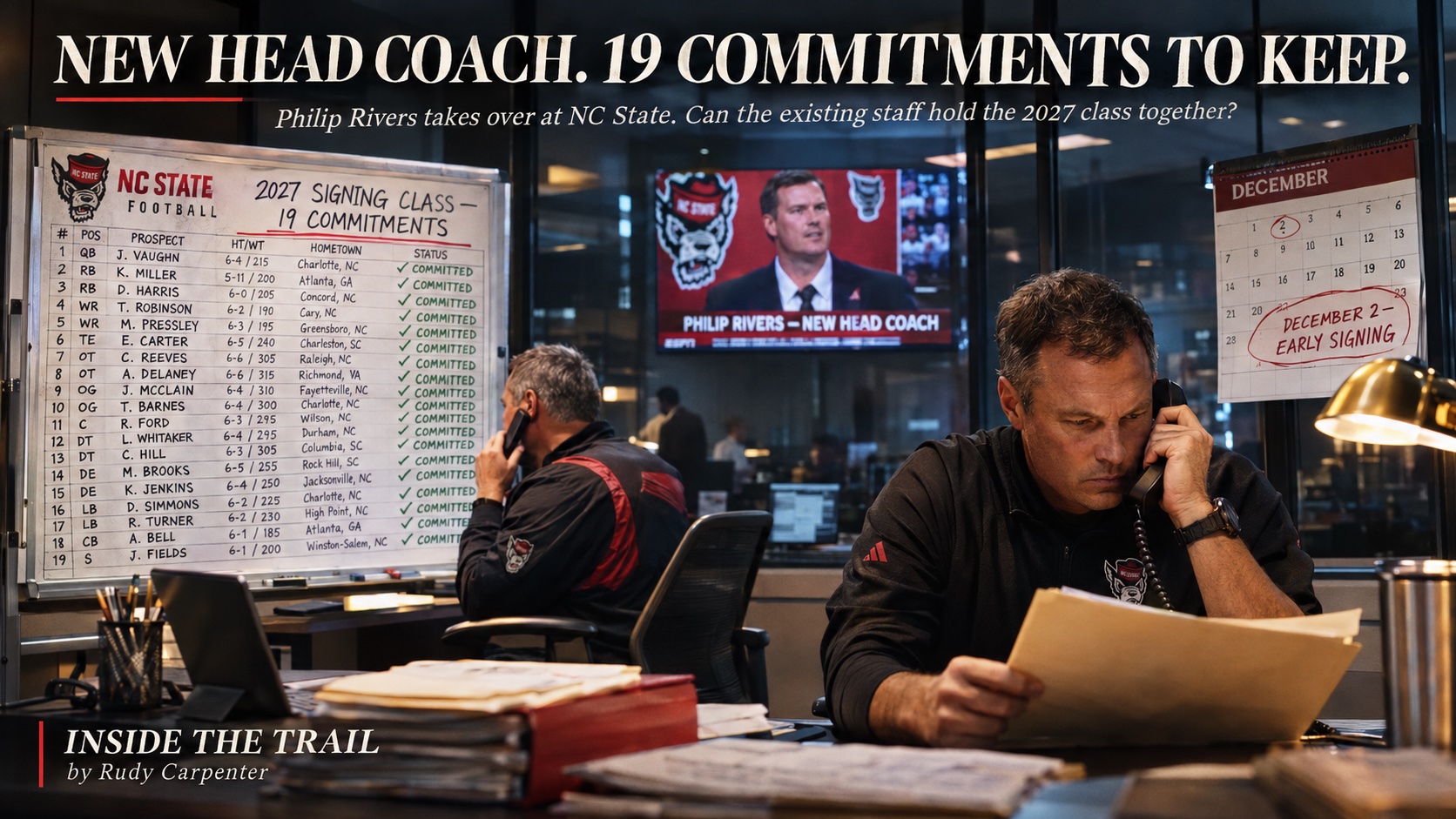
There are two stories happening when a head coach gets hired in mid-November. The one on the press release is about vision and culture and momentum. The one happening inside the building, at the same time, is about nineteen phone calls that need to get made before the press conference is over.
Philip Rivers was introduced as NC State head coach on November 13. The hire was approved by the Board of Trustees after a five-year deal at $3.25 million annually was finalized. His son Gunner, a four-star quarterback in the 2027 class, committed to the Wolfpack in February. The class currently sits at 19 commits with a top-25 national ranking. Early signing opens December 2.
That is a narrow window. And understanding what actually happens inside a program during that window is the part most families never get to see.
The first priority is not new recruiting. It is retention.
When a head coach is hired in November, the position coaches who have been recruiting this class for the last 12 to 18 months are not waiting for direction. They are picking up the phone. Not to relay a message from the new staff. To tell their recruits, in direct terms, that they are still there and nothing has changed between them.
That relationship is the actual foundation of a verbal commitment. A recruit does not commit to a program in the abstract. He commits to a specific person: the coach who took his calls on a Sunday night, who showed up to his film session, who sat across from his parents and answered their questions without rushing out the door. When a transition happens in November, every committed player is working through one question quietly. Is that person still going to be there?
This is worth understanding before anything else. The head coach who just arrived may have an enormous name and an impressive playing career. The parents may be genuinely excited about what his brand brings to the program. But a commit who has been building a relationship with a position coach for two years is not primarily asking whether the new HC is impressive. He is asking whether his guy is staying.
The staff a new head coach protects first tells you something.
A new HC, especially one with no prior college staff experience, faces two pressures that push in opposite directions. He wants to build his own staff, bring in coaches he trusts from his own network, install his own system. At the same time, the position coaches already on that staff are the relationships holding his existing commitments together.
I talked to a coordinator last week who has been through two of these mid-November transitions. The description he gave both times was essentially the same. The new HC reviews the class, identifies which position coaches have the strongest relationships with the most important commits, and protects those coaches first, at least through signing day. The message, stated or implied, is that the staff will remain intact for early signing regardless of any longer-term changes.
The transition that fractures a class tends to happen one of two ways. Either the new HC moves too quickly to bring in his own people and position coaches leave before those relationships can be transferred. Or a position coach, sensing uncertainty, takes a call from another program and is gone before anyone can get ahead of it. That second scenario is harder to control and can unsettle a class faster than the original coaching change ever could.
The NC State situation has an unusual anchor worth noting. When a head coach own son is committed to the same class, the information asymmetry changes for every other recruit in that class. Rivers is not going to arrive and dismantle the relationships that helped bring his son future teammates to that program. The other 18 families can read that signal clearly. It does not guarantee every commit holds, but it changes the calculation in a meaningful way.
What to watch in the next ten days.
The dead period for FBS programs starts November 30. After that date, there are no in-person contacts, no campus visits, no recruiting conversations with new prospects. For families whose athlete is committed to a program navigating a coaching transition, the remaining contact window is roughly ten days.
The question worth asking in that window is not whether the new head coach seems capable. It is whether the coach who recruited your athlete is still going to be in that building in January.
A few signals matter here. Whether the new HC has stated publicly that the existing staff will remain through early signing regardless of longer-term plans is one. That announcement, when it comes, is designed to stabilize the class and it usually works as intended. Whether any position coaches on staff are appearing in news reports in connection with other openings is another. A position coach taking calls elsewhere during a transition is information a family can use.
If your athlete is committed to a program that just changed head coaches and the dead period is ten days away, the right move is a direct conversation with your position coach, not a waiting posture. Ask directly whether he expects to remain through signing day.
If no one has given your family a clear answer by November 29, what does that silence tell you about the decision in front of you?