

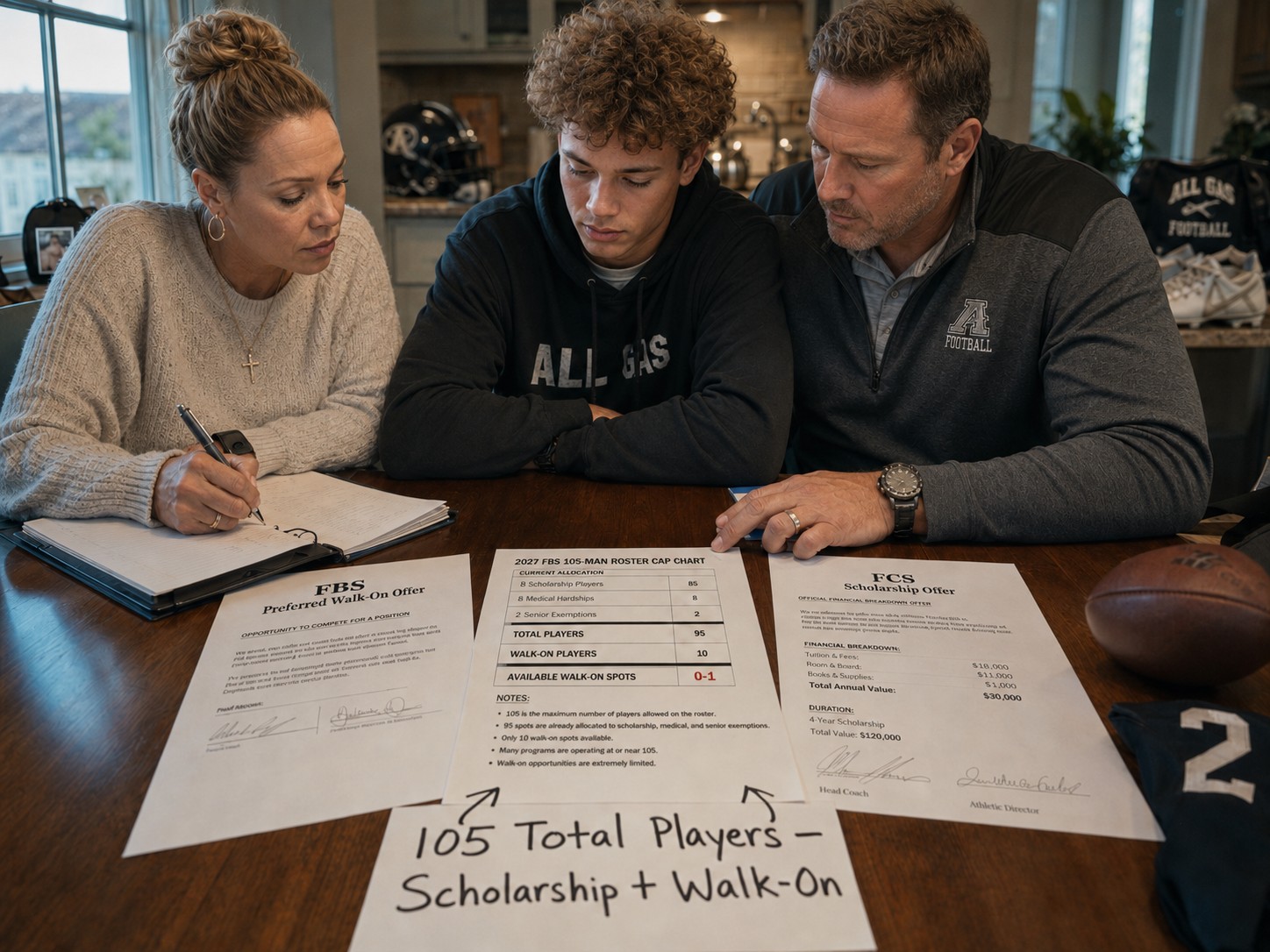
The 105-player roster limit took effect this season under the framework established by the House v. NCAA settlement. FBS programs that opt in can carry no more than 105 total players, scholarship and walk-on combined.
What the roster cap changed
That number matters because it represents a significant reduction from how programs have historically operated. Many FBS schools previously carried 140 to 150 players total when walk-ons were counted alongside scholarship athletes. That buffer absorbed depth players, developmental prospects, and athletes who came in on preferred walk-on arrangements with the expectation of earning a scholarship through performance and time.
The cap compresses all of that. Every spot on the 105-man roster now carries explicit value in a program's planning. Programs are not carrying extra bodies. They are building intentionally to a ceiling, and athletes who do not fit within that ceiling are not on the team.
What this means for the walk-on offer
The traditional walk-on model worked because programs had room to absorb development players. A coach could tell a family that the athlete should come walk on and earn a scholarship, and mean it, because the roster had space while the staff evaluated the athlete over time.
That flexibility is narrower now. With 105 spots shared between scholarship athletes and any walk-ons a program chooses to keep, programs are reducing non-scholarship roster members. The preferred walk-on slot, which once served as a realistic foot in the door, is more selective in an environment where every spot carries a real cost.
This does not mean the walk-on path is closed. But families evaluating a walk-on offer should understand that the implicit promise behind it, the belief that a scholarship will follow if the athlete performs, is being tested by a structure that leaves fewer spots available to make that happen.
The competition one level down has intensified
Displaced athletes have to go somewhere. Players who previously would have walked on at FBS programs are now pursuing scholarships at FCS, Group of Five, and Division II programs. That has increased the athletic quality of the pool those programs recruit from, and the scholarship offers they make are going to athletes who in prior cycles might have accepted a walk-on slot one level up.
The FCS scholarship model already produced a competitive environment. The influx of displaced FBS-caliber talent has added pressure to that market. Families evaluating an FCS or Group of Five scholarship offer should understand that those offers are now harder to earn than they were two or three cycles ago, even as the scholarship dollar amount may look similar.
The decision families are facing now
For a family comparing a walk-on offer from an FBS program against a scholarship offer from an FCS or Group of Five school, the conversation has changed.
A scholarship at any level provides roster security, financial support, and a place on the depth chart with a realistic path to compete. A walk-on offer at a higher level provides exposure and the possibility of a scholarship, in a roster environment with fewer spots available to make that promise real.
Neither decision is automatically correct. Program fit, the athlete's evaluated position on the depth chart, and the staff's genuine level of interest all matter. But families who have been counseled for years that walking on at a bigger program is the safer long-term path should reexamine that assumption against a structure that no longer operates the way it once did.