

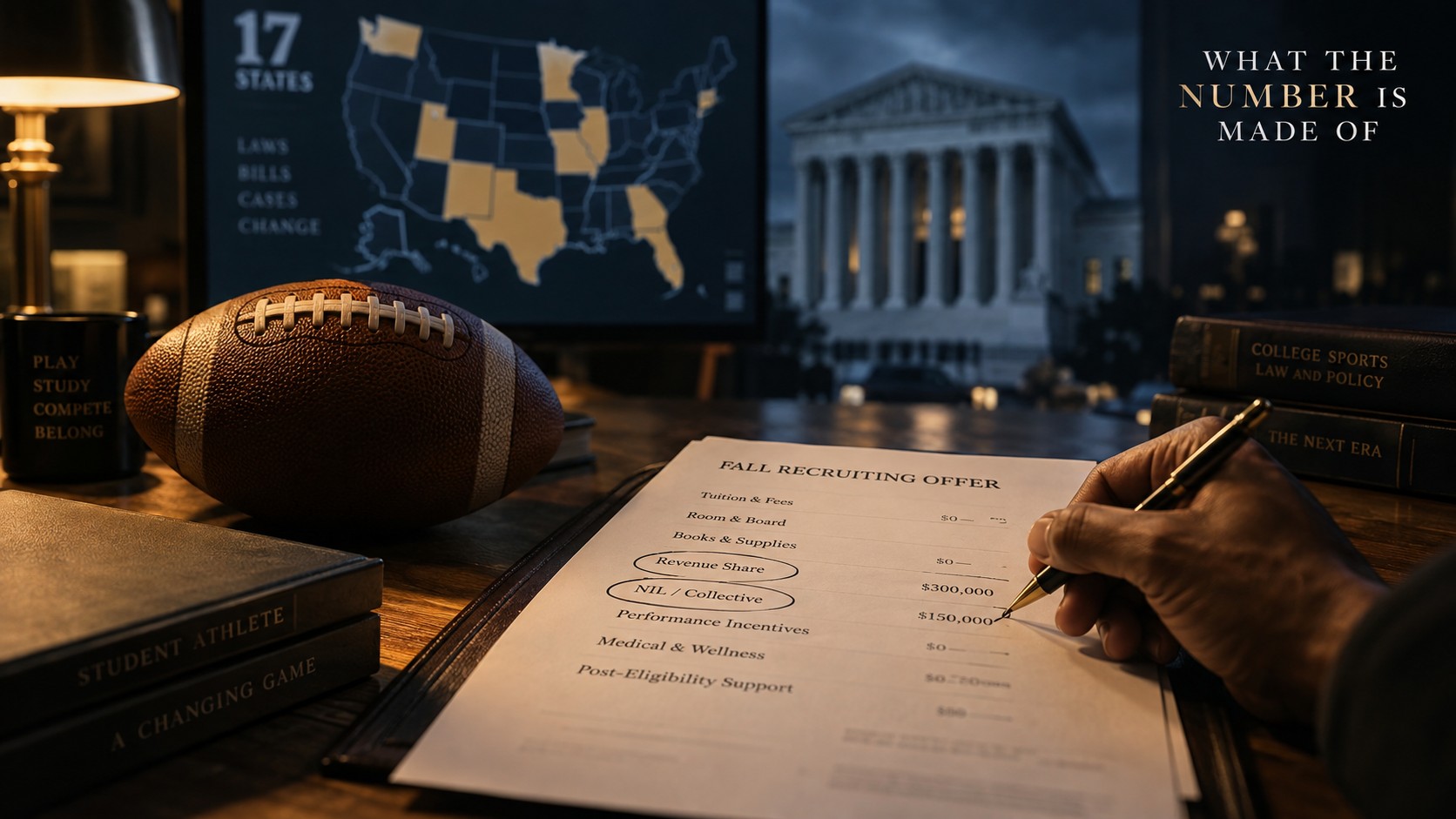
A federal challenge to how the settlement works
On June 9, 2026, two Division I football players filed a class action in the U.S. District Court for the Northern District of California. The plaintiffs, USC linebacker Talanoa Ili and Stanford quarterback Charlie Mirer, are not challenging the House v. NCAA settlement itself. They are challenging how it is being enforced.
Specifically, the complaint targets the $20.5 million annual revenue-sharing cap and the NIL Go clearinghouse. The plaintiffs argue that both mechanisms restrict compensation opportunities that state law in 17 states already protects. The complaint also challenges a clearinghouse rule requiring donor collectives to demonstrate a valid business purpose for NIL deals, a requirement the plaintiffs argue suppresses exactly the kind of third-party arrangements state law was designed to permit.
The 17 states and what is being contested
The states named in the complaint are California, Arizona, Connecticut, Maryland, Michigan, Mississippi, Nevada, New Jersey, New York, Ohio, Oregon, Pennsylvania, South Carolina, Tennessee, Utah, Virginia, and West Virginia. In each of those states, the plaintiffs argue, athletes hold NIL rights under state law that the House settlement's implementation effectively caps or restricts.
The plaintiffs seek an injunction halting clearinghouse enforcement in those states and lifting the revenue-sharing cap for schools in those jurisdictions. They are also seeking triple damages under federal antitrust law.
The case is before Judge Claudia Wilken, who approved the original House settlement and retained jurisdiction over disputes arising from its implementation. The defendants (the NCAA, the Power Four conferences, and the College Sports Commission) are expected to respond to the complaint in mid-September.
What families evaluating fall offers should understand
Programs presenting revenue-sharing numbers to recruiting families this fall are doing so under a cap that is actively contested in federal court. The $20.5 million ceiling may not represent the final word on what schools in these 17 states can pay.
For families, this is not a reason to delay decisions or to treat any offer as unreliable. Compensation discussions at this stage of recruiting are non-binding on both sides. But it is a reason to ask more precise questions: where the money originates, what conditions attach to it, and whether the figure comes from direct revenue-sharing, from a collective, or from a combination of both.
A number sourced from the school's direct revenue-sharing pool operates differently than a number sourced through a collective in a state with strong NIL protections. If the lawsuit succeeds, the ceiling on third-party collective deals in those 17 states could rise substantially. If it fails, the current framework holds.
The question worth asking before you evaluate any number
The revenue-sharing landscape in college football is being shaped simultaneously through legislation, litigation, and school-level policy. The Protect College Sports Act sits in the Senate. The California class action sits before a federal judge. Programs are presenting compensation figures against that backdrop every week.
Families who understand this context are in a better position to ask the right questions. Not how large the number is, but what the number is made of, and how stable the structure beneath it is. That question applies whether a family is evaluating a program in one of the 17 named states or anywhere else in the country.