
The College Sports Commission has publicly acknowledged that some programs are routing athlete compensation through entities with formal contractual relationships to the university. For families currently evaluating fall offers that include a third-party NIL component, that distinction is worth understanding before signing anything.
What an associated entity actually is
When a program describes a total compensation package, it typically draws from three sources: revenue-share from the school’s settlement allocation, school-sponsored NIL, and third-party NIL from outside the athletic department.
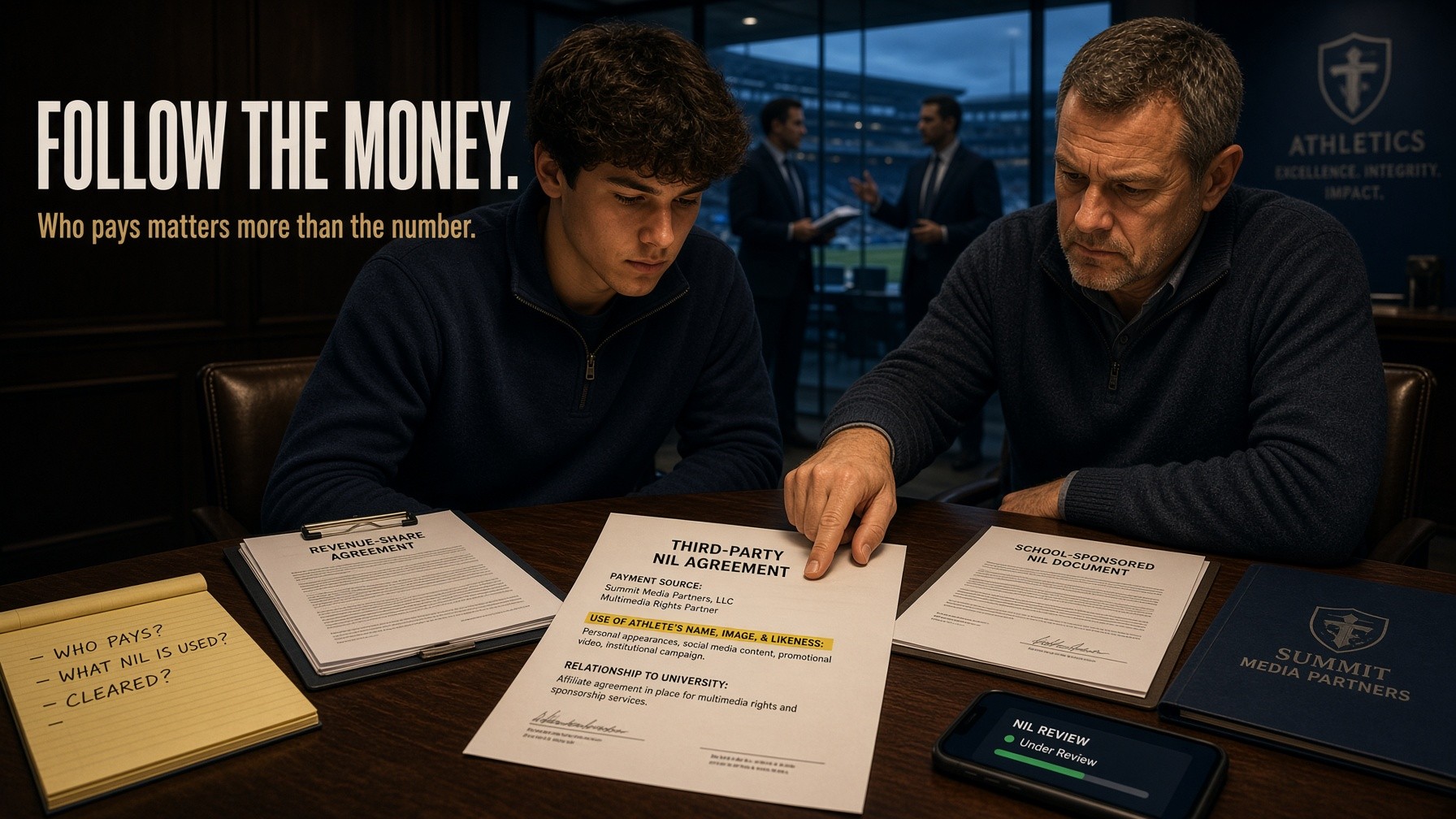
Not all third-party NIL originates from independent sources. Some comes from what the CSC calls an “associated entity”: a multimedia rights partner, a corporate sponsor, or an apparel company that holds an existing contract with the university. These companies have institutional relationships with the school. They are not independent of it.
The distinction matters because associated entity deals currently bypass the $20.5 million revenue-sharing cap established under the House settlement. Routing compensation through a third party with school ties allows programs to present a larger total number than their settlement allocation alone would permit.
Why programs structure packages this way
The House settlement limits how much a school can pay athletes directly. It does not cap what third parties can pay. Associated entities exploit that gap.
The CSC has reviewed hundreds of millions of dollars in third-party NIL arrangements since it began operations. Its leadership has acknowledged publicly that some compensation is structured to pass through entities with formal ties to the school while appearing as independent third-party activity. The CSC now applies stricter clearinghouse standards to associated entity deals than to genuinely independent arrangements.
That does not make these deals automatically invalid. It does mean that a “third-party NIL” estimate in a recruiting offer may represent something different than it first sounds.
What to verify before the conversation ends
The CSC enforces a specific standard: associated entity NIL deals must clearly identify whose NIL is being used and how. Arrangements where an entity pays an athlete without specifying the actual NIL activation are considered non-compliant. Any deal valued at $600 or more must be reported through the CSC’s NIL Go clearinghouse within five days of signing.
Families can ask three direct questions about any third-party NIL component in an offer:
- Is this payment from an independent company, or from an entity that has an existing relationship with the school?
- Is there a documented agreement specifying how the athlete’s name, image, or likeness will actually be used?
- Has this arrangement been cleared through NIL Go, or is clearance expected after the athlete signs?
These questions do not change whether a program is the right fit. They clarify what the offer actually includes, and that is useful information to have before December.