

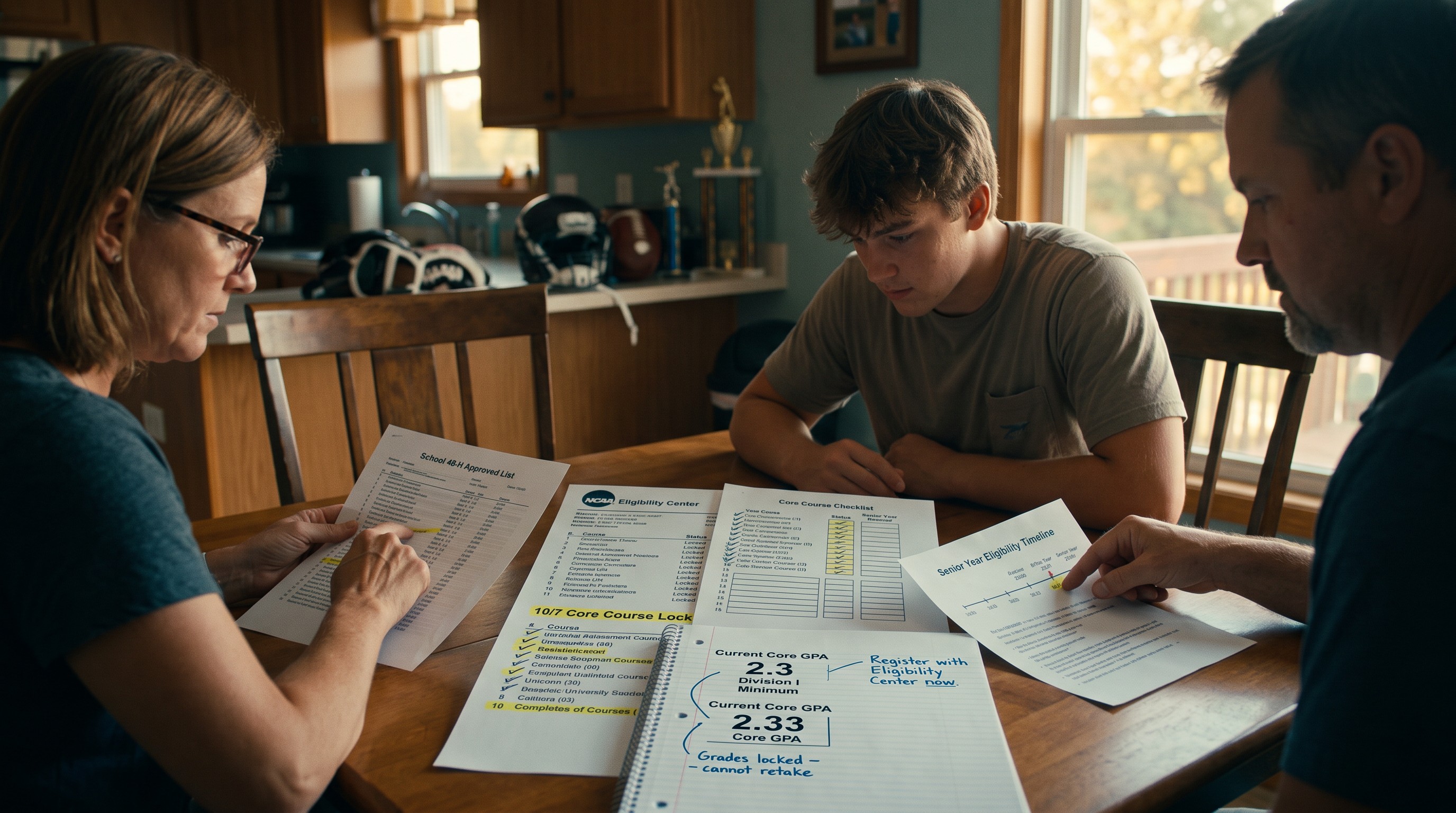
The NCAA locks in 10 of a 2027 athlete’s 16 required core course grades the moment senior year begins. Those grades cannot be retaken, replaced, or improved. For a family still early in the recruiting process, this is one of the most underappreciated structural deadlines in the calendar.
How the rule works
Division I eligibility requires 16 NCAA-approved core courses completed across high school. Of those 16, ten must be finished before senior year, specifically before the start of the seventh semester. Seven of those 10 must come from English, math, or natural and physical science.
The NCAA refers to this as the 10/7 requirement. Once a student-athlete begins senior year, the grades earned in those pre-senior courses are locked permanently into their Eligibility Center record. There is no exception.
A 2.3 minimum core GPA is required for Division I competition. That number is calculated only from the 16 approved core courses, not from the overall high school transcript. The two can differ meaningfully.
What senior year can still fix, and what it cannot
Senior year matters. The remaining six core courses count toward the final 16, and strong senior-year grades can improve the overall core GPA if a student-athlete still has courses left to complete.
But senior year cannot undo a poor grade earned in a locked course. If a junior-year class counted as one of the 10 required pre-senior core courses and the grade was inadequate, that grade stays in the Eligibility Center’s calculation. No retake in senior year changes it.
For families where the core GPA is comfortably above 2.3, this is a checkpoint, not a crisis. For families where the margin is thin, now is the time to understand what the senior-year courses can and cannot do for the final number.
Why this matters in the recruiting context
A college coach investing recruiting attention in a prospect is making a judgment, eventually, about whether that athlete can sign a financial aid agreement. The NCAA Eligibility Center certification is a prerequisite for that signature. An eligibility problem discovered in November changes a program’s internal calculus. Usually not publicly, and often not in a way that gets communicated to the family directly.
Most recruiting conversations focus on fit, film, offers, and visits. Academic eligibility rarely enters those conversations until it becomes a problem. The better approach is to treat it as an infrastructure question, something that should be confirmed before the fall recruiting push begins, not discovered after.
What to do now
A 2027 athlete who has not yet registered with the NCAA Eligibility Center should do so before senior year begins. The preliminary review gives families an early read on current standing: which courses have been entered, how the core GPA currently calculates, and whether any course may not appear on the school’s approved list.
High school counselors can request the school’s NCAA-approved course list, called the 48-H form, to verify which courses qualify. This step often takes one conversation and a few days. It is not complicated. But it is much easier to address now than in October.
The goal for 2027 families is to enter senior year with a clear academic eligibility picture, so the focus can stay where it belongs: on recruiting strategy, not on paperwork that should have been handled months earlier.