

Three weeks from now, the rosters go public
The NCAA dead period ends July 31. Most FBS programs open fall camp between August 1 and August 8, and when they do, they submit official scholarship counts under the 105-man roster cap. Those rosters are public. They are posted on athletic department websites and indexed across recruiting databases within days of camp opening.
For a family evaluating an offer, the scholarship count at your athlete’s position is the most honest document that program will share with you. It does not require interpretation. It requires counting.
What to count and why it matters
A 105-man roster is a financial document before it is a football one. Every scholarship player represents a decision a program already made. Every open spot represents one they still need to make.
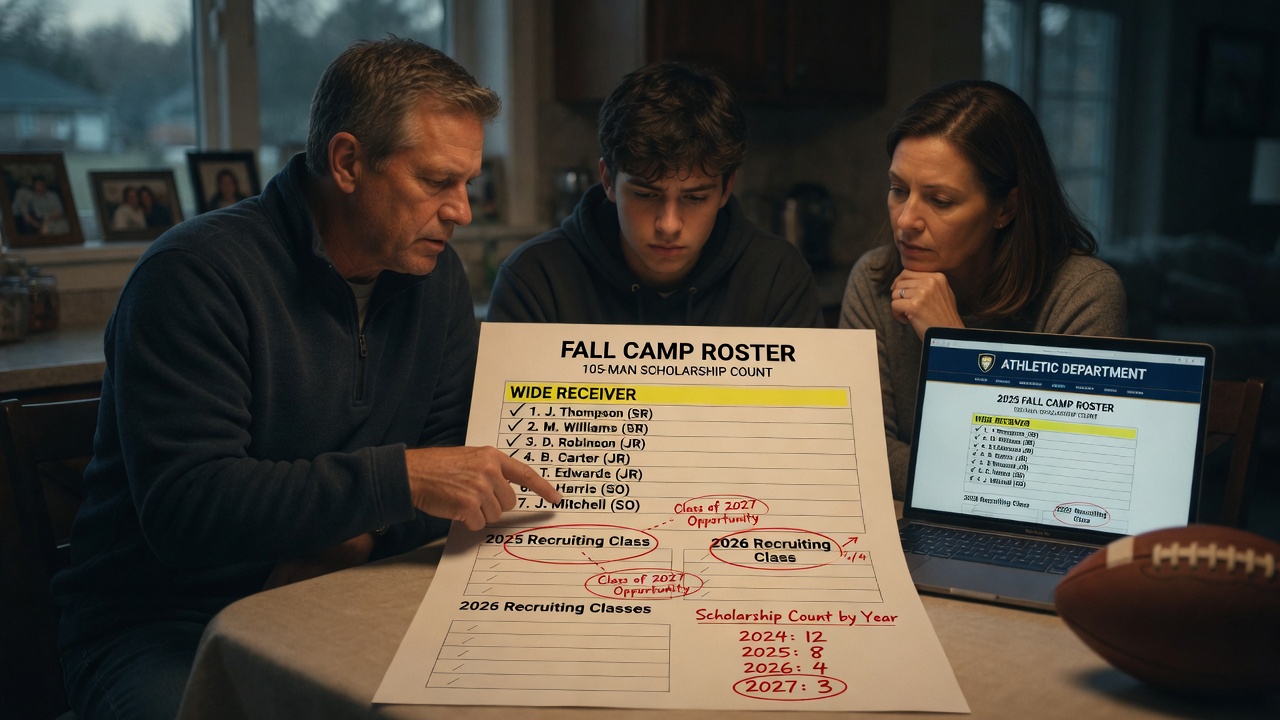
When a family reads a fall camp roster, the useful question is not how many players the program has at that position. It is how many scholarship players at that position are juniors or seniors, players who will be off the roster within one or two seasons. A program with two senior starters and nothing recruited in the 2025 or 2026 classes at that position has real need going into 2027 signing day. A program with four scholarship players at the same position already committed in those classes has much less.
Neither situation changes whether the offer is genuine. But one gives the family clearer context for where their athlete sits in that program’s 2027 class.
What depth tells you and what it doesn’t
A scholarship gap at a position does not guarantee an offer will follow or that a commitment will be accepted. Programs recruit based on need, but they also recruit the best available player and trust the class to sort itself out. A program that is heavy at your athlete’s position is not necessarily done recruiting there. A program that is light is not necessarily ready to move.
What the roster does is convert a vague interest signal into a more grounded question. If a program has already committed two players at your athlete’s position in the 2027 class, the fall camp roster tells you something real about how an offer from that same program ranks on their board. If the position is thin across the 2025 and 2026 classes, the offer lands in different context.
Reading the roster does not make the decision for you. It sharpens the question.
What families can do before August
The dead period ends in two weeks. Fall camp rosters finalize a week after that. The sequence is useful.
Now is the time to identify the two or three programs that matter most to your family, pull up their current rosters from the athletic department website, and map scholarship depth at your athlete’s position by class year. The picture will sharpen when fall camp rosters are finalized in early August, but starting from the current public roster gives a family a working baseline before camp opens.
Families who understand their athlete’s positional value to specific programs are better positioned to read interest accurately, evaluate communication clearly, and make more informed decisions when the fall recruiting window opens.