

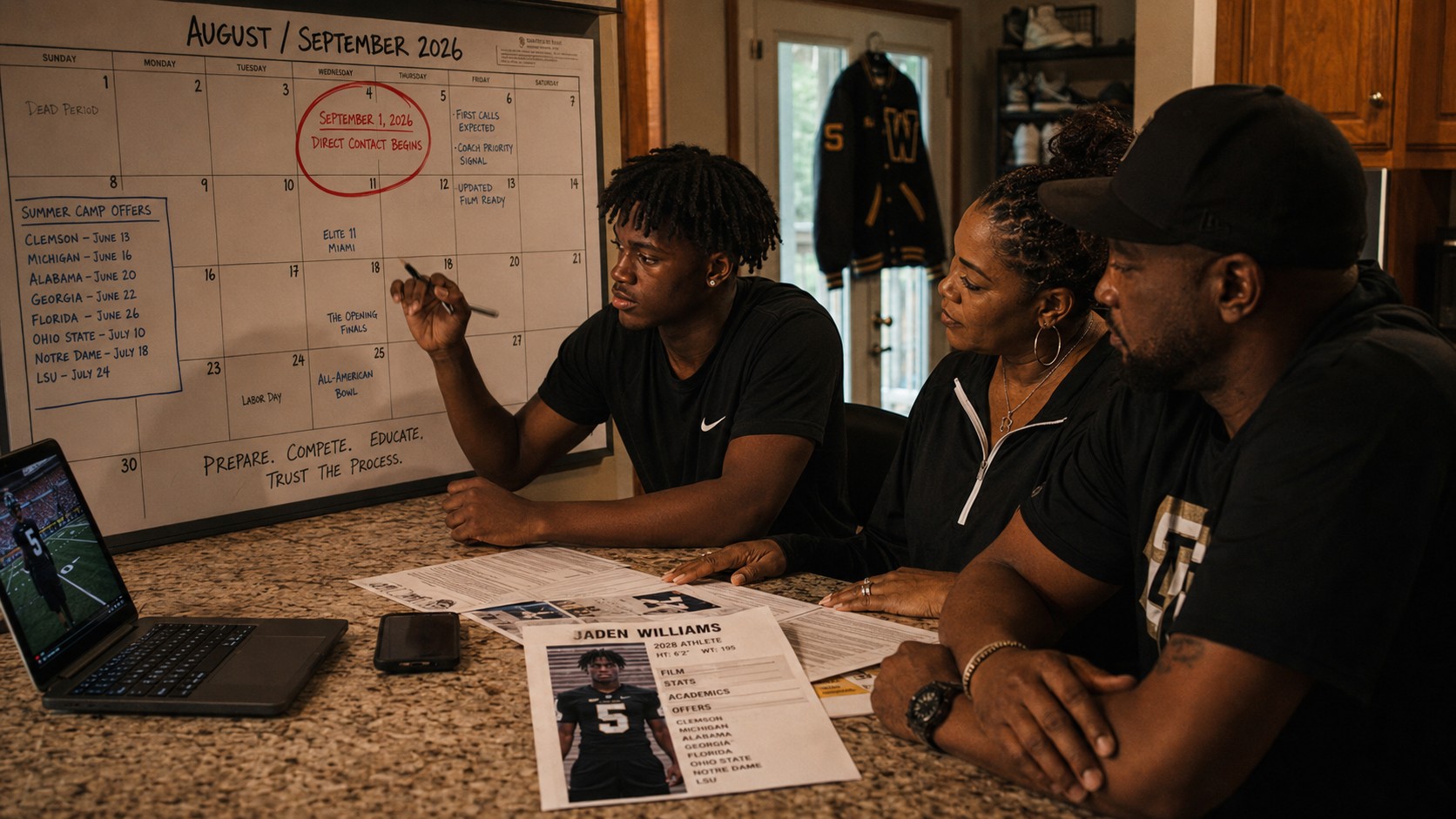
The date that changes direct contact
September 1, 2026 arrives in roughly six weeks. For families with athletes in the class of 2028 who are entering their junior year of high school this fall, that date marks the official start of direct coach-to-recruit communication.
Since June 15, Division I coaches have been permitted to send printed materials and some electronic communications to rising 2028 juniors. What they could not do is call. They could not text. They could not show up at a high school practice or arrange an off-campus meeting.
On September 1, all of that changes.
What the summer evaluation cycle set in motion
This spring and summer, the 2028 class began attending college camps in earnest. Programs across the Power Four have been evaluating prospects in person at their facilities, and for athletes who performed well, early offers have already followed. Alabama has already made offers to multiple 2028 prospects and is actively building its position boards for the class. Similar board-building is underway across the country.
The pattern is consistent: evaluation at camp, offer extended to the most ready prospects, sustained material-level contact through the summer, and then September 1 when coaches can introduce themselves directly and begin real conversations.
For 2028 families who received an offer or strong evaluation this summer, September 1 is when the programs behind that interest can call and explain what they are seeing.
Why the timing of the first call is worth reading
A coach's first call to a prospect is not simply an introduction. It is a signal about where an athlete sits on a program's board.
Programs that call early in September are communicating priority. Programs that wait until October or November may be watching the athlete's junior season before deciding. Neither response is automatically a red flag, but both carry information. A family that understands this can read the phone calendar more clearly rather than reacting to it.
For athletes who are further down a board, silence in September is not necessarily disinterest. It may mean the program is in evaluation mode and waiting for game film before deciding. Knowing that distinction reduces anxiety and improves decision-making.
What to have in place before September 1
September 1 is most useful for families who are already organized.
Film from the most recent season should be updated, clearly labeled, and accessible within minutes of being asked. Basic profile information should be current. Parents and athletes should agree in advance on how to handle a first call from a college coach: who picks up, what the tone should be, what questions to ask.
A family that is organized and composed projects differently than one that is scrambling. That projection forms quickly, and coaches notice it.