

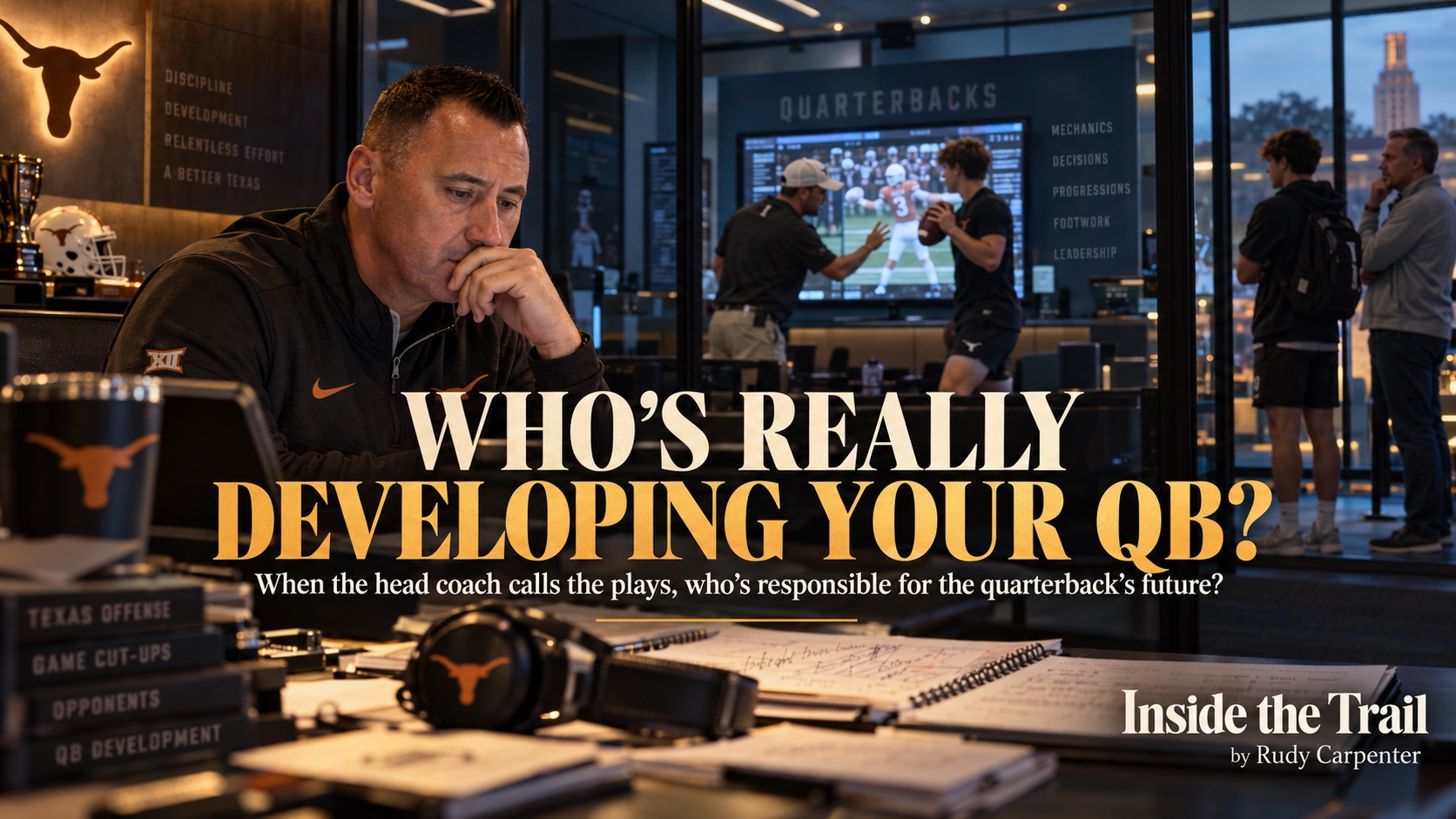
The Arrangement Families Think They Understand
There's a piece making the rounds this week about Steve Sarkisian at Texas, where a columnist argues that Sarkisian's decision to call plays himself is going to cost him his job. The Football Scoop column, published October 11, lays out the numbers: Texas's offense has the highest three-and-out rate in the SEC through its conference games, and the team is on pace to score fewer points than any of the last three seasons. The argument is about performance and job security.
What the column isn't about is the family with a high school quarterback sitting in their living room right now who has Texas on their board, or who is evaluating five other programs structured the same way. Those families hear "I'll be the one calling your son's plays" and process it as a positive. The head coach himself is your son's play-caller. The most powerful person in the building has a direct stake in your son's development.
That's one way to read it. Here's another.
What It Actually Looks Like from the Inside
I've talked to enough coaches at all levels to know that the HC-as-OC model puts a real strain on everything except the game plan itself. A head coach calling plays is deep in film every Tuesday night, building a scheme that is entirely his own. Monday morning he's watching opponent tape as a coordinator, not as the CEO of a football program. The staff notices. Recruiting calls get moved. The administrative side of building and developing assistants runs thinner than it would if those jobs were separated.
None of that means the model doesn't work. Lane Kiffin has run his own offense and produced elite results doing it. The programs where this arrangement holds together are the ones where the position coaches are genuinely empowered to own the daily player relationships while the head coach runs the system.
That's the question families rarely think to ask during an evaluation: when the head coach is also the offensive coordinator, who is actually in the quarterback room on a Tuesday morning? Not on game day. On an ordinary Tuesday, when your son has a film session at 7am and a mechanics drill at 8:30. Is the head coach running that session, or is he building a game plan? And if he's building the game plan, who's in that room developing your son?
At the programs where this model works, there's a dedicated QB coach who owns that daily relationship. Families should ask to understand that role specifically before committing, not just who will call the plays, but who is in that room every morning.
The Question That Actually Protects Your Son
There's also a staff-continuity question that most families don't sit with until they're past the decision.
In a traditional structure, a head coach firing doesn't automatically unwind the offensive staff. The coordinator might stay. The QB coach might stay. The scheme that recruited your son can survive a transition. When the head coach and the offensive coordinator are the same person, that protection is gone. The play-caller and the most powerful person in the building leave together. The new staff brings their own offense, their own quarterback preferences, their own sense of what the position should look like.
That's not a reason to rule out these programs. Some of the best program fits in college football are built around a head coach who sees the game entirely through his offense, and when that man is invested in your son's development, the relationship can be exceptional.
But the Sarkisian situation at Texas is worth paying attention to this fall, not for what it says about his job security. For what it teaches about the questions a QB family should be asking before they ever sit down to sign anything.
If the man who recruited your son is also the man calling his plays, and that arrangement ever comes under pressure, who in that building carries your son's relationship through it?