

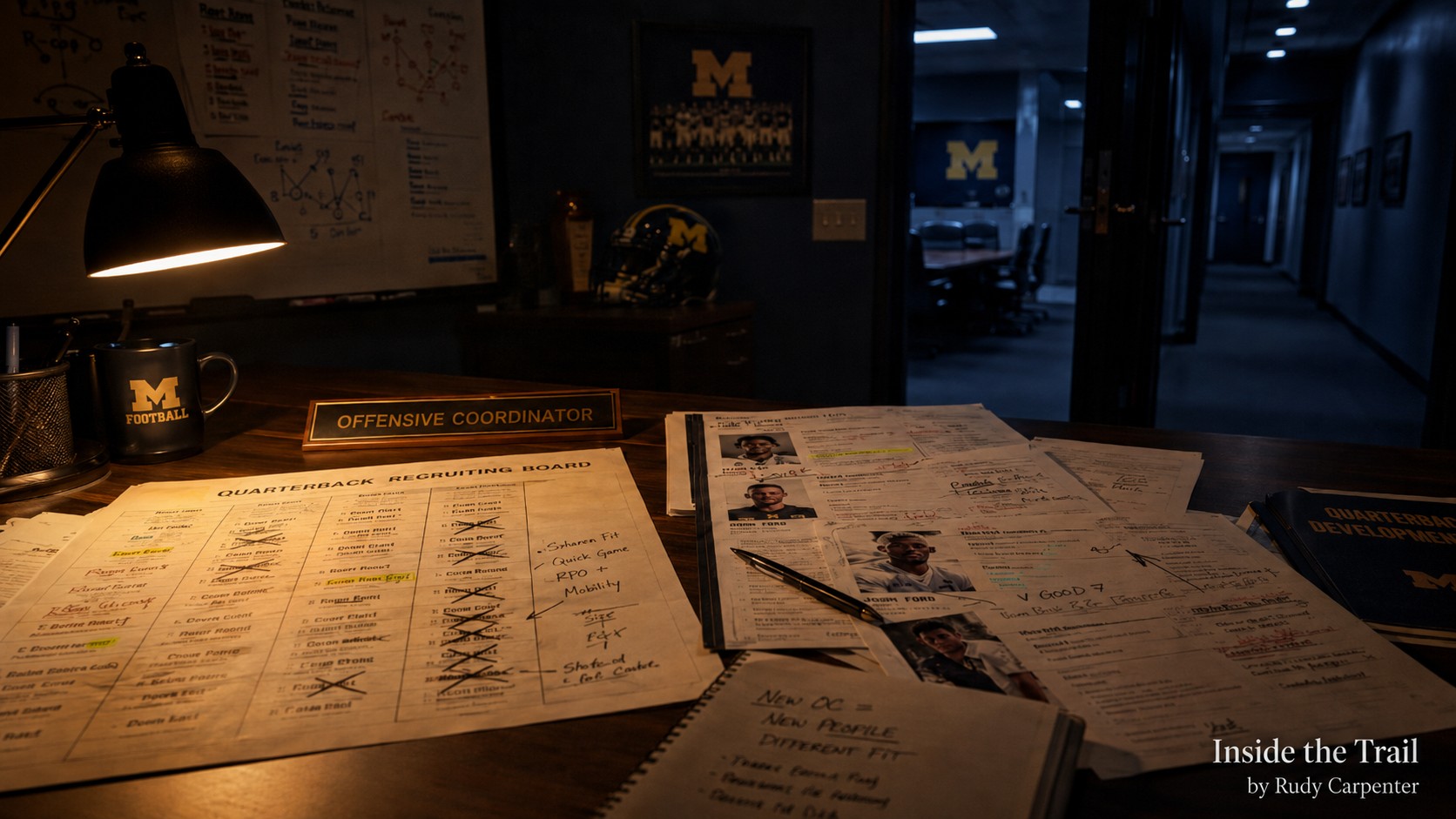
When a new offensive coordinator walks into a program, the first thing he does is not look at the roster. He looks at the board.
Not the depth chart. The recruiting board. The names a staff has been calling, visiting, and building relationships with for the past year or more. And within a few weeks, he starts quietly rearranging it.
This is not about rankings or stars. It is about fit. A coordinator who runs a high-tempo spread wants different things from a quarterback than one who runs 12-personnel under center. A spread-first OC may prioritize a mobile processor who extends plays and reads fast. The coordinator who preceded him may have been building everything around a pure pocket passer with a big arm. These are not the same job, and they are not evaluating the same athlete.
When I call a new offensive coordinator early in a cycle, one of the first things I want to understand is what he actually needs at quarterback. Not what the program publicly says. Not what the previous staff recruited. What this coordinator needs, in his system, on his terms.
The answer tells me more about which families are in a real position than anything published on a recruiting site.
How the board reshapes after a coordinator hire
Families tend to think of a verbal commitment to a program as a commitment to a coaching staff. That instinct is understandable, but it gets complicated when coordinators move.
When an offensive coordinator changes, the evaluation lens changes with him. A quarterback who was the top priority to the previous OC may still be in the program's top consideration, or he may have quietly slipped to a 'stay in touch' designation while the new staff figures out whether his skill set fits their system. The family does not always find out right away. The calls still come. The relationship feels warm. But the priority level inside the building has shifted.
The reverse also happens. Quarterbacks who were nowhere on a program's board under the old coordinator suddenly become targets when a new OC arrives. He may have recruited that kid at a previous stop. He may know the high school coach personally. He may run a system the kid was built for. Boards that felt stable in June can look completely different in September, and families who had no traction with a program earlier in the cycle are suddenly getting calls they did not expect.
Across Power Four programs entering the 2026 season, there are sixty-three new offensive or defensive coordinators, with seventeen programs replacing both coordinators at once. That is a significant portion of the landscape, and it means a large number of recruiting boards are in active recalibration right now, whether or not programs are saying so publicly.
What the evaluation criteria actually changes
It is not enough to know that a coordinator changed. What matters is understanding how his evaluation criteria differ from his predecessor's.
Coordinator transitions tend to fall into recognizable patterns. An OC who runs a high-tempo, RPO-heavy system tends to weight quick processing and mobility. He wants a quarterback who can read coverage pre-snap, work through a fast decision, and extend a play with his legs when structure breaks down. Arm strength matters, but it is not the primary filter.
An OC who runs a pro-style system, closer to 11-personnel with vertical passing concepts, tends to weight footwork, base, and arm talent more heavily. He wants a quarterback who can stand in a clean pocket and deliver a throw on time to a specific spot. Mobility is valued, but it is not the lead criterion.
These are not minor differences. They determine who gets offered, who stays under serious consideration, and who gets moved to a courtesy tier while a new staff evaluates its own targets.
North Carolina opens the 2026 season with Bobby Petrino as offensive coordinator, one of the most recognizable offensive minds in the sport. The profile of quarterback Petrino values is documented across decades of film and more than a dozen head coaching and coordinator stops. It is worth understanding that profile before assuming whatever interest a previous Carolina staff expressed translates directly to what the current staff wants to see.
What families in active recruitment should be doing now
The 2026 season opened this past weekend. For families with a quarterback in the 2027 cycle who has active interest from programs that changed coordinators this offseason, one question matters above the others: has the new offensive coordinator actually evaluated your son's film?
Not the previous coordinator. Not the head coach. The offensive coordinator who is now calling this offense.
Interest is always contingent on fit, and fit is always defined by who is doing the evaluating. A coordinator who inherits a list of recruits from his predecessor may carry that list for a few weeks out of professional courtesy, then quietly reset based on his own assessment. If your son's film has not been in front of him directly, the relationship your family built with the previous staff is a starting point, not a guarantee.
Coordinator transitions do not automatically transfer relationships. The new OC has to see the film himself and decide the kid fits what he is building. The sooner a family understands that, the sooner they can take the right steps to make sure it actually happens.
Has your son's film been evaluated by the new offensive coordinator, and not just the one who left?