
What these laws do
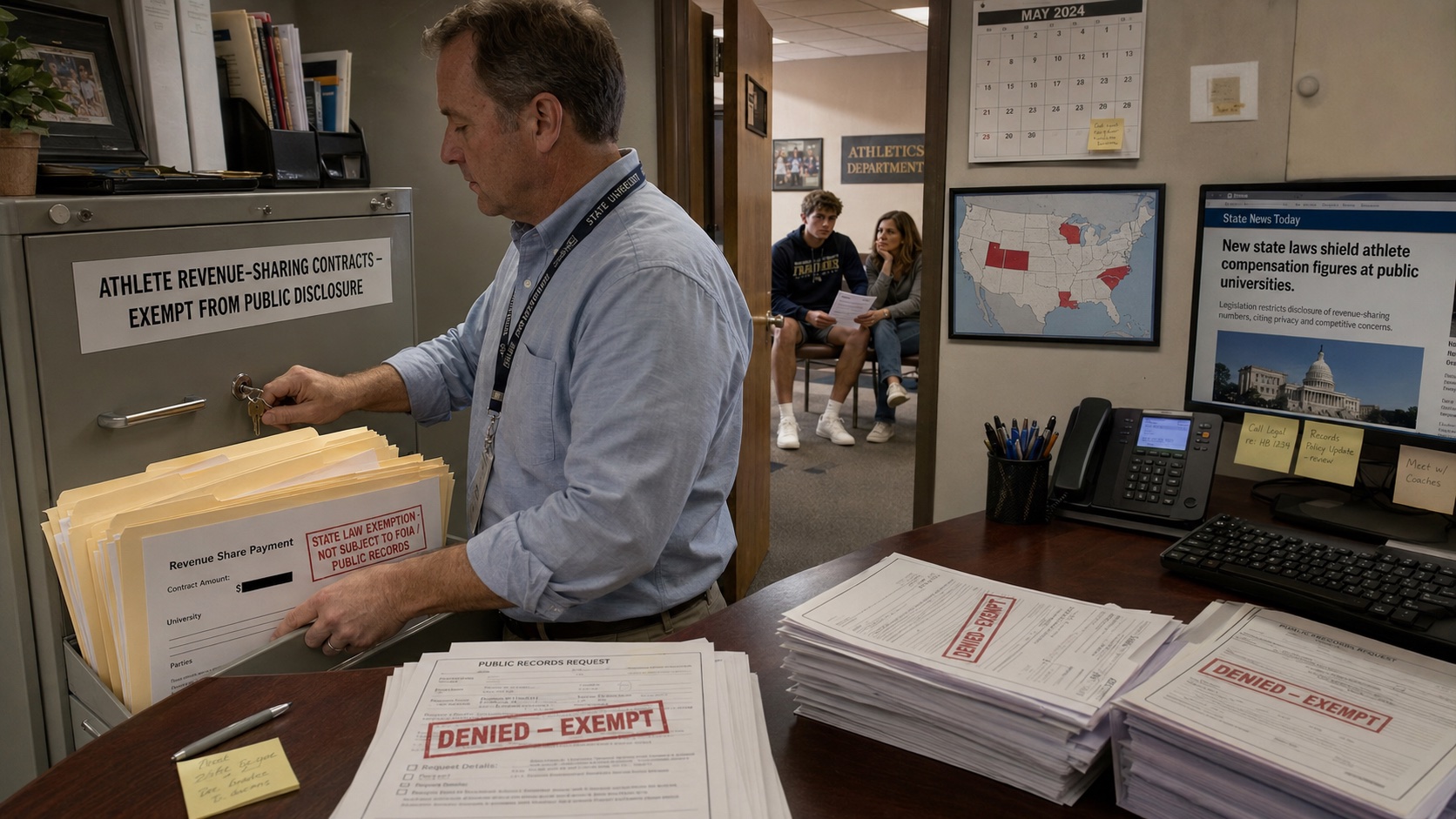
At least six states have passed or are advancing legislation that removes athlete revenue-sharing contracts at public universities from public records disclosure requirements. The list includes South Carolina, Wisconsin, Louisiana, Colorado, Utah, and North Carolina, where a bill advancing through the legislature could reach a floor vote in the weeks ahead.
The specifics vary by state, but the core effect is consistent. Once these laws take effect, program revenue-sharing budgets, how funds divide among sports programs, and individual athlete payment amounts are no longer accessible through standard public records requests at affected institutions.
The argument programs are making
Supporters of these exemptions frame them as a competitive necessity. The logic is straightforward: if a program at a public university must disclose that it offered a player a specific figure, a better-resourced program can use that information to outbid it. Keeping the details private removes that leverage.
At least one state governor vetoed a version of this legislation, citing concerns about public accountability at state-funded institutions. In South Carolina, the legislature voted to override that veto. North Carolina's bill is advancing on a similar track.
What it means for families evaluating offers
The practical effect for families in the recruiting process is a change in what independent verification looks like.
At programs in states with these exemptions, there is no public record families can use to cross-reference a revenue-sharing offer against what other players at the program currently receive. A staff's description of an offer as standard for a position, or consistent with the program's investment at that role, has no external check available.
At schools in states without exemptions, families could previously use public records requests or disclosed aggregate spending data to understand where an offer falls within a program's overall compensation structure. That option is narrowing at a growing number of institutions.
What remains available
Several reference points continue to exist regardless of state disclosure laws.
- Settlement participation is public. The roughly 327 of 364 Division I schools that have elected to participate in the House settlement's revenue-sharing framework are a matter of record. Whether a program has opted in is verifiable.
- Some programs voluntarily disclose. A number of institutions continue to share general budget parameters even when not required by state law.
- Conference and tier data. Published reporting on median roster costs by program tier and conference provides general context on where a school's spending likely falls. These figures are approximate but useful.
- Clearinghouse filings. The College Sports Commission holds approved deal information through its NIL clearinghouse. While individual deal details are not broadly public, the existence of the review process provides some structural transparency around what types of arrangements programs are submitting.
The shift underway is from a landscape where offer data was independently verifiable at many public institutions to one where evaluation depends more heavily on understanding a program's overall investment philosophy, its historical spending patterns, and whether a figure is consistent with what its general competitive position suggests. For families in this process, that context now matters more than it did a year ago.