

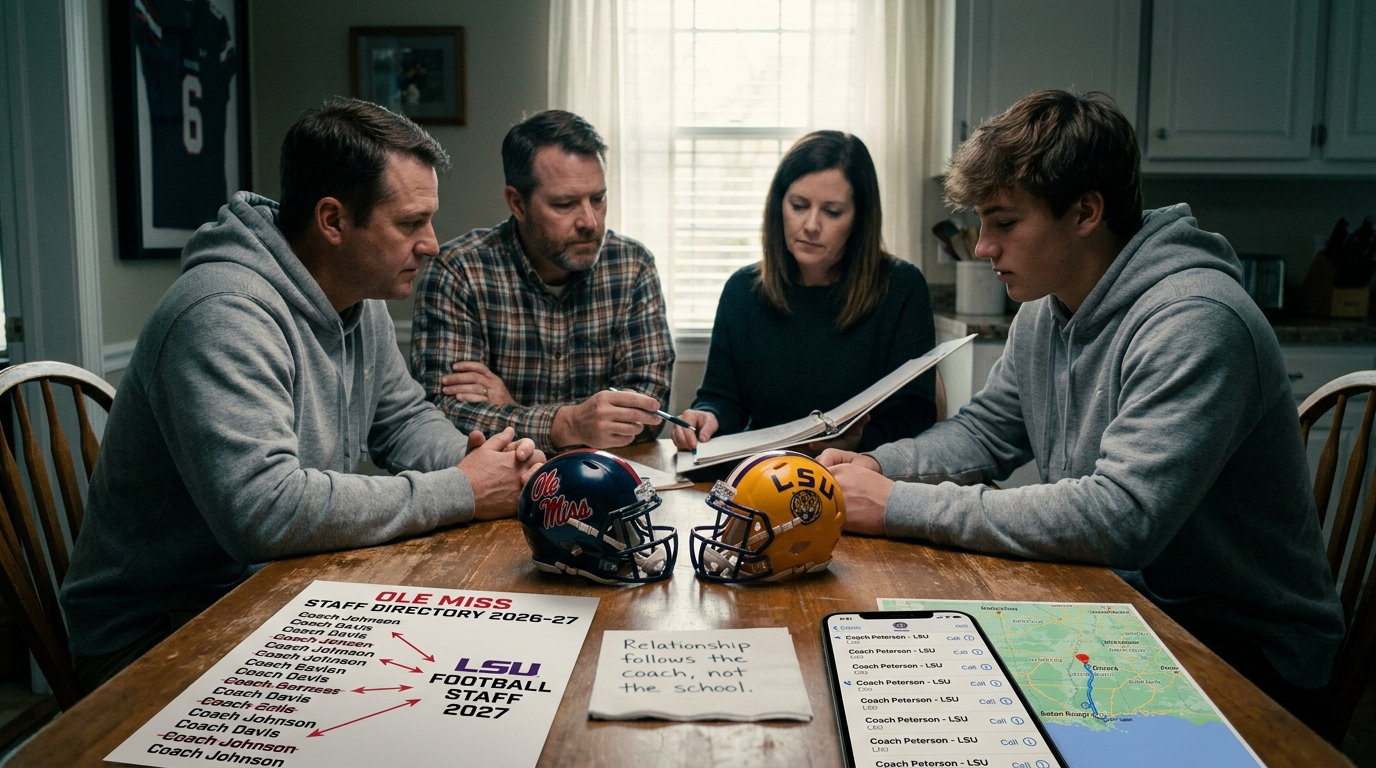
Lane Kiffin was at SEC Media Days in Tampa last week. He made a few jokes, which is customary. One of them involved Pete Golding, the new Ole Miss head coach, having bought Kiffin's old house in Oxford. Kiffin apparently still has access to the Ring camera at the front door, and he let the room know it. It got a laugh.
It also tells you something. When Kiffin left Oxford for Baton Rouge in December, he took eight of his eleven coaches with him: his offensive coordinator, his quarterback coach, his wide receivers coach, his offensive line coach, his running backs coach, his tight ends coach, and two defensive coaches. All eight are at LSU now.
That is not a staff departure. That is a staff migration. And for any family that had been building a relationship with one of those coaches during Ole Miss's 2027 recruiting cycle, the map moved without their permission.
How recruiting relationships actually travel
Most families track programs. They look at the name on the helmet, the stadium, the conference, the head coach's record. What they often don't track closely enough is the specific coach doing the calling.
That coach is the one who has watched the film. Who has talked to your athlete's high school position coach. Who has built whatever real trust exists between your family and that program. In the current college football environment, where assistants move freely and staffs rebuild routinely, that coach is not a fixed asset at any school.
When Kiffin's staff relocated to Baton Rouge, every recruit they had been working in Ole Miss's 2027 pipeline faced a real decision. The coach who had been calling, who had seen something in the athlete's film, who had built familiarity with the family, was now at a different school with a different logo on the sideline. The relationship didn't dissolve. It relocated.
For some families, that made an interest in LSU feel like a natural next step. The coach they trusted was in Baton Rouge. For others, it meant starting over in Oxford with Golding's new staff, rebuilding with coaches who didn't know the athlete's name yet.
Ole Miss will be fine. Golding is a credible hire and the program has real momentum behind it. But the family that had spent six months building a relationship with the Ole Miss offensive line coach or the Ole Miss quarterback coach? Those coaches, Eric Wolford and Dane Stevens, are in Baton Rouge now. That specific investment lives at a different address.
The question families usually forget to ask
I talk to position coaches every week. One thing I have come to understand is how often families read interest from a program as interest in a school, when what they have actually built is a relationship with a person.
A coordinator who has been at a program for seven years and is the head coach's closest football friend is a fundamentally different recruiting anchor than a position coach in his second year who followed a coordinator from two jobs ago. The second coach might be an outstanding evaluator and a tireless recruiter. He also might be one good offer away from accepting a better job somewhere else. When he goes, he takes the recruiting file in his head with him to wherever he lands.
This is not a reason to distrust position coaches. Most of them are doing genuine work and building real relationships. It is a reason to understand the full picture of who you are building a relationship with, not just the school they happen to represent at the moment.
Staff migrations like the one from Ole Miss to LSU reveal something useful. They show that in college football recruiting, the relationship is often more portable than the school. A coach who has built genuine interest in your athlete can carry that interest to a new address. Sometimes the new address turns out to be a better opportunity than the original program was.
The reverse is equally true. When a coach departs a target school and the incoming staff doesn't know your athlete's file, you are essentially starting over. An offer that existed under the old staff may technically remain, but the relationship that gave it weight is gone.
When you look at the programs your athlete is in the most consistent communication with, do you know how long the coach doing that calling has been at that school, and where he was before he got there?