

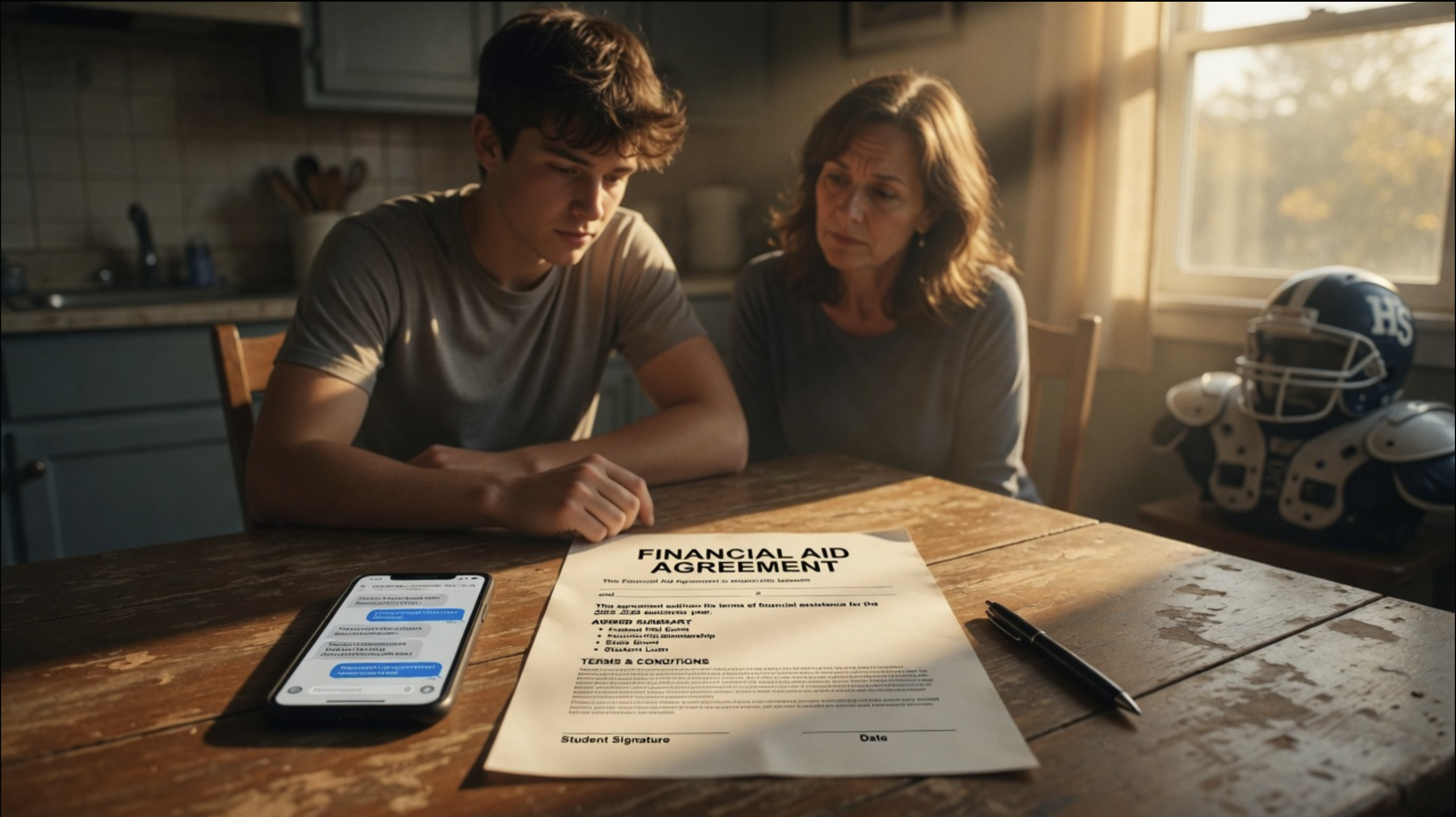
In October 2024, the NCAA eliminated the National Letter of Intent after roughly sixty years and replaced it with a financial aid agreement signed directly with the school. That document, signed by the recruit and a parent or guardian, is the only binding instrument in football recruiting. Everything before it, the offer and the verbal commitment, binds no one.
An offer is not always one you can accept
Families tend to treat an offer as a fixed thing. It is not. Coaches distinguish, privately, between a committable offer and a non-committable one. A committable offer is one a recruit can accept on the spot. A non-committable offer keeps a program in contact without holding a spot, usually framed with conditions such as keeping the grades up, continuing to develop, and staying available. Both are called an offer. Only one can be acted on today.
Schools rarely volunteer which kind they have extended. The most useful question a family can ask is also the one most often skipped: Is this offer committable right now? The answer reorders a recruiting board faster than any ranking does.
A verbal commitment holds no one in place
A verbal commitment is a statement of intent, not a contract. The recruit can later sign elsewhere. The program can stop recruiting him. Neither side is penalized, because no rule governs a verbal agreement. In a cycle where commitments are landing earlier in the process, that distinction matters more, not less. An early commitment is real as a signal and reversible as a fact.
What this means for a family now
The sport is in its summer dead period, when no in-person contact is allowed and offers and commitments accumulate by phone and text. It is a better time to take inventory than to count trophies. For each offer on the table, confirm whether it is committable. For each commitment already made or received, hold it as binding only at the signature, and not before.
The signing windows are the fixed points: a December early period and a February regular period, with the aid agreement generally due within about two weeks of the written offer. Until that agreement is signed, the process remains open in both directions. The families who navigate it best are the ones who read each step for exactly what it is, and nothing more.