

Why programs mention it early
By October and November of senior year, most recruited athletes in the 2027 class will hear some version of the same question from a target program: Can your athlete graduate in December and enroll in January?
The question sounds casual. It is not.
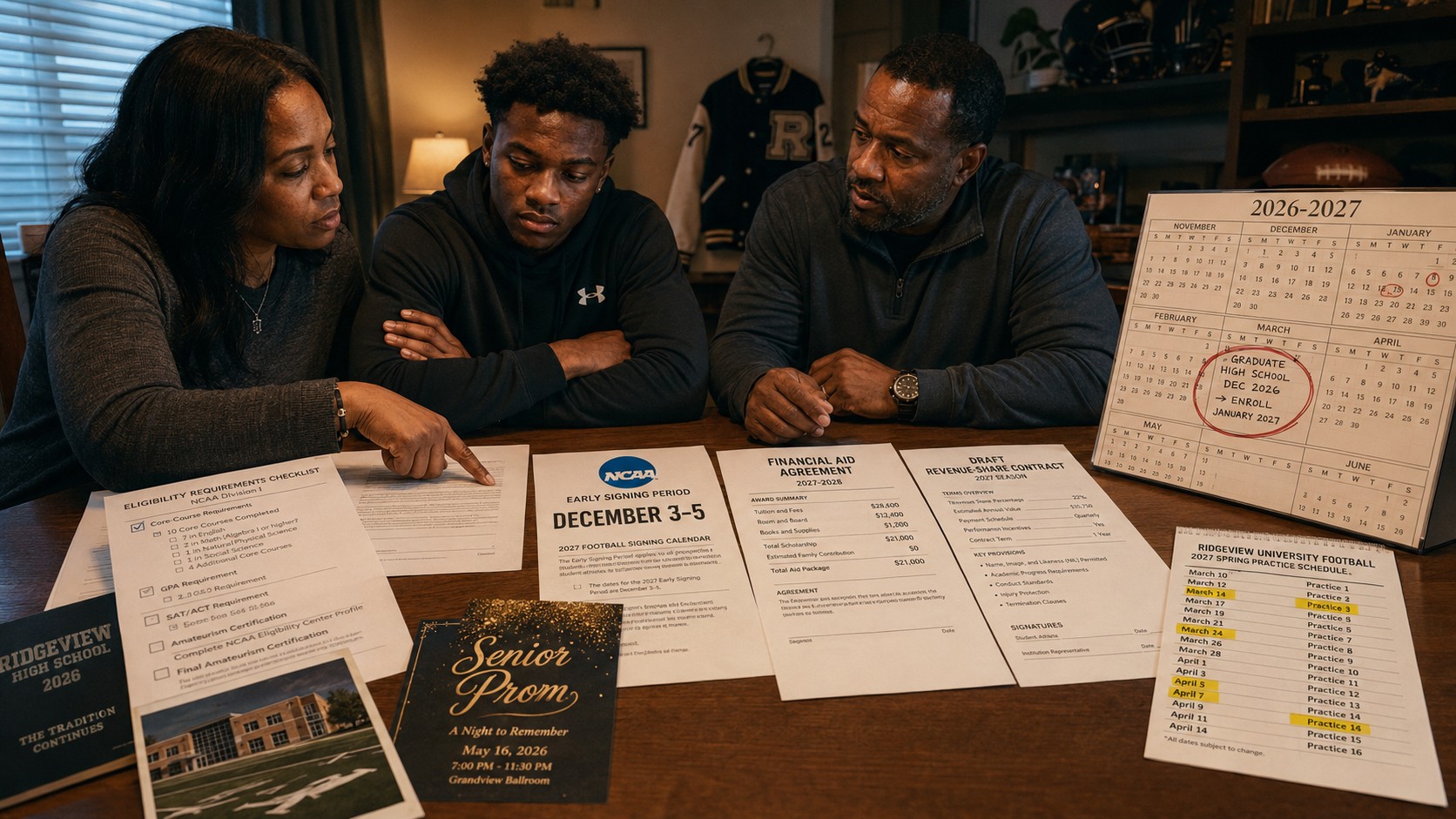
Early enrollment means the athlete finishes high school requirements by December, signs a financial aid agreement during the Early Signing Period (December 3 through 5, 2026), and arrives on campus in January, seven months before the rest of his incoming class.
Programs want this for a specific reason. Spring practice, which typically runs from February through April, is one of the only windows a staff can evaluate a freshman in a real competitive environment before the winter transfer portal window opens. A program that lands an early enrollee has a semester-long head start on seeing where the athlete fits and how quickly he develops.
For the family, the calculus is different.
What the family gives up
The most direct cost is the second semester of senior year. An early enrollee finishes his core high school requirements in December and completes his first college semester in the spring instead. Prom, spring sports, graduation with his high school class. Most of that goes away.
There are also academic requirements that must be satisfied early. Division I initial eligibility runs on 16 core courses with a 2.3 minimum GPA. Families need to confirm with the NCAA Eligibility Center that the athlete can meet that threshold without a full senior spring semester. Some athletes can. Others cannot, and they need to know that before the coach asks.
The Eligibility Center certification process takes time. Starting it in the fall of senior year is late. Starting it in the summer is the right pace.
What the revenue-share era adds
Programs are now presenting written revenue-sharing contracts alongside financial aid agreements, often at or before signing. An early enrollee in the 2027 class will sign those documents before experiencing a day of spring practice, before seeing where he fits on the depth chart, and before knowing whether the coaching staff that recruited him is still in place.
That is not a reason to avoid early enrollment. It is a reason to read the contract carefully, understand what it binds, and confirm that the written terms match what was discussed verbally before anyone signs anything.
What a family should do with this right now
The Early Signing Period opens December 3. The right time to understand the early enrollment decision is before a coach introduces it as a natural next step in the fall.
Families should confirm now whether the athlete can satisfy Division I eligibility requirements without a full senior spring semester. They should understand what a revenue-share contract covers before they see one in a coach's office. And they should be clear on what the athlete is giving up academically and socially, so that when the question is asked, the answer comes from a considered position rather than in the moment.
Programs benefit from a January enrollee. Whether the family benefits depends on the athlete's circumstances, the contract's terms, and how clearly the decision is made before it is due.