

The ruling
On Friday, June 12, a South Carolina circuit court judge granted Clemson wide receiver Tristan Smith a temporary injunction against the NCAA, clearing him to play a fifth college season in 2026. The NCAA had denied his fifth-year waiver in November on the grounds that he had already played four seasons without a redshirt, including two years at a junior college and one at the FCS level.
Judge Jessica Ann Salvini ruled the denial was inconsistent with an earlier NCAA waiver granted to Malik Benson, another former Hutchinson Community College player who went on to play three more Division I seasons and was drafted in April. The judge wrote that the only material distinction between the two cases was that Smith's final eligible season fell in 2025-26 rather than 2024-25.
Why the pattern is the story
Smith's injunction follows a now familiar arc. In late 2024, Vanderbilt quarterback Diego Pavia won an injunction that effectively gave the 2024-25 class of former junior college athletes an extra year. Texas Tech quarterback Brendan Sorsby has been the subject of a similar eligibility ruling. Friday's order cited Sorsby's case explicitly.
For a family evaluating a roster, this is not a story about one player or one program. It is a story about how predictable roster turnover has become.
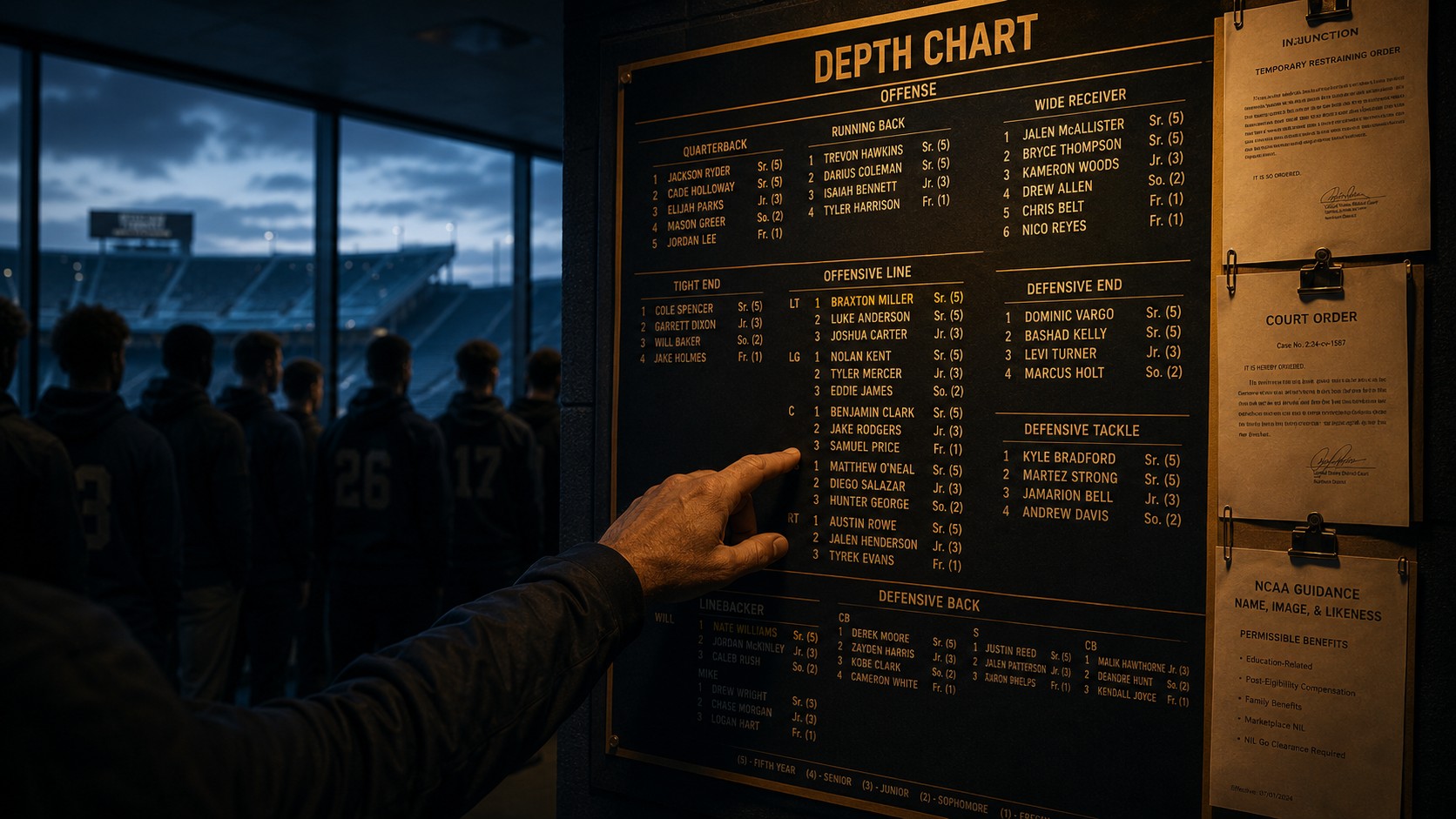
A program operating under the 105-player cap has a fixed budget of spots. When a senior wins an injunction to play another season, the slot that would have rolled to a true freshman does not roll. The depth chart sits one step higher. The newcomer's snap path lengthens.
What it means for a family in the recruiting process now
The advisory implication is straightforward. When you evaluate a program's depth chart this summer, do not read it at face value. Ask:
- How many players at your athlete's position currently hold fifth-year waivers or active eligibility lawsuits?
- How many of your athlete's grade-class peers signed at the same position last cycle, and where do they actually sit going into fall camp?
- When a court extends eligibility for a starter mid-cycle, what does the program do? Does it pivot, or does it hold?
These are quiet questions. They separate a recruiting decision grounded in roster reality from one made on roster optimism.
A note on what this is not
This is not a story about Clemson, or about any one judge or any one player. The eligibility-litigation pattern is bigger than the Smith ruling, and the recruiting implication is bigger than any single roster. Naming the dynamic clearly is the work. The decisions follow from that.