

What changed
On June 24, the Division I Cabinet finalized a sweeping overhaul of college eligibility rules. Under the new age-based model, Division I athletes receive up to five years of competition -- five actual seasons, not the old four-within-five structure that required redshirts and waiver filings to manage.
The change eliminates redshirt years, sport-specific eligibility rules, and eligibility extension waivers for most circumstances. The five-year window begins when an athlete enrolls full-time in college, or at the start of the academic year following their 19th birthday, whichever comes first.
The new model applies fully beginning with the 2027-28 academic year. Athletes entering in fall 2026 may use whichever framework benefits them more. Programs must submit any remaining waiver requests under the old rules by July 31.
What this means for the depth chart
Under the old system, four-season competition limits created a natural rotation cycle. Programs planned around redshirt years, medical extensions, and the steady departure of players who exhausted their eligibility on a known schedule.
That planning logic changes under the new model. A player entering as a freshman this fall has five full seasons ahead of them, not four. A sophomore on the more-favorable-framework election may have four seasons remaining instead of three.
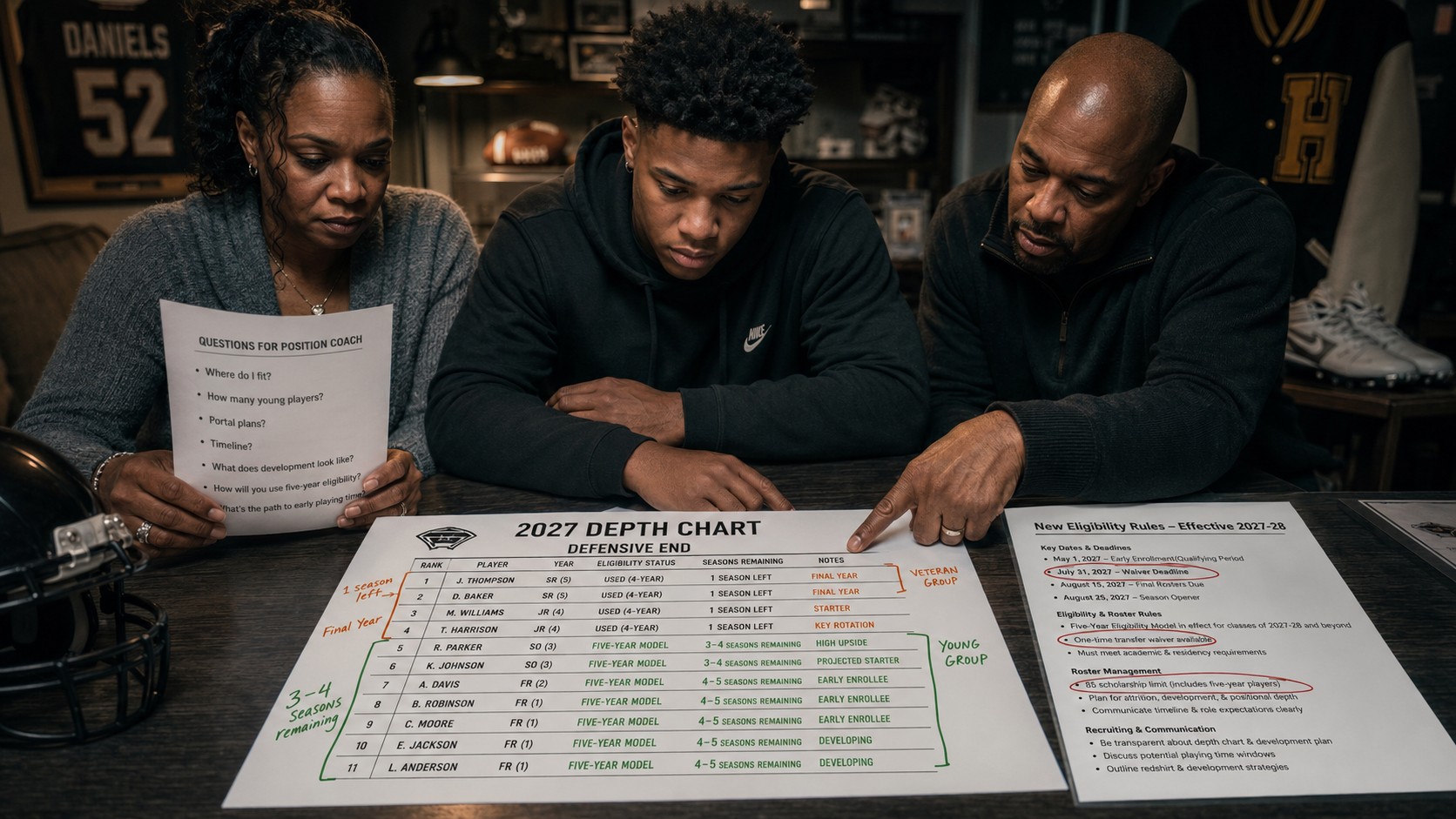
For a family receiving an offer today, the relevant question is not just who is ahead of your athlete on the current depth chart. It is how many of those players are early in a longer clock.
A program with a group of freshmen and sophomores stacked at a given position, all of them under the new five-year model, is not a group that will turn over in two years. That is a group that may have three or four seasons of eligibility remaining, all competing for the same spots an incoming recruit is being promised.
What to ask when evaluating a program
This is not a reason to decline interest from a program. It is a reason to understand the roster more precisely before committing.
For families currently in active conversations with programs:
- Ask the position coach how many players at your athlete's position are under the new five-year model versus the older framework.
- Ask where the program sees roster turnover happening, and in what year.
- Factor the answer into how long a realistic path to playing time may take.
Programs generally welcome specific questions during this period. A family that asks about the depth chart timeline signals the kind of seriousness coaches prefer in a recruit.
The transition period adds a wrinkle
The July 31 deadline is the last date programs can file waiver requests for athletes still governed by the old rules. After that, the 2026-27 season begins with a mixed roster: some players on old eligibility frameworks, some on the new one.
This means the turnover math for a current recruit's depth chart is not uniform across the roster. Asking a position coach which framework each player at that position is using is a reasonable and practical question. Programs running recruiting conversations right now should be ready to answer it.