

The 2026 college football season opens with a transfer enforcement mechanism that programs and players are navigating for the first time. For families working through recruiting decisions, understanding how it works is part of reading the current landscape clearly.
What a ghost transfer is
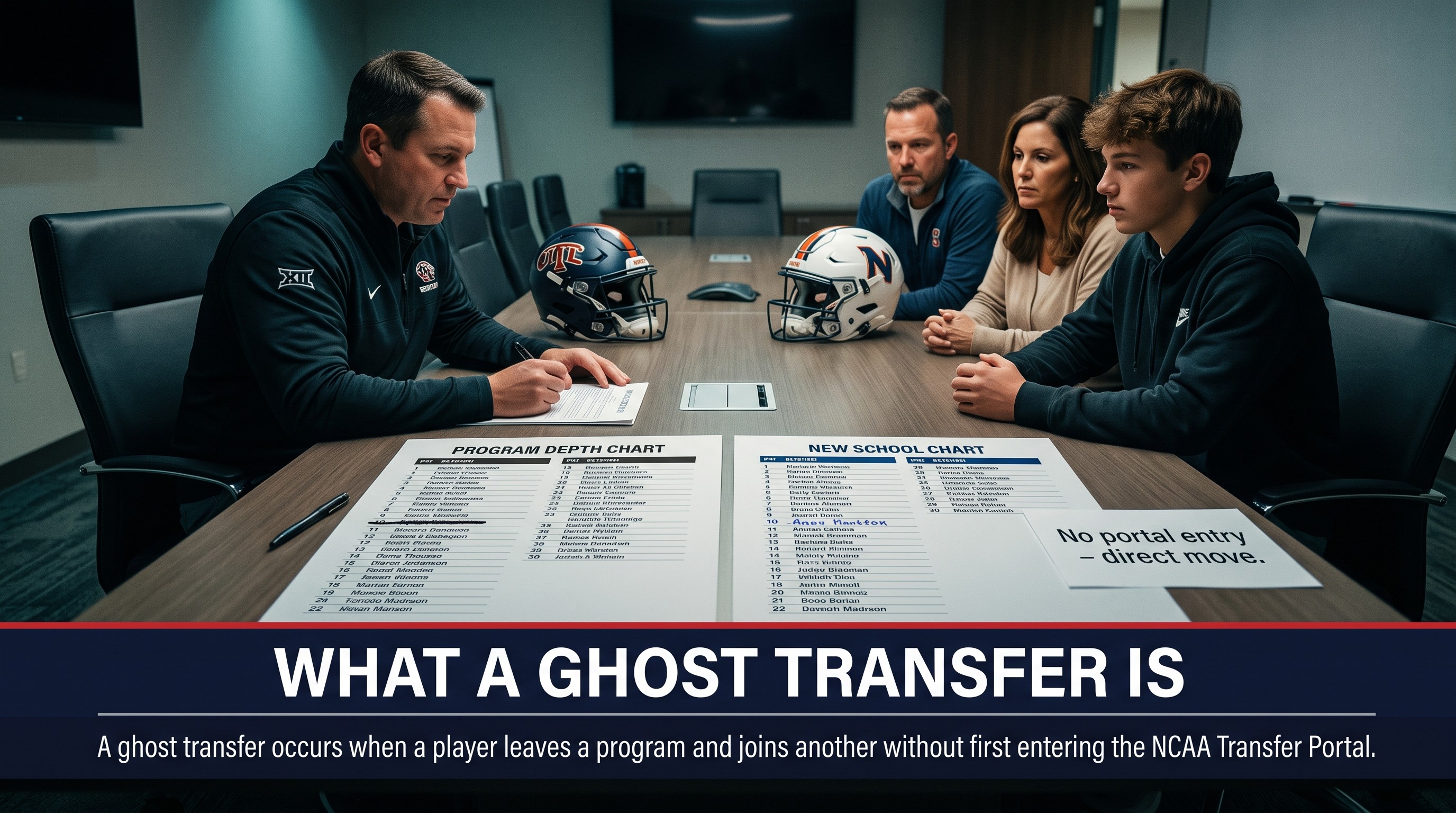
A ghost transfer occurs when a player leaves a program and joins another without first entering the NCAA Transfer Portal. The portal is the formal mechanism governing player movement between programs. Bypassing it entirely is now treated as a significant violation.
Two high-profile cases defined the problem. In early 2025, a Wisconsin defensive back joined Miami without entering the portal. A BYU quarterback moved to Tulane the same way. Both played in the College Football Playoff. Neither faced consequences at the time. That gap in enforcement made the situation untenable, and the NCAA acted.
What the rule says
On April 1, 2026, the NCAA Division I Cabinet adopted automatic penalties for transfers occurring outside the portal after February 25, 2026. A school that signs, adds to its roster, or allows a transferred athlete to participate in team activities before portal entry faces:
- A head coach suspension of 50% of the season
- A fine equal to 20% of the sport's annual budget
The penalties are self-enforced. Schools must notify the NCAA within 15 days of discovering a violation. Failing to self-report adds a 10% suspension to the head coach's penalty and an additional 5% fine.
Why enforcement remains uncertain
Skepticism followed the rule immediately. CBS Sports reported that multiple coaches doubted the penalties would survive legal review, with one SEC head coach stating they stood little chance of holding up in court. An attorney covering college sports enforcement predicted legal filings the moment a school is actually penalized.
Courts have constrained NCAA authority over athlete movement at several points since the House v. NCAA settlement. The self-enforcement model creates pressure that depends on institutional compliance, and programs with legal resources may choose to absorb penalties rather than concede them. Whether the rule survives a serious legal challenge is genuinely uncertain. That does not change the procedural requirement: the rule is in effect, and the process is clear.
What this means for recruiting families
For families working through a commitment decision, two things are worth understanding.
The first is program stability. A head coach suspended for 50% of a season is a real disruption. When a program's offer is on the table, understanding how that staff operates inside the rules is part of reading the program clearly. A ghost transfer violation affects coaching availability and leadership for the first half of the season.
The second is understanding the transfer process itself. If an athlete eventually wants to leave a program, the sequence is non-negotiable: the athlete must enter the portal before any contact with another school. No workouts, no visits, no conversations outside the portal. That requirement holds regardless of whether the penalty structure survives legal challenge.
The rule took effect earlier this year. The 2026 season is the first real test of whether the enforcement model holds. For families navigating a commitment, knowing how the portal is supposed to work, and what bypassing it costs, is part of approaching the process with clear eyes.