

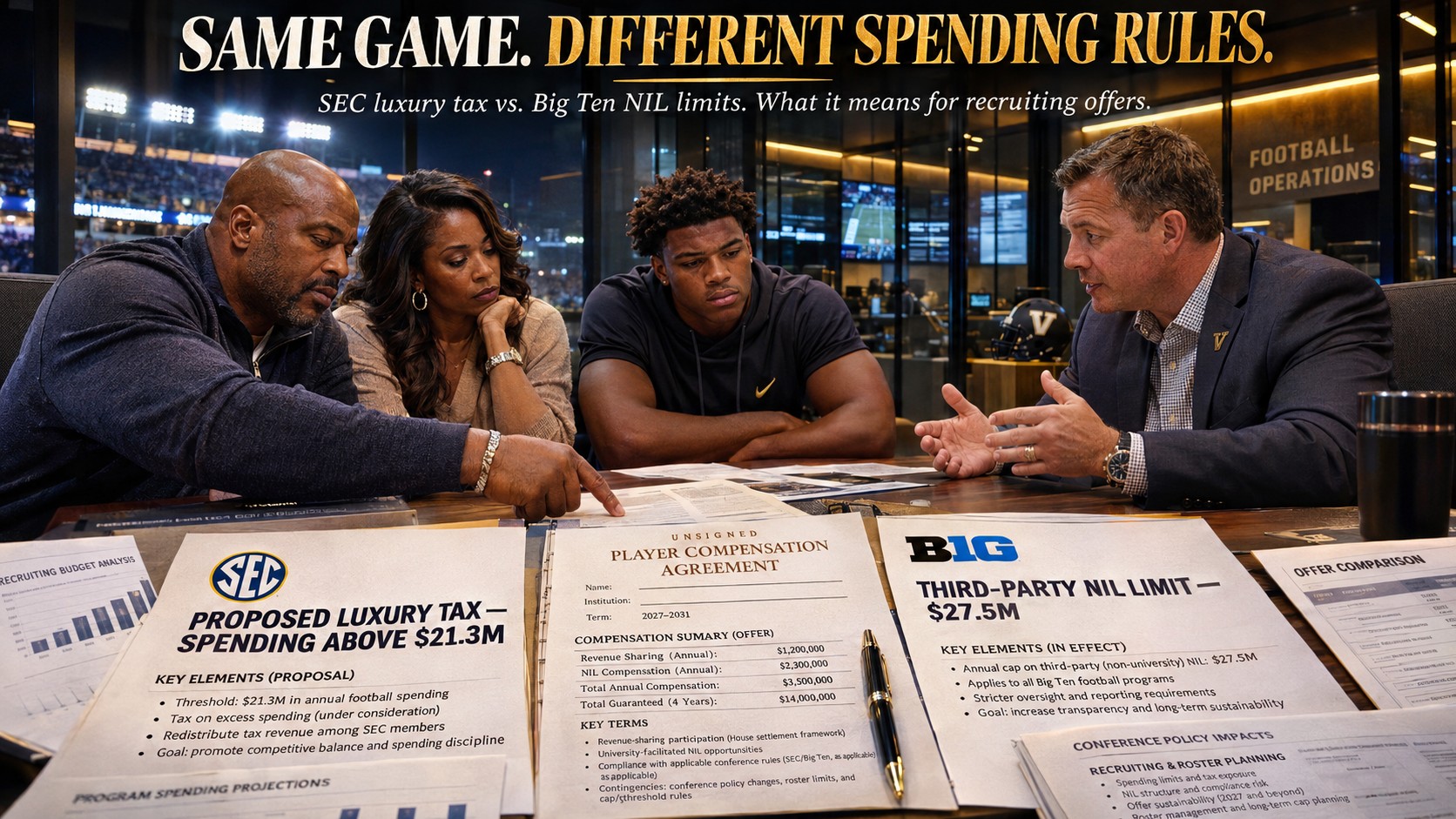
What the SEC is considering
Multiple reports confirmed this week that the SEC is working toward a luxury tax on member schools that spend more than the House settlement's $21.3 million annual revenue-sharing cap. A conference working group, including athletic directors, university presidents, and general counsels, is developing the formula with a vote targeted before the early signing period opens December 2.
The proposed structure is graduated: roughly 1% on amounts up to $1 million over the cap, rising to 3% on overages of $3 million or more. What the conference does with that revenue has not been decided.
One week earlier, the Big Ten took a different approach. It adopted rules limiting institutional involvement in third-party NIL to $27.5 million per school, bringing total conference-permitted spending to $49 million. The Big Ten's model restricts the structure of spending. The SEC's proposed model prices it.
Why conferences are acting on their own
The original plan was federal. After Tuesday's midterm results made House passage of the Protect College Sports Act unlikely, conferences are filling the gap. The result is two of the largest conferences in the country moving forward with divergent enforcement models for the same underlying problem.
That problem is opacity. Direct revenue sharing is the visible number. Third-party NIL arrangements (boosters, collectives, affiliated deals) are not. As one SEC source told ESPN: "We have no idea what anybody's spending. Agents can play you all day long."
What this means for families evaluating offers
Conference spending rules do not reduce an offer already on the table. If a program has communicated a revenue-share figure to your athlete, that number is their commitment to him.
What the rules change is the competitive environment going forward.
The SEC formula under discussion is modest. A school spending $3 million over the cap would pay roughly $90,000 in penalties, a manageable cost for a program running a $35 million roster. The tax creates friction at the margin. It does not reset the competitive order.
The more useful question for families is not what the conference will charge for overspending. It is whether the offer on the table reflects a program's sustainable operating baseline or a recruitment-cycle push that may moderate after signing.
That distinction matters most when evaluating programs that have been spending aggressively in recent cycles: rising mid-major schools, newer power programs building rosters from scratch. For those programs, conference-level pressure (tax or cap) adds a constraint their current offers may not have fully accounted for.