

The contract has evolved
When a college program extends a scholarship offer today, the financial conversation often goes further than it once did. Revenue-sharing agreements and third-party NIL deals have become a standard part of how programs recruit and retain players.
What has changed more recently is the exit language.
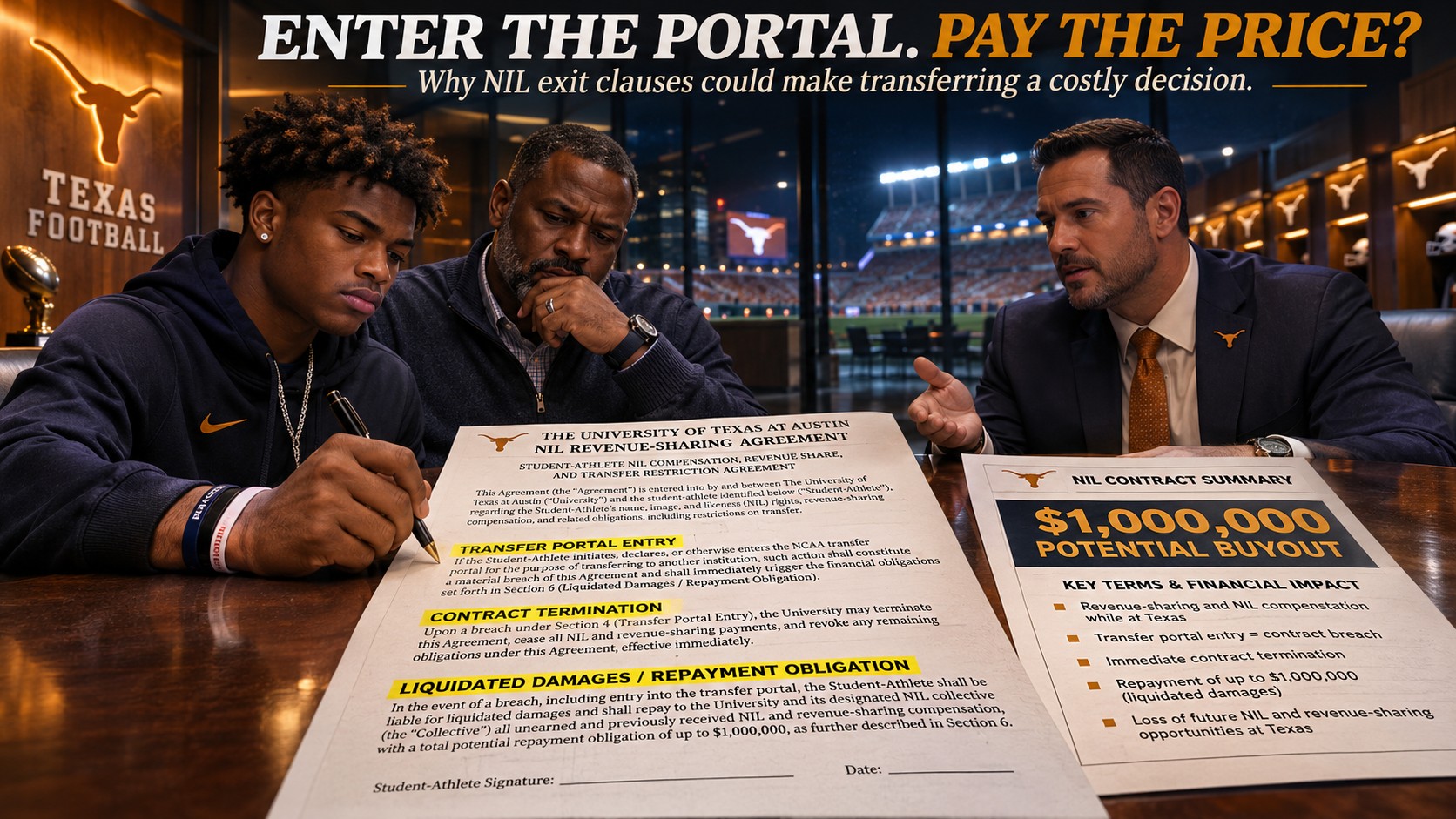
More programs are now inserting provisions that treat portal entry as a contract trigger: either as a termination event, a repayment obligation, or both. Entering the portal does not automatically cancel a signed NIL contract. The contract language governs what happens next, and that language is increasingly written to protect the program's investment.
What enforcement looks like
These clauses are no longer theoretical. A handful of cases have moved into litigation.
Georgia sought $390,000 in damages from a defensive end who transferred to Missouri after receiving only a single payment. FAU filed suit against four players for amounts ranging from $18,000 to $69,000 after they moved to Power 4 programs. A Cincinnati quarterback faces a $1 million buyout claim following his transfer to Texas Tech.
Courts have not yet ruled on whether this type of liquidated damages language is enforceable. Legal observers note that many clauses appear punitive rather than tied to actual program losses, and the cases have not been resolved. The litigation is real, and the financial exposure for an athlete who enters the portal is also real, regardless of how a court eventually rules.
The pattern holds at both the Power 4 and Group of 5 levels. Mid-major programs in particular have embraced this language as a retention mechanism, since they face the greatest risk of losing athletes to higher-revenue schools after one or two seasons.
What this means during the recruiting process
For families evaluating programs, the NIL conversation now includes a layer it did not have two years ago.
Understanding what an NIL agreement says about portal entry is not a detail to sort out after a commitment letter is signed. It is part of evaluating the program. Specifically:
- Ask about the exit provisions before signing. A strong relationship with a program does not change what a contract says. The leverage to negotiate favorable terms exists before signature, not after.
- Understand the distinction between a termination event and a repayment trigger. The first ends the contract. The second creates a potential financial obligation. These carry different risk profiles.
- Factor the single portal window into your thinking. With the spring portal window eliminated, the January 4 to 13 window is the only standard entry point in the calendar year. That compresses the timeline for any family rethinking a commitment made the previous December.
The bottom line
NIL contracts have always been legal agreements with obligations. What is newer is the explicit use of exit-cost language to change the financial risk of a transfer decision.
For families going through the commitment process this fall, the fit question now carries more weight than it did before revenue sharing reshaped program finances. Choosing carefully, and understanding what you are agreeing to, is not a legal exercise. It is a standard part of due diligence.