

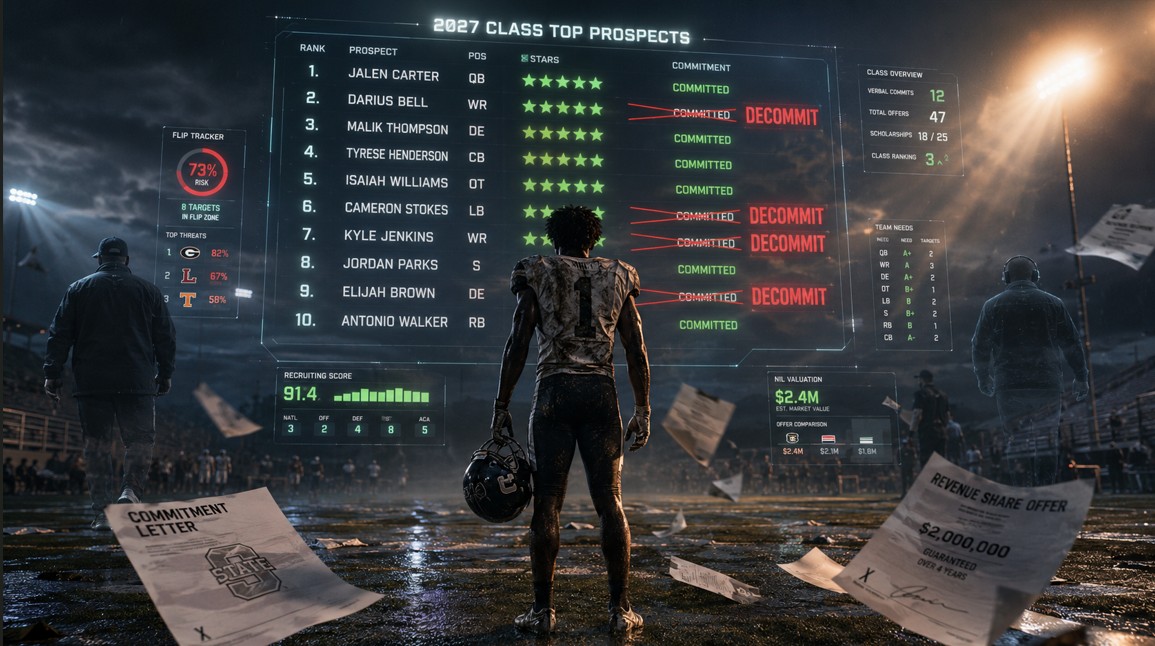
Five months before the early signing period opens in December, the 2027 recruiting board is moving. CBS Sports is running a live flip tracker. On3 has catalogued the biggest decommitments of the cycle. Nearly 60 percent of prospects ranked in the top 300 are already committed, but a meaningful number of those commitments will not hold through signing day.
The board is not settled
The early commitment pace in the 2027 class has been higher than at this point in previous cycles. By June, more than 60 percent of the top 300 had pledged to a program. But early commitments do not equal stable ones. Each cycle, several five-star commitments fail to hold through December signing day. Beneath the five-star tier, movement is more common still.
July's commitment volume is lighter than May and June, which reflects a simple reality: families who were ready to commit have committed. The ones still evaluating programs are in no hurry. For programs still chasing elite uncommitted prospects, that patience represents leverage, not indecision.
What drives a flip
Most of the significant flips tracked in the 2027 class trace back to one of two causes: a coaching staff change, or a shift in the relationship with the position coach who originally recruited the prospect.
When a head coach or coordinator is removed mid-cycle, committed recruits face a different program than the one they originally agreed to join. Reopening a recruitment in that situation is a reasonable response to a changed reality, not a breach of trust and not instability for its own sake. The original commitment was to people, not to a logo.
Revenue-share terms are beginning to enter late-cycle decisions as August 1 approaches, the date programs can begin presenting written compensation agreements to 2027 recruits. For some families, written terms will be the first direct, side-by-side comparison they can make between programs. That comparison changes the calculus in ways an informal offer cannot.
What a flip signals for uncommitted families
When a committed recruit decommits, something concrete happens: a need reopens on that program's board. A staff that spent months building toward a wide receiver or defensive end is now recruiting that position again. Active outreach resumes.
For families with athletes still uncommitted at a specific position, tracking which programs lost commits, and at which positions, identifies where active recruiting is happening now. That awareness is not a reason to act urgently. It is the kind of structural intelligence that separates a prepared recruiting process from a reactive one.
What to watch before September
The summer dead period continues through July. Coaches cannot make off-campus visits or appear at high school practices while it is in effect. When the contact window reopens in the fall, programs with the most active board needs will be the most visible.
Families whose athletes are uncommitted in the 2027 class should track flip activity now, not to react to it, but to understand the recruiting landscape before coaches are allowed to reach them in person. Knowing which boards are open going into the fall evaluation window is how a well-organized process begins the season ahead.