

What the proposal would change
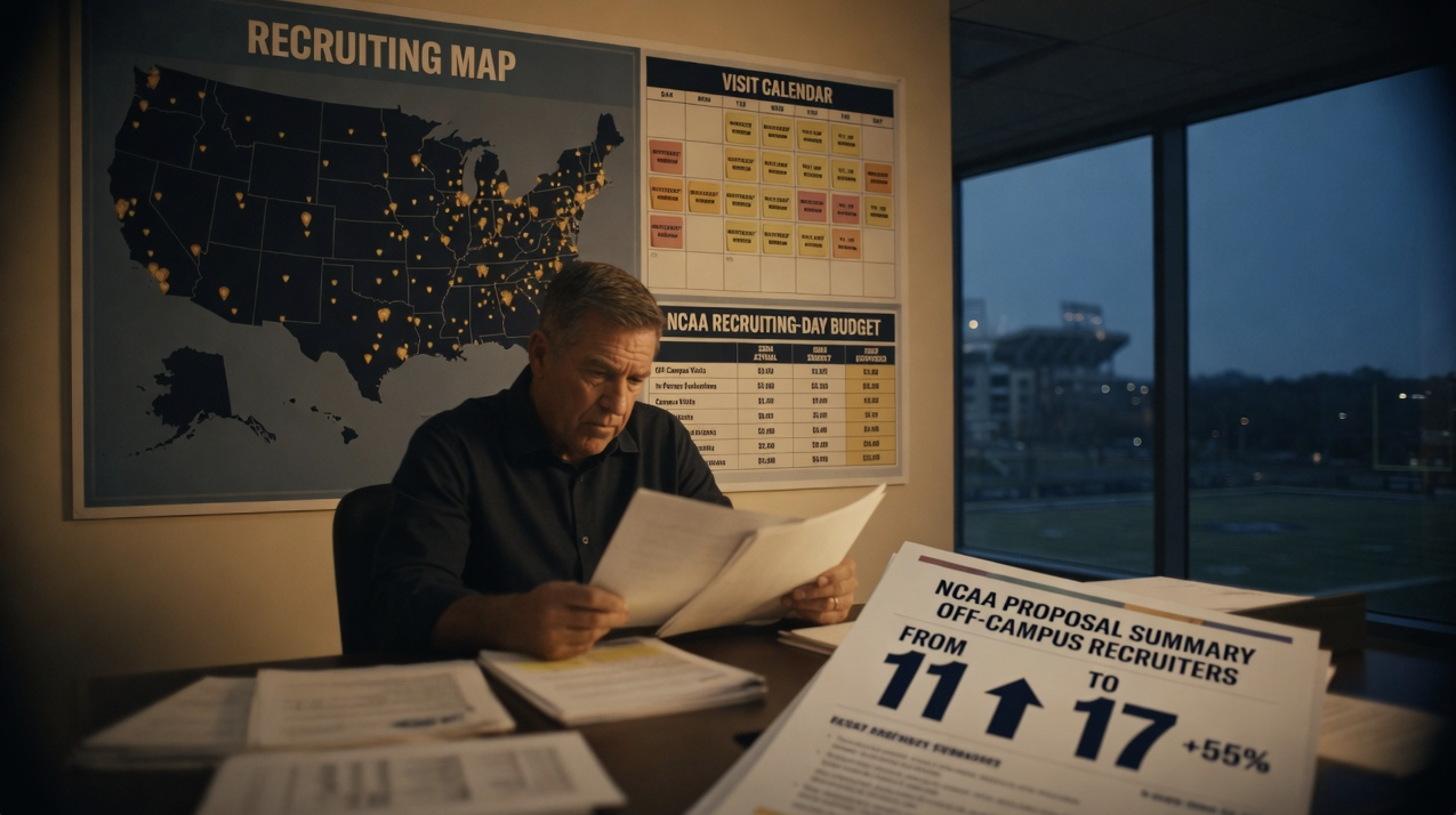
On June 24, the NCAA's FBS Oversight Committee introduced a proposal to modify the football calendar. One part of it concerns who is allowed to recruit a prospect in person. Under current rules, an FBS program may send up to 11 staff members off campus to recruit, and the head coach must be one of them. The committee's concept would raise that number to 17, the head coach plus 16 assistants, and pair it with a yearly allotment of recruiting person days that each staff would budget across the cycle.
The change is not settled. The committee is gathering conference feedback and could introduce the measure through the expedited legislative process at its July or August videoconference. If adopted, it would take effect January 1, 2027.
Why the person-day budget matters more than the head count
The number that draws attention is 11 to 17. The number that matters more has no headline yet: the total person days each staff is allowed to spend on the road. Adding coaches does not add time. It gives a program more people to deploy against the same finite budget of in-person evaluation. A day a staff spends watching one athlete practice is a day it does not spend on another.
That turns off-campus recruiting into what it has quietly always been, a rationed resource. A program cannot be everywhere. It chooses where to send people, and those choices reveal a board.
What it means for a family now
For a family, none of this requires action. The proposal is months from a vote and would not take effect until 2027. What it should sharpen is how you read attention.
- Whether a program sends someone to see the athlete in person, at a practice, a game, or a home visit, not only who sends a text or a graphic.
- Which staff member comes. A position coach or a coordinator spends a scarcer kind of time than a general recruiting message costs.
- How often. Repeated in-person contact is a program spending its budget, and a budget is a steadier signal than enthusiasm.
A digital relationship is inexpensive to maintain. In-person recruiting costs a program something real, and under this proposal it would cost a measured, budgeted amount. When a staff spends that resource on your athlete, it is telling you where you sit on a board that no ranking will show you. That is worth reading closely, this cycle and the next.