

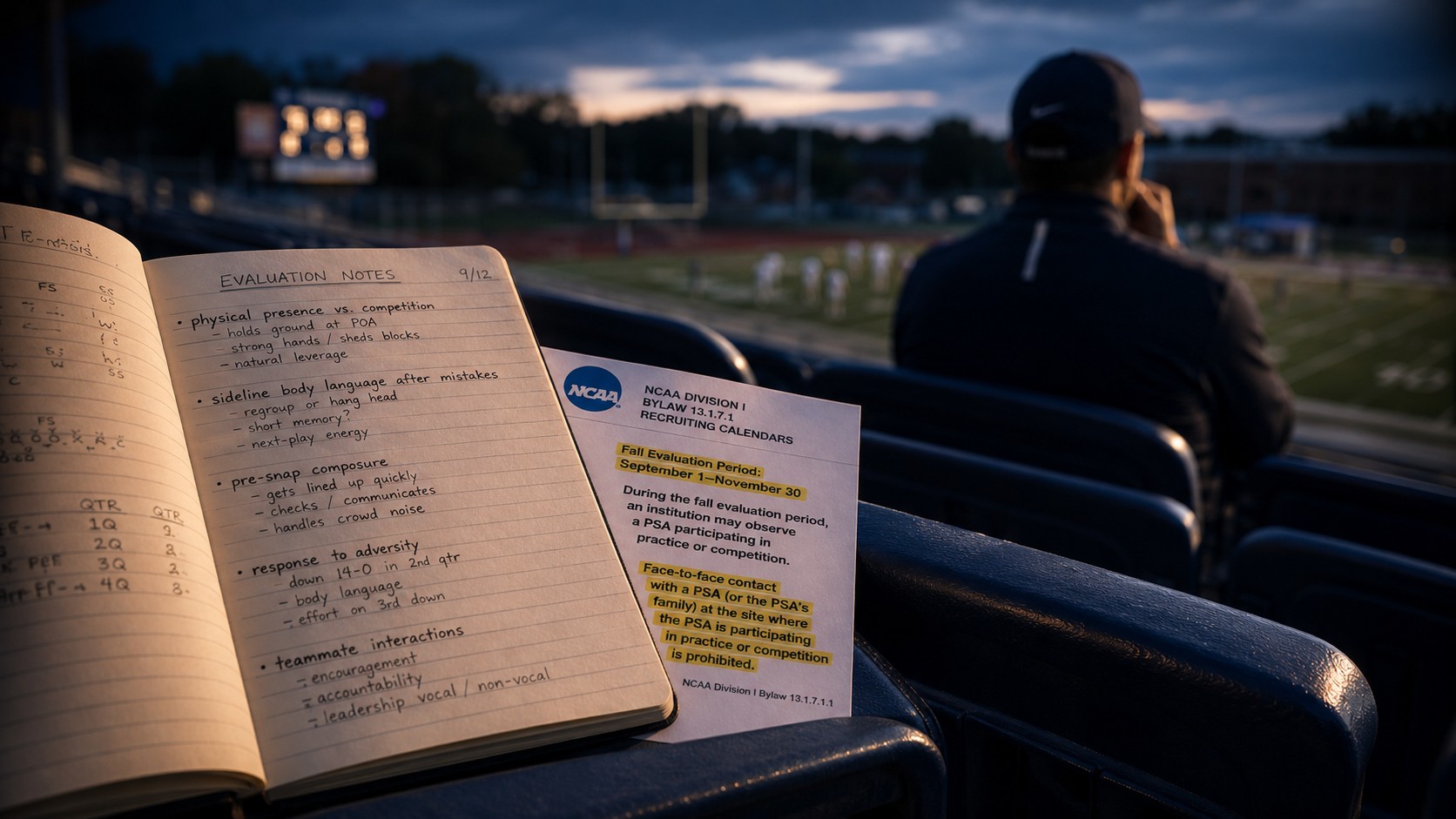
The FBS fall evaluation period typically runs from September 1 through November 30. During this window, college coaches can attend high school games, visit campuses, and watch athletes compete in person. For 2027 families still working through the process, this stretch is one of the most active on the recruiting calendar and one of the most frequently misread.
What coaches can and cannot do during an evaluation visit
One of the most commonly misunderstood rules: when a coach attends a high school game during the evaluation period, NCAA rules prohibit face-to-face contact with the recruit or family at the competition site. Seeing a coach in the stands does not mean a conversation is about to happen on the sideline. That conversation takes place separately, by phone or on campus.
What a coach can do during a fall evaluation:
- Attend a game or practice and watch the athlete compete
- Visit the high school campus to speak with coaches, teachers, and counselors
- Continue phone, text, and email communication independent of the in-person visit
What a coach cannot do:
- Have direct, in-person contact with the recruit or family at the competition site
- Approach the athlete or family on the sideline or in the stands
What coaches observe live that film cannot show
Game film remains the primary evaluation tool. Coaches spend far more hours in film rooms than they do traveling to games. But an in-person visit fills specific gaps that even strong film does not capture.
What coaches tend to observe during a live evaluation:
- Physical size and presence relative to the competition on the field
- Body language between plays: on the sideline, after a mistake, during a timeout
- Pre-snap composure and focus
- How the athlete responds to a bad series or an error
- Interactions with teammates and coaches during the game
The conversation a coach has with the high school coaching staff is also part of the visit. Character assessment (work ethic, conduct, how the athlete handles adversity) factors into a program's evaluation alongside every measurable athletic trait.
What this means for a 2027 family
A coach making the trip to a game is a genuine signal of interest. It represents a deliberate scheduling investment. But it is not an offer, and it is not a verdict. Families should not read the visit as either.
The right posture: do not seek out or approach the coach during the game. The athlete should compete normally. The evaluation is specifically designed to observe how an athlete performs and conducts himself in a standard game environment. Anything that disrupts that environment changes what the coach is able to see.
A coach in the stands is a data point. Families who understand the mechanics of the evaluation period (what restrictions apply, what coaches are watching for beyond athleticism, and what the visit actually signals) are better positioned to read the moment accurately.