
Since the College Sports Commission launched its NIL Go clearinghouse in June 2025, it has approved $166.5 million in NIL deals. Another $29.3 million worth remain pending. That gap is not administrative lag. It reflects a system under strain. For families evaluating recruiting offers that include NIL compensation, understanding what the clearinghouse actually does is now part of making an informed decision.
How the clearinghouse is supposed to work
When an athlete accepts a third-party NIL deal from a collective, a booster entity, a multimedia rights holder, or a corporate sponsor, that deal is supposed to flow through NIL Go before compensation is paid. The CSC reviews the agreement to confirm it specifies what the athlete is being paid to do, that the pay represents fair market value for those specific activities, and that no terms are structured as disguised pay-for-play.
The intent is to separate legitimate NIL activity from what amounts to an inducement to sign with a program.
Where the system is breaking down
The clearinghouse was designed assuming most deals would be straightforward corporate sponsorships. Instead, between January and February of this year, 78 percent of submitted deals involved associated entities: boosters, collectives, and program-affiliated organizations whose agreements require far more scrutiny.
The result is weeks-long processing delays, athletes missing deals with time-sensitive deadlines, and an estimated $11 million in deals stuck in limbo. The CSC's own chief executive acknowledged the volume was not anticipated: "I don't think the system was designed with this amount of associated deals in mind."
More significantly, multiple power-conference collectives have begun bypassing the clearinghouse entirely, paying athletes before CSC approval is granted. The CSC has since launched a confidential tip line and appointed a former federal prosecutor as its Deputy General Counsel. Its stated position is unambiguous: there is no safe harbor for deals that skip the approval process, and athletes who accept unapproved compensation face eligibility consequences.
What this means when you hear NIL numbers in a recruiting pitch
Families hearing NIL figures during a recruiting visit or in a coach's pitch should understand a few things that do not always get communicated clearly.
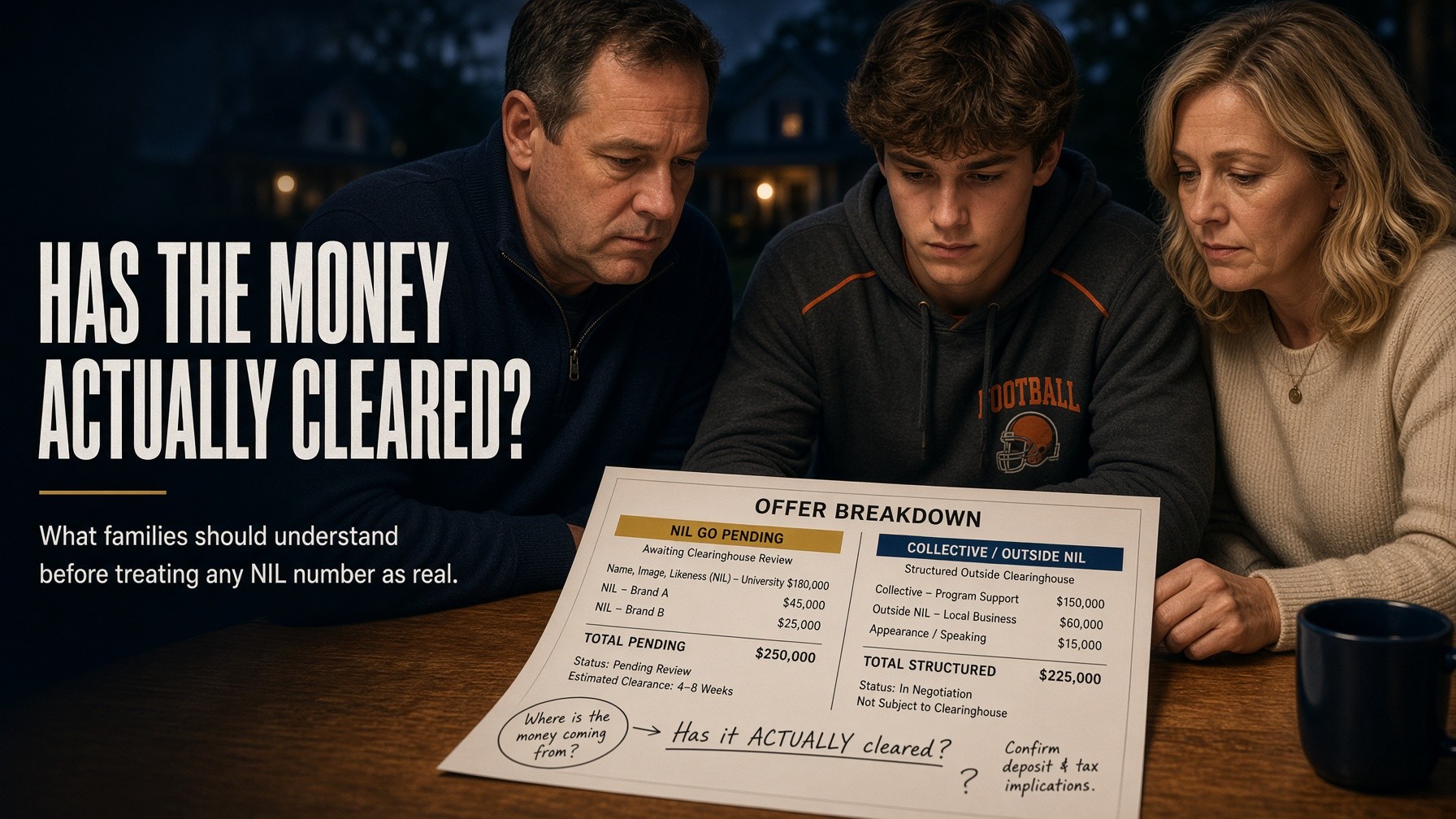
An NIL number from a collective is not guaranteed compensation. It is a stated intention. For it to be payable without putting the athlete's eligibility at risk, it must clear the NIL Go review process. Delays are real. Rejections happen: $29.3 million worth of deals were still pending as of earlier this year.
Asking which entity the offer originates from, whether it has been submitted to NIL Go, and what the current approval timeline looks like is not an adversarial question. It is a reasonable one. A program with a functioning collective relationship should be able to answer it.
The NIL clearinghouse was built to protect athletes as much as to regulate programs. Understanding how it actually operates, including where it is under strain, is part of making a clear-eyed recruiting decision this fall.