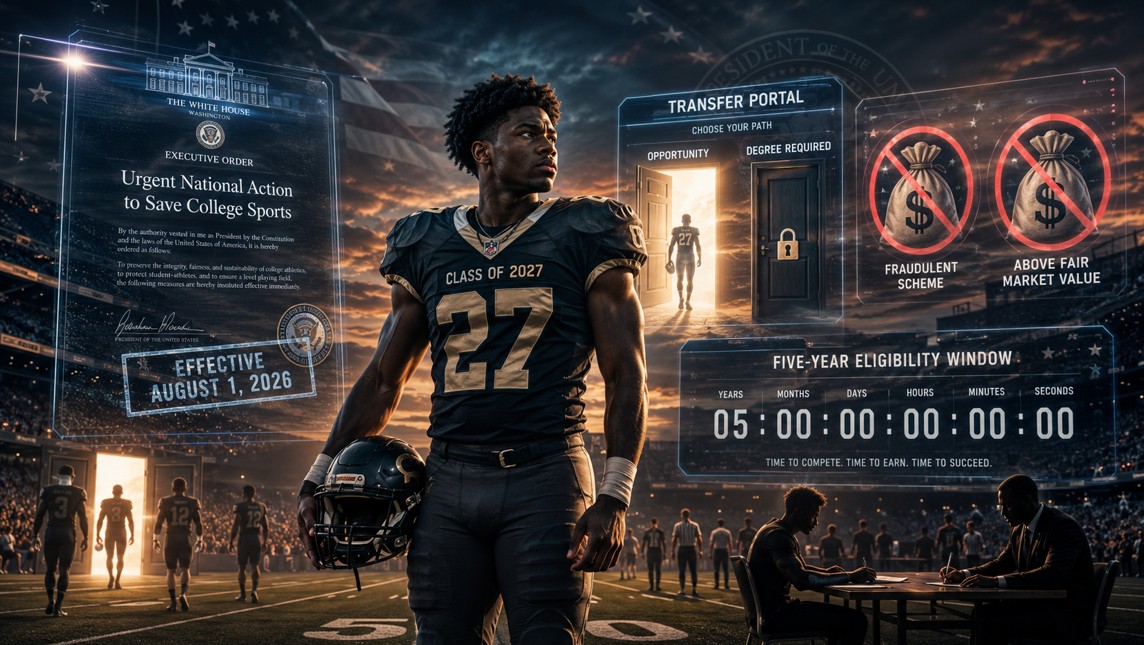
On April 3, 2026, the White House signed an executive order titled "Urgent National Action to Save College Sports." The operative enforcement date is August 1, 2026 — three weeks from now. For families navigating the 2027 cycle, the provisions are worth understanding before the August contact period opens.
What the order covers
The order establishes three categories of standards and calls on the NCAA and its member institutions to adopt them by the August 1 effective date.
Transfer eligibility. Athletes are permitted one transfer with immediate playing eligibility during their five-year participation window. A second transfer with immediate eligibility is available only after the athlete has earned a four-year degree. That is materially more restrictive than current practice, where most athletes move once and retain immediate eligibility without a degree requirement.
NIL standards. The order defines a "fraudulent NIL scheme" as any arrangement that pays for goods or services above their actual fair market value in connection with athletic participation. Collectives that facilitate pay-for-play arrangements are explicitly prohibited from receiving federal funds. Programs are expected to ensure their NIL activities meet this standard, and federal agencies will evaluate compliance.
Eligibility window. The order establishes a five-year participation limit for college athletes, with narrow exceptions for military service, missionary work, and other absences in the public interest. Athletes who have competed professionally cannot return to college athletics.
How enforcement works
The enforcement mechanism is the most consequential part. Federal agencies are directed to evaluate whether institutions violating covered rules are eligible for federal grants and contracts. Schools with more than $20 million in annual athletics revenue are within scope. Suspension or debarment from federal funding is the stated consequence for non-compliance.
The Federal Trade Commission is directed to pursue enforcement against agents and collectives facilitating fraudulent NIL arrangements. The Department of Justice is directed to challenge conflicting state NIL laws.
Executive orders are subject to legal challenge, and several states have existing NIL laws that may conflict with the federal framework. The full scope of enforcement will develop over time. That said, August 1 is when the compliance evaluation process formally begins for covered institutions.
What this means for a 2027 family
Three things are worth tracking in the weeks ahead.
Transfer portal activity may compress. If the one-transfer rule holds, the calculus around entering the portal changes for current athletes at every program. Families evaluating a school's depth chart should factor in that roster movement may slow, making openings harder to predict mid-cycle.
NIL conversations carry more compliance risk. Programs and collectives now operate against a federal market-rate standard, not just the College Sports Commission's existing clearinghouse. When a number is quoted during the August contact period, the program is now representing that it meets federal fair-market-value standards — or taking on institutional risk if it does not.
The regulatory picture is still forming. This order is not the final word. The Senate's competing legislation is still in markup. The College Sports Commission has its own enforcement framework. State NIL laws remain in place. A family should treat the federal executive order as one layer of a still-evolving regulatory environment — not a settled conclusion.
For now, the most useful thing a family can do is understand what programs are telling them on August 1 about NIL and transfers, and ask whether those representations account for the federal standards that just went into effect.