

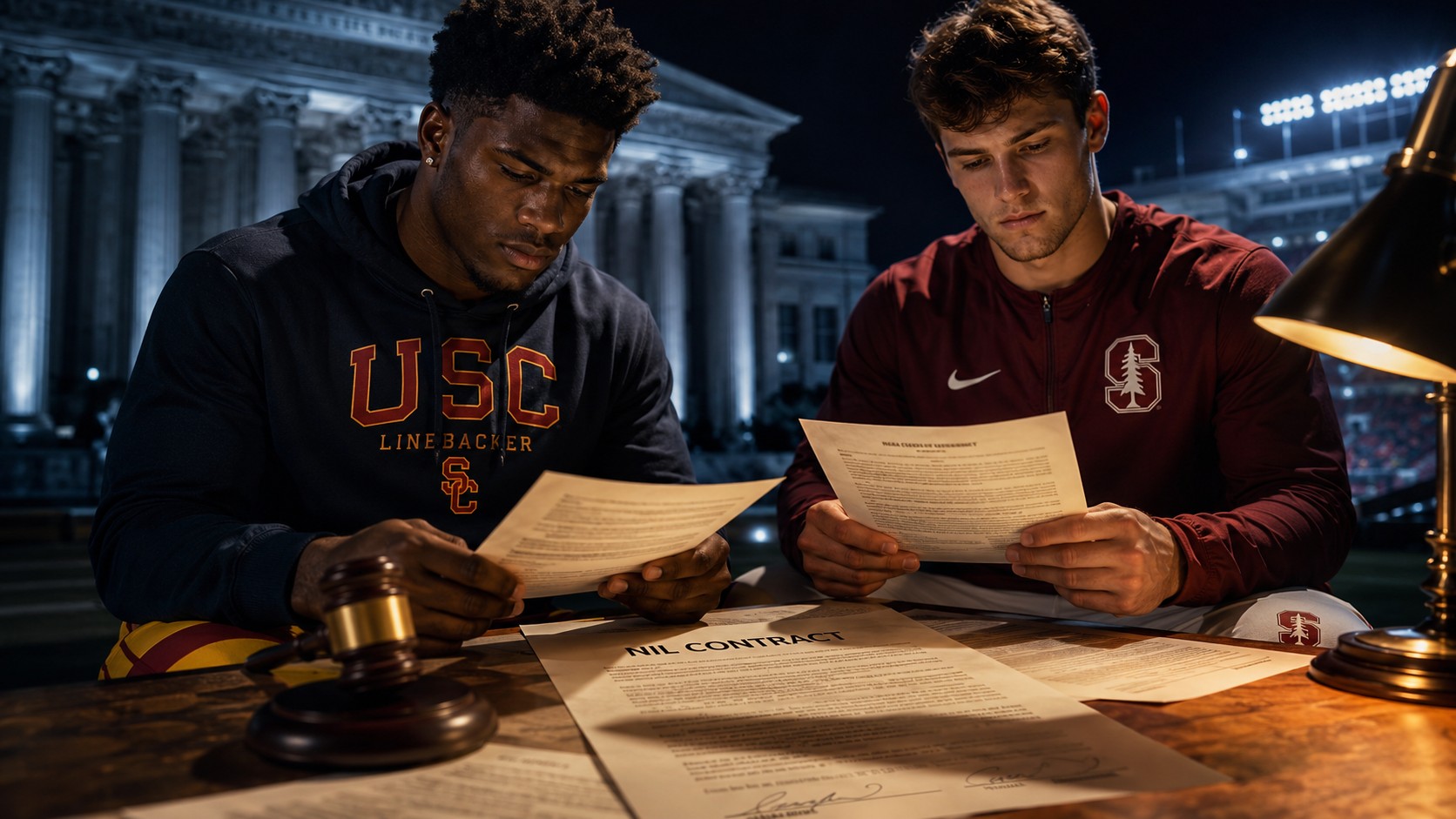
On Tuesday, two college athletes filed a proposed antitrust class action in the U.S. District Court for the Northern District of California against the NCAA, the power conferences, and the College Sports Commission. The complaint does not attack the underlying House settlement. It targets the settlement's enforcement arm, the CSC and its NIL Go clearinghouse, in seventeen states whose laws protect athletes' ability to earn unlimited NIL compensation.
What was filed and where
The plaintiffs are USC freshman linebacker Talanoa Ili and Stanford senior quarterback Charlie Mirer. They are represented by attorneys from Berger Montague and Freedman Normand Friedland. The case has been assigned to U.S. Magistrate Judge Thomas Hixson. The named states with statutes that the suit says conflict with the CSC's enforcement include California, New York, Ohio, and Michigan. The plaintiffs are asking for monetary damages and an injunction to suspend enforcement.
A parallel front to the June 10 hearing
Yesterday, in the same court system, U.S. Magistrate Judge Nathanael Cousins heard a separate motion from House settlement class counsel arguing that multimedia rights companies and traditional brand sponsors should not be classified as "associated entities" subject to CSC review. The two cases run on parallel tracks. The first asks a court to narrow what flows through CSC review. The second asks whether the CSC can enforce the cap at all in states with their own NIL protection laws.
What it changes for a family reading a 2027 offer
The day-to-day reading does not move much, and that is the point. The clearinghouse is still operating. None of the published review rules are paused while the litigation proceeds.
What changes is the certainty horizon. Any dollar figure in an offer that depends on the CSC's continued enforcement authority is, today, a number contingent on outcomes a federal magistrate has not yet ruled on. A family who reads that figure as a firm commitment is taking on more legal exposure than the offer document discloses. A family who reads it as a current cleared number, subject to revision as courts continue to rule, is reading it accurately.
The advisory posture is unchanged. Read offers conservatively. Ask which entity is actually paying, on what schedule, and through what mechanism. Expect another round of legal news before the 2027 cycle reaches its signing window.