

The rule
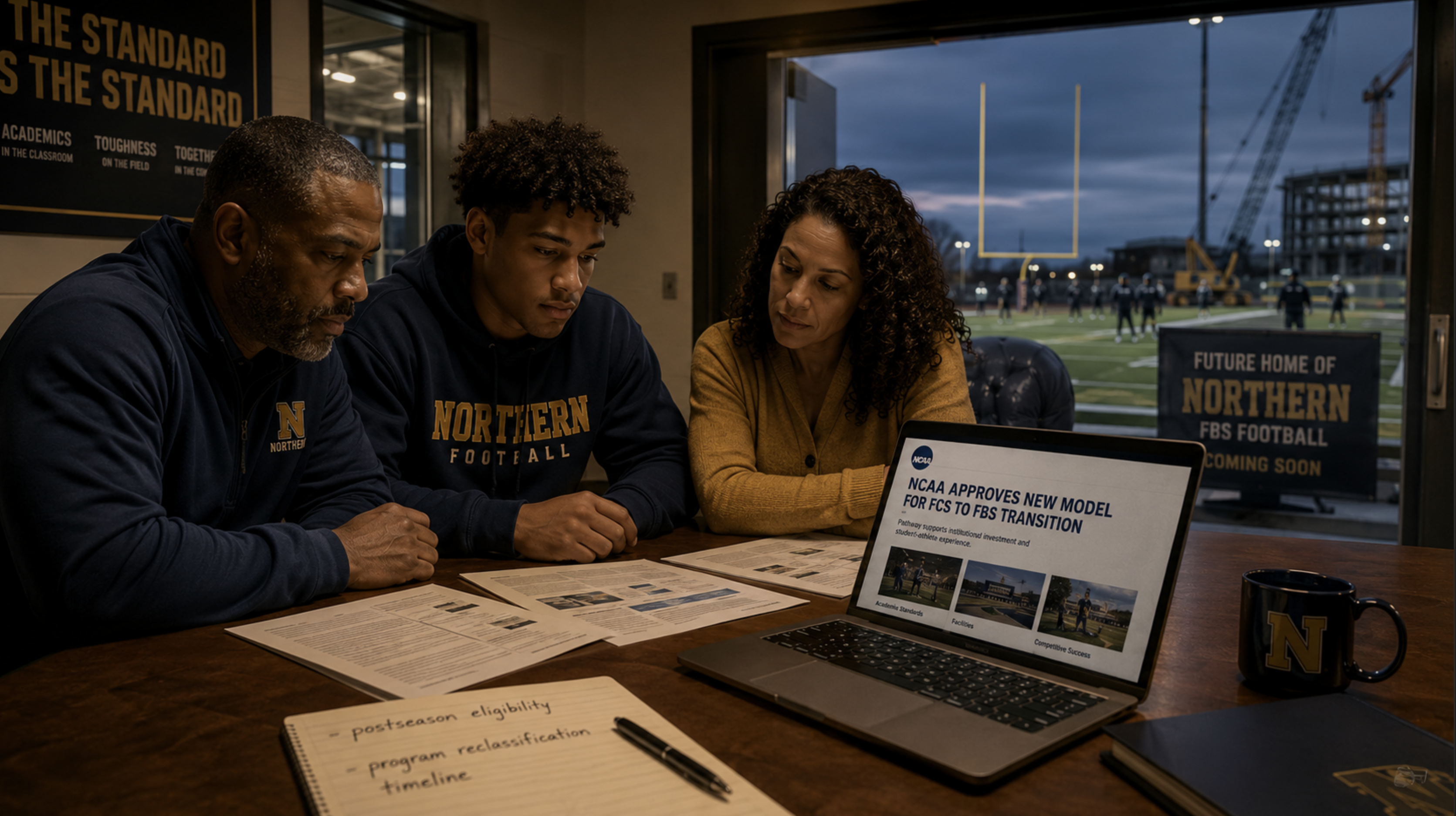
On Wednesday, June 24, the NCAA's Division I Cabinet eliminated the two-year postseason ban that applied to programs reclassifying from FCS to FBS. The change took effect immediately. A transitioning program that finishes with a winning record and meets standard bowl requirements is now eligible for a bowl game, a conference championship, and the College Football Playoff in its first FBS season. Under the old rule, those teams sat out the postseason for two years while they completed the move.
Two programs feel it right away. North Dakota State and Sacramento State both step up to the FBS this summer, and both paid heavily to do it. Each owes the NCAA a multimillion-dollar entry fee on top of conference costs. Until last week, that investment came with a built-in two-year wait before either could play for anything in January.
What it changes about an offer
For a family, the rule matters in one narrow but real way. When a recruit receives an offer from a program in the middle of a reclassification, the old structural knock is gone. That knock was simple: you cannot play in a bowl or the Playoff for two years. A 2027 signee at a transitioning program is no longer choosing a roster locked out of the postseason. One genuine negative has come off the board.
That is worth knowing. It is not worth overweighting.
The advisory read
A bowl ban was never the main reason to take or pass on an offer from a transitioning program. It was a footnote. The decision still turns on the things it always has: the depth chart at the athlete's position, the program's record of developing players, the stability of the staff making the offer, the academic fit, and whether the schedule and resources match where the athlete actually projects.
A single rule change, good or bad, should not move an evaluation much. What it should do is remind a family how fluid this landscape has become. The labels, FCS, FBS, and transitioning, shift faster than they used to, and they describe a program's paperwork more than its fit for one athlete. A strong program at any level is a real opportunity. A weak one with postseason eligibility is still a weak one.
When an offer arrives from a program in motion, the right response is the same as always. Look past the headline and weigh what will actually shape the next four years.