

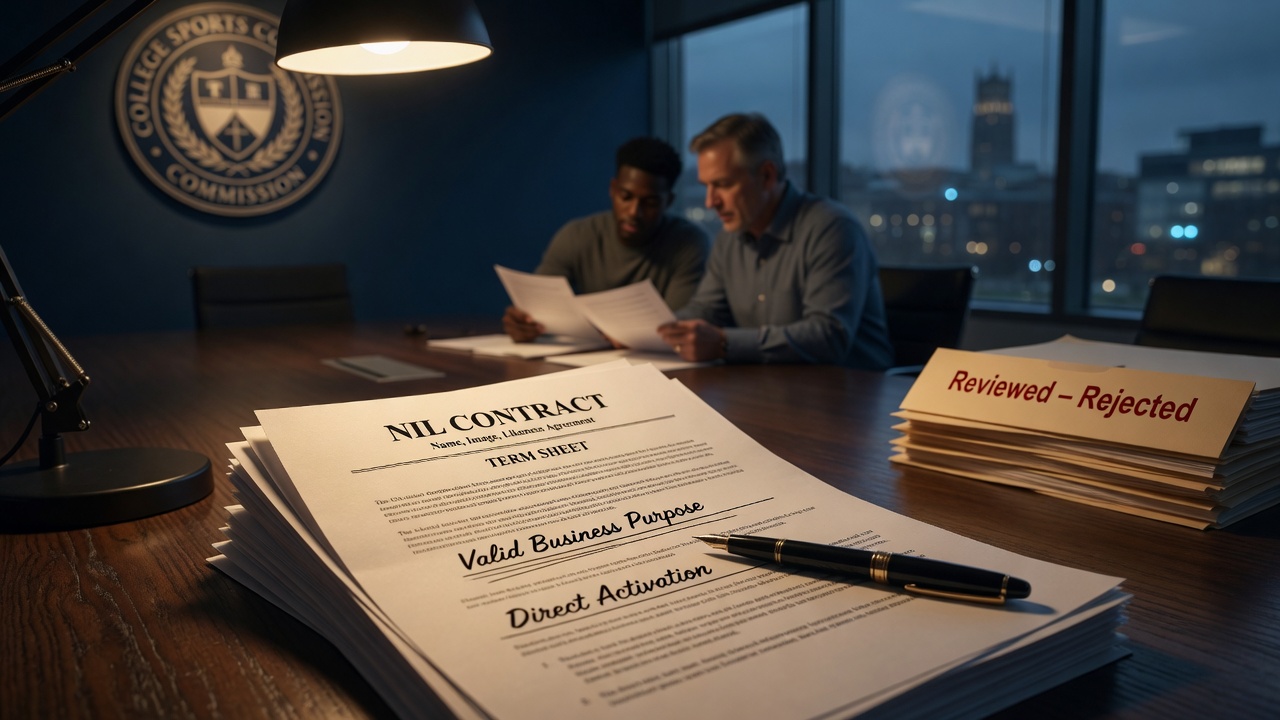
Since launching in June 2025, the College Sports Commission has rejected 1,153 NIL deals. On May 11, 2026, a neutral arbitrator upheld the CSC's rejection of more than $1 million in proposed NIL agreements between 18 Nebraska football players and Playfly Sports, the program's multimedia rights partner. It was the first binding arbitration decision in the post-House era.
For families about to receive offers in the 2027 cycle, the ruling is less about Nebraska and more about a pattern. A written NIL number is not the same as a paid NIL deal. The CSC reviews submitted deals and can reject them. The arbitrator's findings give every family a clearer picture of what the CSC is actually looking at.
The three tests an NIL deal now has to pass
The Nebraska decision turned on three findings, and each one points to a question a family can now ask out loud.
- Associated entity. Is the party paying the athlete a school-affiliated entity, such as a collective, a multimedia rights partner, or a related sponsor? If so, the deal is subject to CSC review.
- Valid business purpose. Is the athlete being paid for goods or services that are actually offered to the general public for profit, or is the payment structured around the NIL label without a real product? The arbitrator found that the Playfly deals failed this test.
- Direct activation, not warehousing. Is the agreement actually using the athlete's name, image, or likeness in a defined commercial way? The arbitrator described the Nebraska structure as warehousing, meaning the payment moved through an NIL agreement without the underlying activation.
What this means for a 2027 family reading an offer
The advisory point is not that NIL is collapsing. The CSC was created to enforce these rules, and the arbitrator's decision shows the rejection authority is real and survives challenge. The point is that a 2027 NIL number on a term sheet is the start of a conversation, not the end of one. The questions to ask are practical.
- Who is the legal payer of the proposed dollars? The school, a collective, a multimedia rights partner, a brand?
- What activity is the athlete being paid for? Appearances, social posts, a defined campaign with a brand, or a flat amount tied to enrolling and playing?
- Is the structure something the CSC has accepted before, or is it a structure currently under review?
- How much of the headline number is guaranteed, recurring, and verifiable, and how much is contingent on a deal that may not survive review?
What to do with the headline number
Treat the largest figure on the page as a ceiling, not a guarantee. Build the family's decision around the portion that is documented, repeatable, and clearly within the rules. The CSC has rejected more than a thousand deals already. Most families never see the rejection because the deal is rebuilt or pulled before signing. That does not make the risk less real. It just makes it less visible.
A federal hearing this week may narrow which deals fall inside CSC review. Even if the scope changes, the underlying advisory point holds. NIL compensation is a regulated market now, and a written number is information, not a commitment.