

What just resolved in Nebraska
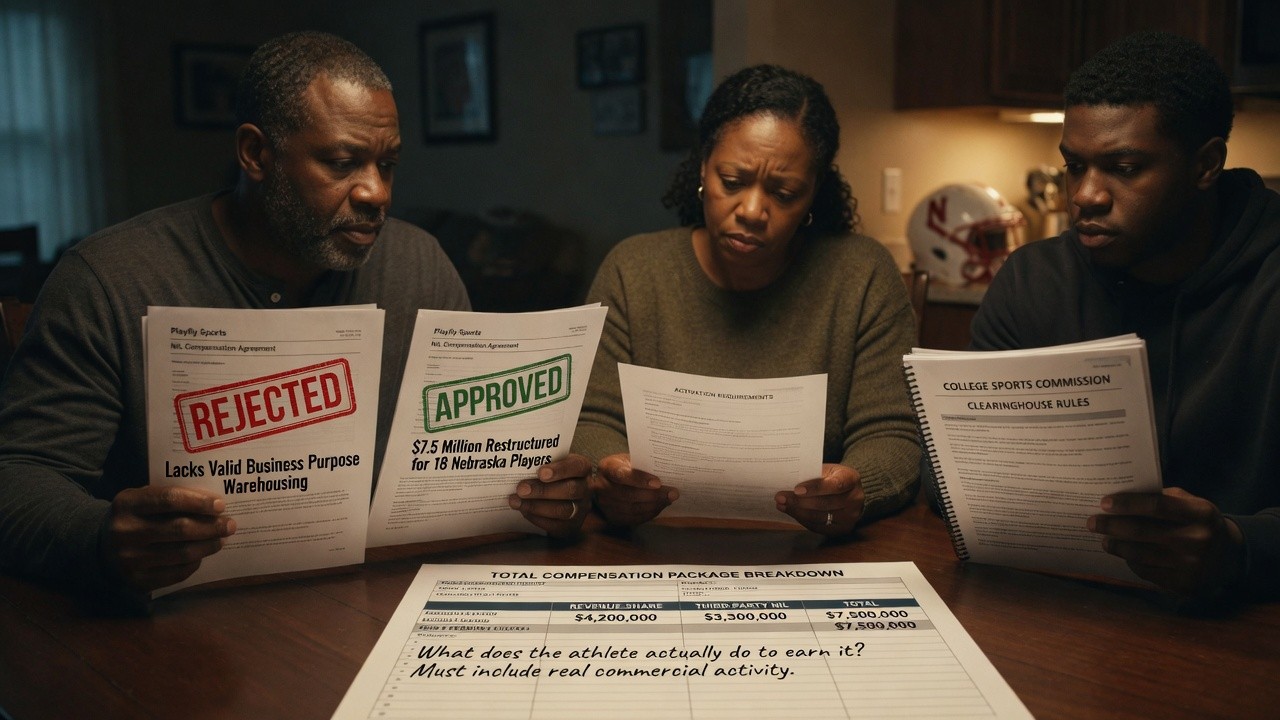
On July 31, the College Sports Commission approved $7.5 million in restructured NIL deals for 18 Nebraska football players. The approval ended a months-long dispute that had moved through arbitration and restructuring before clearing the clearinghouse.
The original agreements were between Playfly Sports, Nebraska's multimedia rights partner, and the 18 players. The CSC rejected them, then upheld that rejection in arbitration in May. The reason: the deals lacked a "valid business purpose" and violated the clearinghouse's rule against "warehousing" NIL rights.
What warehousing means, and why it fails review
Warehousing is when a company pays athletes for NIL rights now with no immediate plan to use them, parking money as compensation without a genuine commercial activity attached.
The CSC's standard is specific. A third-party deal must include goods or services the company offers to the general public for profit. Athletes must also activate those rights immediately rather than holding them for future use.
In Nebraska's case, the original Playfly deals did not meet that standard. The restructured deals did. Players will now fulfill actual responsibilities tied to the agreements before full payment is made.
What this means when a program presents total compensation
Programs routinely pitch recruits on a package with two components: the revenue-share allocation (capped at $21.3 million per school annually) and third-party NIL opportunities, often arranged through the school's own multimedia rights partner.
Families need to know that the third-party piece is not guaranteed the moment it is offered. It has to pass CSC review. A deal that looks like a done package can be rejected if it does not include real commercial activity.
The clearinghouse has reviewed more than 36,000 deals since June 2025 and has rejected nearly 1,800. Nebraska's case is notable because it went all the way to arbitration before the underlying deals were restructured into an approvable form.
The practical question for families
When a coach presents total compensation that includes a third-party NIL component, the question worth asking is straightforward: What does the athlete actually do to earn it?
If the answer is specific (appearances, content, endorsement activity the company actively uses), that is a deal structured to pass review. If the answer is vague, or if the company's involvement seems to have no clear commercial use, that deal may face the same scrutiny Nebraska's original agreements did.
A rejected third-party deal does not necessarily end the conversation. Nebraska's case shows it can be restructured and approved. But for a family comparing offers, a package that may require restructuring is a different thing from one that moves cleanly from offer to clearinghouse approval.